Spices · Profile
Guajillo Powder: The Mexican Mirasol Chile, Dried and Ground
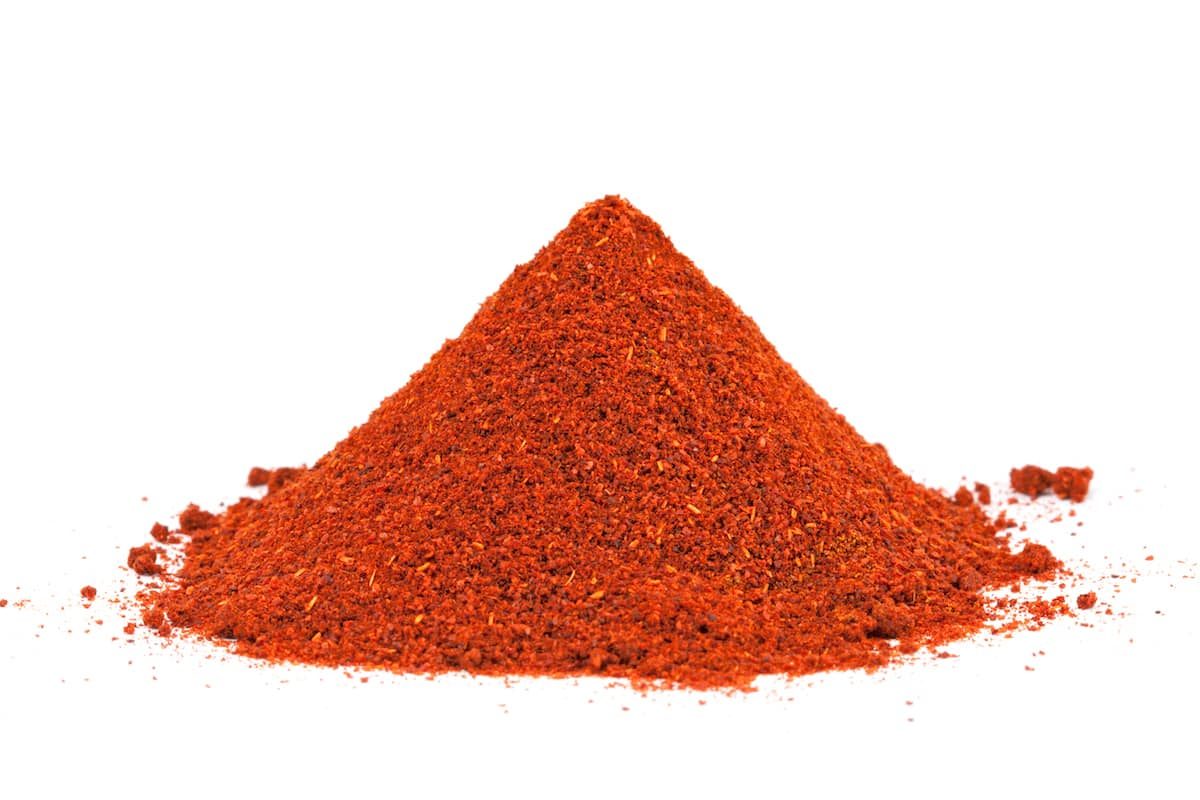
Guajillo powder is ground, dried guajillo chile, one of the main Mexican chiles grown for drying. Mexican agronomists call it “chile guajillo o mirasol” and classify it as Capsicum annuum, the same species as ancho, jalapeño and cayenne.12 It is mild and reddish brown, and goes mainly into mole pastes and adobo-style marinades.34 This page covers what it is, where it is grown, how hot it is, how it is used, and how to buy it.
At a glance
| Botanical name | Capsicum annuum L.12 |
| Plant family | Solanaceae (nightshade family)5 |
| Other name | Mirasol (Mexico)13 |
| Part used | The dried ripe fruit, ground |
| Main growing states | Zacatecas, San Luis Potosí, Durango, Aguascalientes, Chihuahua (see Production)13 |
| Heat | Mild; one published rating gives 2,500–5,000 SHU (see Heat)6 |
| Main uses | Mole pastes and marinades34 |
| Forms sold | Whole dried pods, ground powder |
Measured values
5 figures, sourced| Measure | Value | Scope | Source |
|---|---|---|---|
| Heat Conventional range | 2,500–5,000 SHU | general rating for the type; no method given (INDY Week, 2015)Unmeasured published rating | indyweek.com |
| Pungency threshold defining "chilli", minimum Limit | 900 SHU | Codex CXS 353-2022; category threshold, not a rating of guajillo | fao.org |
| Ochratoxin A, maximum Limit | 20 µg/kg | EU Regulation 2023/915, dried Capsicum spices including chillies, chilli powder, cayenne and paprika | eur-lex.europa.eu |
| Aflatoxin B1, maximum Limit | 5.0 µg/kg | EU Regulation 2023/915, dried Capsicum spices including chillies, chilli powder, cayenne and paprika | eur-lex.europa.eu |
| Total aflatoxins, maximum Limit | 10.0 µg/kg | EU Regulation 2023/915, dried Capsicum spices including chillies, chilli powder, cayenne and paprika | eur-lex.europa.eu |
Each figure is quoted as its source states it, with the samples or standard it applies to. Where sources differ, both are shown; nothing is averaged. All measured values
What it is
The Real Academia Española defines chile guajillo as a Mexican chile whose fruit is reddish brown, long and narrow.7 In Mexican agricultural literature the same chile is called guajillo or mirasol: a 2020 paper from Mexico’s agricultural research institute describes “el chile guajillo o mirasol (Capsicum annuum L.)” as one of the main types grown for drying, and a 2019 study of guajillo collections from northern Mexico writes “guajillo chili (mirasol)”.13 The University of Arizona’s extension service also lists guajillo among the C. annuum chiles.2
Capsicum annuum is native from the southern United States to Brazil and the Caribbean, and a 2014 study combining four lines of evidence places its domestication in central-east Mexico.58
Two points that circulate widely could not be traced: that “mirasol” refers to the pods growing upright toward the sun, and that “guajillo” means “little gourd” after the rattle of dry seeds. Neither is shown to be wrong; we found no source for either.
Not the Peruvian mirasol
The word mirasol is also used in Peru, for a different chile. Peru’s state news agency describes Peruvian ají mirasol as ají amarillo that has been dried.9 Ají amarillo belongs to a separate species, Capsicum baccatum.10 So Mexican mirasol (guajillo) and Peruvian ají mirasol share a name but not a species. The claim that guajillo is a common chile in Peruvian cooking appears to come from this mix-up; see ají amarillo powder for the Peruvian chile.
Where it is grown
| Source | Main states | Scope |
|---|---|---|
| Santiago-López et al., Revista Fitotecnia Mexicana, 20201 | Zacatecas, San Luis Potosí, Durango and Aguascalientes | States where the type is most grown; no year or share given |
| Martínez-Damián et al., Revista Mexicana de Ciencias Agrícolas, 2019, citing Aguilar and Esparza (2010)3 | Chihuahua, Durango, San Luis Potosí and Zacatecas, with 83.7% of production | Share of national guajillo production, from a 2010 source |
The 2020 paper puts the national average yield at 1.58 tonnes of dried chile per hectare, which it calls low, without giving the year of that figure.1 We found no current national production total for guajillo alone.
Flavor
Guajillo tastes of dried red chile with a bright, slightly tangy fruitiness and mild heat; that description is ours. Comparisons to cranberry, apricot, pine or smoke are common in food writing but are opinion, and we found no aroma analysis of guajillo to check them against. The 2019 study measured color, vitamin C, phenols, anthocyanins and antioxidant capacity in 30 dried guajillo samples from Durango and Zacatecas, but not aroma or pungency.3
Heat
Chile heat comes from capsaicinoids, mainly capsaicin and dihydrocapsaicin, and HPLC is the most accurate way to measure them.11 We found no HPLC measurement of guajillo.
| Source | Figure | Scope |
|---|---|---|
| Lisa Sorg, INDY Week (2015)6 | 2,500–5,000 SHU | General rating for the type; no method given |
| Codex CXS 353-202212 | 900 SHU or more defines “chilli” | Category threshold, not a rating of guajillo |
| Martínez-Damián et al. (2019)3 | Capsaicinoids present; not measured | 30 dried samples, Durango and Zacatecas, 2014 |
The often-repeated comparison with jalapeño heat could not be checked: we found no source that measured the two side by side. Individual pods vary, so taste before adding more.
How it is used
- Mole. Mexico’s agriculture ministry says dried ancho, mulato, mirasol, guajillo and pasilla chiles go mainly to the artisanal mole industry.4 For a ready blend, see mole powder.
- Marinades and adobos. The 2019 study calls guajillo the main ingredient in marinades (adobos), and notes its use for extracting natural dyes.3
- Chili. Saveur’s chili con carne pairs six dried guajillo chiles with six chiles de árbol, softened, seeded and pureed.13 See best spices for chili.
- Rubs. INDY Week’s guide suggests guajillo as a rub for chicken.6
- Enchilada sauces and salsas. Common practice.
The claim that guajillo is “the” chile of North African harissa could not be traced; sources on harissa name dried chile generally. See harissa powder.
Buying and quality
- Read the label. Pure guajillo powder should list only chile. A blended “chili powder” usually adds cumin, oregano and garlic; see chili powder.
- Color. A deep, even brick red with no brown or pale patches suggests fresh, well-dried stock. The 2019 study compared its samples’ hue with values it cites from the Mexican standard NMX-FF-107.3 That standard itself was not reviewed for this page; the color advice here is kitchen judgment.
- International standard. Codex CXS 353-2022 covers whole, crushed and ground dried chile.12
Storage
We found no published shelf-life figure for guajillo powder from a regulator or standards body. Store it airtight, away from heat and light, and replace it when the color dulls and the smell fades.
Safety and nutrition
Mycotoxins. EU law sets maximum levels for dried Capsicum products “including chillies, chilli powder, cayenne or paprika”: 20 µg/kg ochratoxin A, 5.0 µg/kg aflatoxin B1 and 10.0 µg/kg total aflatoxins.14 No recall or regulator finding specific to guajillo was found.
Nutrition. We found no nutrient analysis of dried guajillo to support the vitamin and mineral claims that circulate for it. For USDA figures on two related dried chiles, see ancho powder and pasilla powder.
Health claims. The strongest human evidence for capsaicin concerns a prescription 8% skin patch, which a 2017 Cochrane review found can give moderate relief to a minority of people with postherpetic neuralgia.15 That is not dietary chile. This page makes no claim that guajillo treats or prevents any condition.
History
Guajillo’s own history is thinly documented in the sources we could open. The claim that Bernardino de Sahagún recorded mirasol chiles and the Aztecs’ heat rankings could not be traced and is left out.
Substitutes and comparisons
- Ancho powder and pasilla powder are its usual partners in mole and the closest swaps in a sauce; see also ancho substitutes and pasilla substitutes.
- For more heat: chile de árbol powder or cayenne pepper.
- For smoke: chipotle powder.
- For color with almost no heat: paprika.
No tested swap ratio was found. Start with equal amounts for a mild chile like ancho and adjust to taste; that is a starting point, not a measured ratio.
Footnotes
-
Santiago-López, Ramírez-Meraz and Méndez-Aguilar, “HMG14E, híbrido de chile guajillo para el Altiplano de San Luis Potosí, México”, Revista Fitotecnia Mexicana, 2020. revistafitotecniamexicana.org · Peer-reviewed ↩ ↩2 ↩3 ↩4 ↩5 ↩6 ↩7
-
Jeffrey C. Silvertooth, “Arizona Chiles”, University of Arizona, 2021. vegetableipmupdates.arizona.edu · Reference work ↩ ↩2 ↩3
-
Martínez-Damián et al., “Intensity of color and bioactive compounds in collections of guajillo chili from Northern Mexico”, Revista Mexicana de Ciencias Agrícolas, 2019. cienciasagricolas.inifap.gob.mx · Peer-reviewed ↩ ↩2 ↩3 ↩4 ↩5 ↩6 ↩7 ↩8 ↩9 ↩10
-
“Chile seco”, Secretaría de Agricultura y Desarrollo Rural, Government of Mexico. gob.mx · Regulator ↩ ↩2 ↩3
-
Capsicum annuum L., Plants of the World Online, Royal Botanic Gardens, Kew. powo.science.kew.org · Reference work ↩ ↩2
-
Lisa Sorg, “DISH: Tips on which peppers suit which dish”, INDY Week, 2015. indyweek.com · Publication ↩ ↩2 ↩3
-
“chile”, Diccionario de la lengua española, Real Academia Española. dle.rae.es · Reference work ↩
-
Kraft et al., Multiple lines of evidence for the origin of domesticated chili pepper, PNAS, 2014. escholarship.org · Peer-reviewed ↩
-
“Día de los Ajíes Peruanos”, Agencia Andina, 2019. andina.pe · Publication ↩
-
Kollmannsberger et al., “Volatile and capsaicinoid composition of ají (Capsicum baccatum) and rocoto (Capsicum pubescens)”, 2011. portal.fis.tum.de · Peer-reviewed ↩
-
Bosland and Walker, “Measuring Chile Pepper Heat”, Guide H-237, New Mexico State University, 2010. pubs.nmsu.edu · Reference work ↩
-
Standard for Dried or Dehydrated Chilli Pepper and Paprika, CXS 353-2022, Codex Alimentarius. fao.org · Standard ↩ ↩2
-
“Chili Con Carne”, Saveur, 2012. saveur.com · Publication ↩
-
Commission Regulation (EU) 2023/915 on maximum levels for certain contaminants in food. eur-lex.europa.eu · Regulator ↩
-
Derry et al., “Topical capsaicin (high concentration) for chronic neuropathic pain in adults”, Cochrane Database of Systematic Reviews, 2017. cochrane.org · Peer-reviewed ↩