Cooking · Profile
Nigerian Spices and Seasonings: Uziza, Calabash Nutmeg, Alligator Pepper, Iru and Ogiri
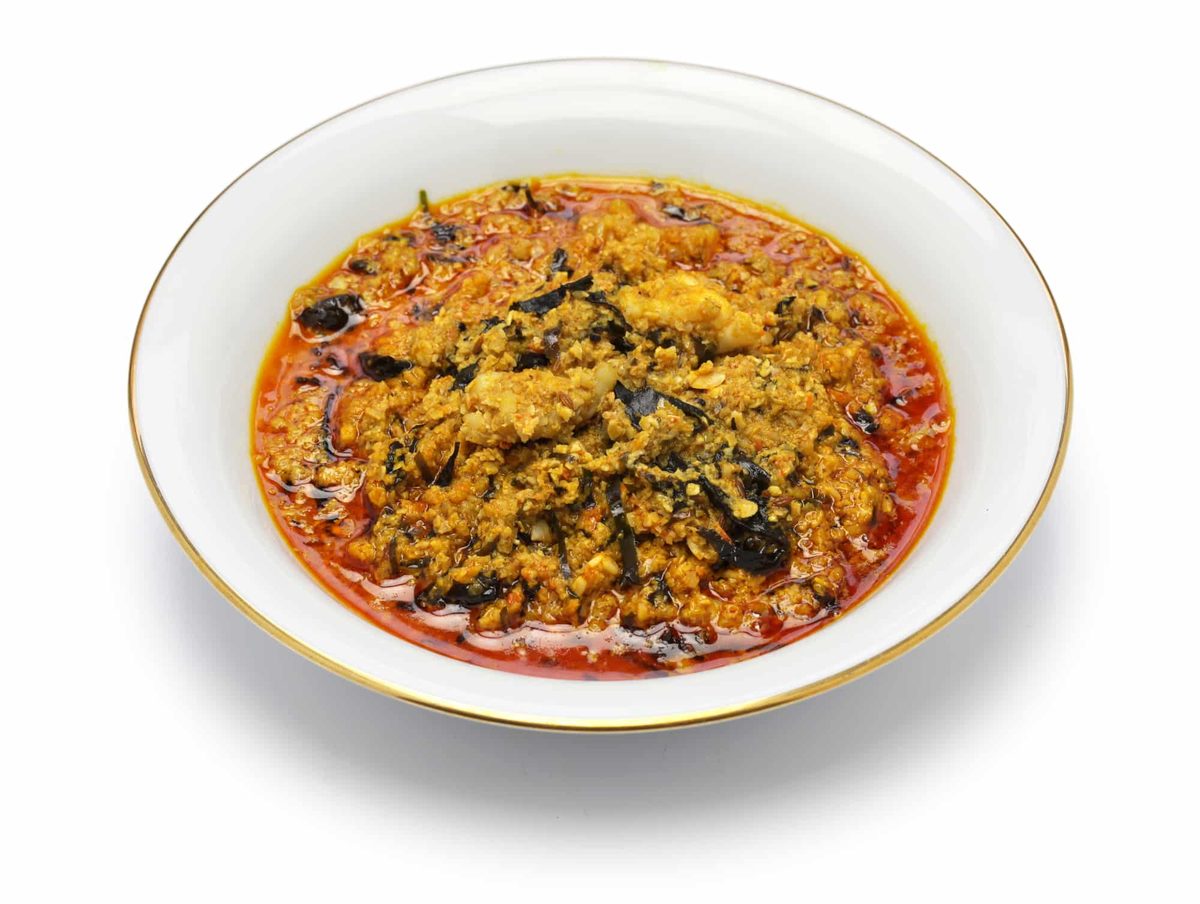
Nigeria’s kitchens draw on spices that are little known outside West Africa: peppery uziza leaves and seeds, calabash nutmeg, alligator pepper, and fermented seed condiments such as iru and ogiri that bring a deep, pungent savor to soups. Curry powder and thyme also have a place, along with fresh chiles. This page covers each, with what the sources say and links to our related profiles.
At a glance
| Seasoning | What it is | What it brings | Where it shows up |
|---|---|---|---|
| Uziza | Piper guineense, a pepper-family climber1 | Peppery heat, a little bitterness | Seeds as a spice;2 leaves in soups (common practice) |
| Calabash nutmeg (ehuru) | Seed of Monodora myristica, custard-apple family3 | Warm, nutmeg-like aroma | Pepper soup spice4 |
| Alligator pepper | Seeds of Aframomum melegueta, ginger family56 | Peppery, resinous heat | Pepper soup spice;4 served with kola nuts6 |
| Iru (dawadawa) | Fermented seeds of the African locust bean, Parkia biglobosa7 | Strong savory, fermented depth | Soups and stews (common practice) |
| Ogiri | Fermented oilseed paste; castor or melon seed versions8 | Pungent, savory | Soups (common practice) |
| Scotch bonnet | Hot fresh chile | Heat | Everyday cooking4 |
Uziza (Piper guineense)
Uziza is the Igbo name for Piper guineense, according to a 2025 study of its seeds.2 Kew lists the plant as a climbing epiphyte of the wet tropics, native across tropical Africa and Madagascar.1 It is in the same genus as black pepper, Piper nigrum. In English it is sometimes called false cubeb or Ashanti pepper:9 Gernot Katzer explains that the so-called “false cubeb pepper” is Piper guineense, whose fruits resemble cubeb berries but are smaller, smoother and reddish, and which tastes like cubeb but fresher and less bitter.9
Seeds. The 2025 study describes the seeds, known as African black pepper, as a spice and food preservative, eaten first in southern Nigeria and now across the country.2 It notes that traditional processing such as soaking, roasting and boiling is done to reduce bitterness and improve taste.2 Use them whole or ground like peppercorns, and in moderation; that is kitchen practice.
Leaves. Chopped uziza leaves are added near the end of cooking to soups such as nsala (white soup) and ofe oha; that is common practice, and we did not find a source for these dish uses.
See cubeb pepper, cubeb pepper substitutes, black pepper and long pepper.
Calabash nutmeg (ehuru)
Calabash nutmeg is the seed of Monodora myristica, a tree of the custard-apple family (Annonaceae).3 Kew gives its native range as western tropical Africa to southwestern Kenya and northwestern Angola, in the wet tropics.3 It is a different plant from true nutmeg, Myristica fragrans.
Yewande Komolafe, writing on the Nigerian pantry for Saveur, lists calabash nutmeg in pepper soup spice, alongside negro pepper (also called uda seeds) and alligator pepper seeds.4 Its use as a stand-in for nutmeg, and its use in banga soup, are common practice; we did not find a source for either, or for a flavor comparison with nutmeg. See nutmeg and nutmeg uses.
Alligator pepper
Alligator pepper is a West African name for Aframomum melegueta, the ginger-family plant whose seeds are sold elsewhere as grains of paradise.6 Kew gives its native range as western tropical Africa to Angola.5 A 2026 review reports that in eastern Nigeria the seeds are served with kola nuts to entertain guests.6 It is also one of the three spices Komolafe lists for pepper soup.4 See alligator pepper, grains of paradise and grains of paradise substitutes.
Pepper soup spice
Pepper soup spice is a blend rather than a single spice. Komolafe’s version includes calabash nutmeg, negro pepper (uda) and alligator pepper seeds; she grinds her own, and notes that preground versions are sold in African grocery stores.4 We found no standard recipe.
Iru (dawadawa): fermented locust bean
Iru is made from the seeds of the African locust bean, Parkia biglobosa, a legume tree that Kew lists as native from western tropical Africa to South Sudan.107 A 2013 study in Frontiers in Microbiology notes that it is called iru or dawadawa in Nigeria and Ghana, with related condiments elsewhere in West Africa, such as soumbala in Burkina Faso.7
How it is made. The seeds are cleaned, boiled, dehulled and fermented at ambient temperature.7 The study describes the process as a spontaneous, solid-substrate alkaline fermentation in which Bacillus species dominate.7 During fermentation, proteins are broken down into peptides, amino acids and ammonia.7 The study does not describe the smell; iru’s strong aroma is often compared to pungent cheese, which is a common description rather than a measured one.
Iru goes into soups such as ogbono and efo riro; that is common practice rather than a sourced finding.
Ogiri
Ogiri is a fermented paste made from oilseeds. A 1990 review of Nigerian fermented foods lists ogiri-isi, made from castor seeds, and ogiri-egusi, made from melon seeds, among the country’s fermented condiments, alongside dawadawa from the African locust bean.8 The same review notes that most of these fermentations are natural and that it also discusses possible risks of eating fermented foods.8
Ogiri okpei is often described as made from the seeds of African mesquite (Prosopis africana); we found that link only in the titles of studies cited by other papers, not in a source we could read, so we leave it unconfirmed. We also found no source for specific dishes such as ofe akwu or ofe nsala, or for comparisons with miso or fermented black beans. See soy sauce powder for another fermented seasoning.
Curry powder and thyme
Curry powder and dried thyme are standard in Nigerian stews and fried rice; that is common practice. We found no source for the character of Nigerian curry powder blends, including the claim that they carry no chile heat. See curry powder, is curry powder spicy?, thyme and cumin.
Scotch bonnet and suya spice
Komolafe notes that Scotch bonnet peppers are used in everyday cooking in Nigeria.4 She also describes suya spice, a dry rub of ginger powder, chile powder, onion powder, paprika, garlic powder and salt, rubbed onto meat or anything else going on the grill.4 See habanero powder and ginger.
Related pages
Footnotes
-
Piper guineense Schumach. & Thonn., Plants of the World Online, Royal Botanic Gardens, Kew. powo.science.kew.org · Reference work ↩ ↩2
-
Attaugwu, Anyadioha and Maxwell, “Proximate, Antioxidant, Vitamins, and Total Phenolic Composition of Piper guineense Seeds As Affected by Soaking and Air-Resting”, Indonesian Food and Nutrition Progress, 2025. journal.ugm.ac.id · Peer-reviewed ↩ ↩2 ↩3 ↩4
-
Monodora myristica (Gaertn.) Dunal, Plants of the World Online, Royal Botanic Gardens, Kew. powo.science.kew.org · Reference work ↩ ↩2 ↩3
-
Yewande Komolafe as told to Leslie Pariseau, “How to Stock a Nigerian Pantry”, Saveur, 2017. saveur.com · Publication ↩ ↩2 ↩3 ↩4 ↩5 ↩6 ↩7 ↩8
-
Aframomum melegueta K.Schum., Plants of the World Online, Royal Botanic Gardens, Kew. powo.science.kew.org · Reference work ↩ ↩2
-
Asemota et al., “Aframomum melegueta K. Schum. (Grains of Paradise) and Its Therapeutic Applications”, Journal of Medicinal Natural Product, 2026. researchonline.ljmu.ac.uk · Peer-reviewed ↩ ↩2 ↩3 ↩4
-
Adewumi et al., “Combination of culture-independent and culture-dependent molecular methods for the determination of bacterial community of iru, a fermented Parkia biglobosa seeds”, Frontiers in Microbiology, 2013. frontiersin.org · Peer-reviewed ↩ ↩2 ↩3 ↩4 ↩5 ↩6
-
Uzogara, Agu and Uzogara, “A review of traditional fermented foods, condiments and beverages in Nigeria”, Ecology of Food and Nutrition, 1990 (abstract). arch.neicon.ru · Peer-reviewed ↩ ↩2 ↩3
-
Gernot Katzer, Cubeb Pepper (Piper cubeba), Gernot Katzer’s Spice Pages. gernot-katzers-spice-pages.com · Reference work ↩ ↩2
-
Parkia biglobosa (Jacq.) R.Br. ex G.Don, Plants of the World Online, Royal Botanic Gardens, Kew. powo.science.kew.org · Reference work ↩