Spice Comparisons · Comparison
Celtic Sea Salt vs. Table Salt: Moisture, Sodium, Iodine and Additives Compared
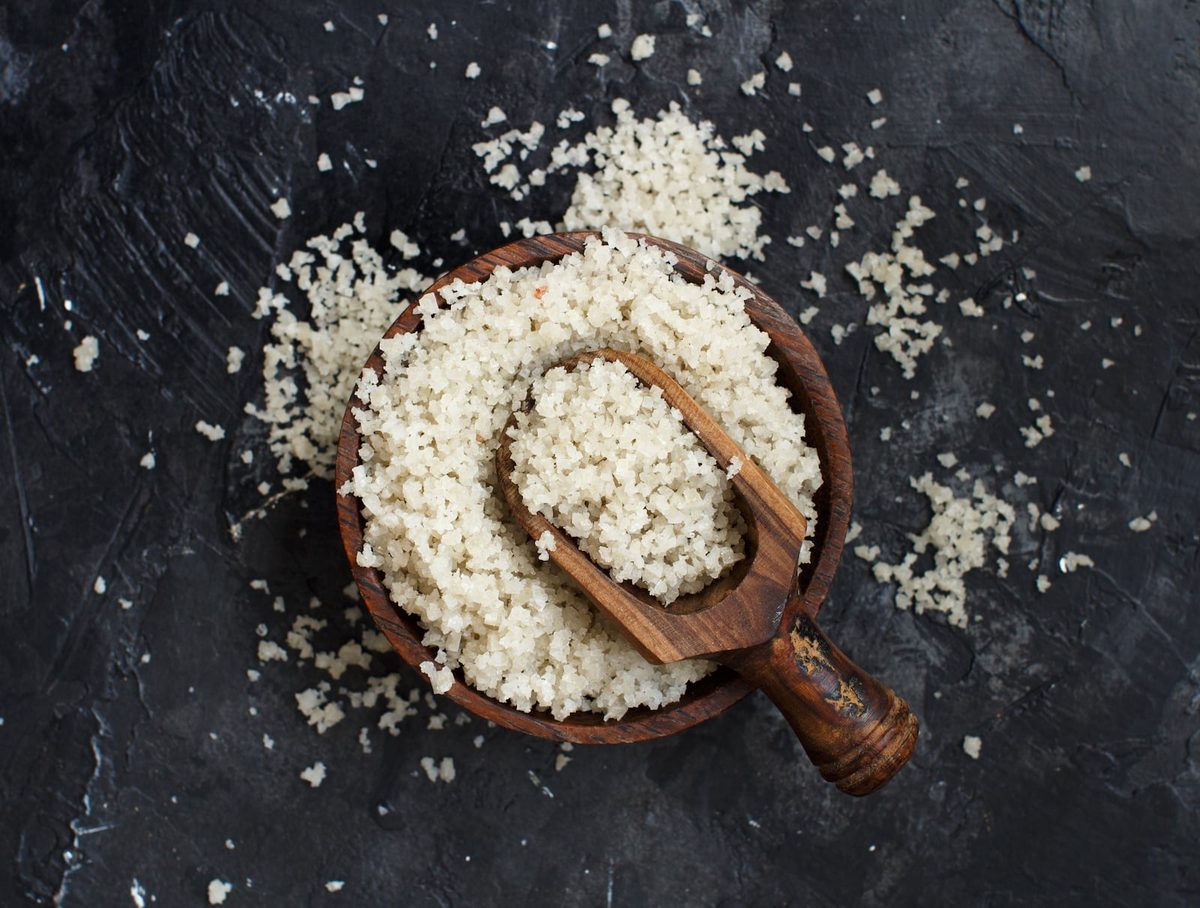
Celtic sea salt and table salt are both sodium chloride, and once dissolved in food they taste the same.12 What separates them is everything around the salt. “Celtic sea salt” usually means Celtic Sea Salt, a brand founded in 1976,3 whose Light Grey Celtic is a moist gray sea salt of the kind French producers call sel gris. Table salt is fine, dry, free-flowing and, in its iodized form, an important source of iodine.24 Which one to reach for depends on whether the salt is going on top of the food or into it, and on whether you count on salt for iodine.
Side by side
| Celtic sea salt (gray salt) | Table salt | |
|---|---|---|
| What it is | Sea salt from evaporation pans; “Celtic Sea Salt” is a brand name3 | Fine-grained sodium chloride5 |
| How it’s made | In Guérande, France, gray salt crystallizes on the clay bottom of salt pans and is gathered by hand6 | Mined from salt deposits and processed to a fine texture (AHA);5 tiny, uniform crystals from rapid vacuum evaporation (ATK)2 |
| Where it comes from | The brand’s pages we read don’t say where Light Grey Celtic is harvested7 | Many countries; 2024 world production about 280 million tonnes, led by China and the United States8 |
| Color | Gray, from fine clay particles (Guérande)6 | White |
| Moisture | Up to 12% for Guérande gray salt;6 the brand says brine stays in its salt7 | Dry; anticaking agents help it pour2 |
| Ingredients | Additives prohibited in Guérande salt6 | Morton iodized: salt, calcium silicate (anticaking agent), dextrose, potassium iodide9 |
| Weight per teaspoon | 6.0 g, from the Light Grey Celtic label (1.5 g per ¼ teaspoon)10 | About 6 g (ATK);11 Morton’s label: 1.5 g per ¼ teaspoon9 |
| Sodium per teaspoon | About 1,920 mg, from the label (480 mg per ¼ teaspoon)10 | 2,325 mg (Tufts);12 about 2,300 mg (FDA);13 2,400 mg (AHA)5 |
| Iodine | None added; the brand reports about 0.2 ppm naturally present7 | Iodized salt in the US: 45 mcg per gram;4 plain salt: none added |
| Flavor (editorial) | Salty, with a damp crunch when eaten whole | Clean and salty |
| Price | No dated, sourced retail comparison found | No dated, sourced retail comparison found |
The Celtic weight and sodium figures are the brand’s own label, not an independent measurement. The three table-salt sodium figures come from three sources and differ slightly; we show all three.
How each is made
Gray salt. The best-documented gray salt is from Guérande, a protected salt-making area on France’s Atlantic coast that lies in two départements, Loire-Atlantique and Morbihan.6 Its official specification says gray salt forms as crystals on the clay bottom of the final pans and that the harvester, the paludier, gathers it by hand from the brine.6 The salt drains for several hours, is not washed, and may contain no additives.6 Its gray color comes from insoluble matter, which the specification describes as fine particles of clay.6 Production is not tiny: the local intercommunal authority gives 16,000 tonnes of gray salt and 700 tonnes of fleur de sel a year from the Guérande salt marshes, in an undated page.14
Celtic Sea Salt is a brand of this style of salt. The company says its founder, Dr. Jacques Delangre, coined the word “Celtic,”7 and its FAQ names Spanish sites for two other products but, on the pages we read, no harvest site for Light Grey Celtic.7 So “Celtic” on a label tells you the brand, not that the salt is from Brittany or from Guérande.
Table salt. The American Heart Association describes table salt as mined from salt deposits and processed to a fine texture that is easy to mix.5 America’s Test Kitchen describes its tiny, uniform crystals as the product of rapid vacuum evaporation and notes the usual anticaking agents.2 Salt is an industrial commodity on a huge scale. The US Geological Survey puts 2024 world production at about 280 million tonnes, led by China (55 million) and the United States (40 million).8
What’s in each, besides salt
Sodium chloride. The Codex Alimentarius standard requires food-grade salt to be at least 97% sodium chloride on a dry basis, whether it comes from the sea, from rock deposits or from brine.1 The AHA says table salt and most sea salts are about 40% sodium.5
Sodium per spoon. Light Grey Celtic’s label gives 480 mg of sodium in 1.5 g, about 32% by our arithmetic.10 That is lower than the roughly 40% the AHA gives for most salts.5 The label does not explain the gap. Moisture is one possible reason, since the brand says brine stays in its salt,7 but we found no analysis that confirms it. Either way, it is not a low-sodium salt. The FDA’s Daily Value for sodium is less than 2,300 mg a day, about a teaspoon of table salt.13
Iodine. This is the biggest practical difference. US iodized salt contains 45 mcg of iodine per gram, and iodization in the US is voluntary.4 Under US rules, iodized salt must say “This salt supplies iodide, a necessary nutrient,” and salt without it must say it does not.15 Celtic Sea Salt says it adds no iodine and that a natural trace of about 0.2 ppm is present,7 which works out to about 0.2 mcg per gram (our arithmetic). The NIH Office of Dietary Supplements notes that specialty salts such as sea salt are not usually iodized.4 A kitchen that has switched entirely to gray salt has given up the iodine. See iodized vs. non-iodized salt.
Additives. Read the label. Morton’s iodized table salt lists salt, calcium silicate (an anticaking agent), dextrose and potassium iodide.9 Salt with an anticaking agent may be labeled “free flowing” under US rules.15 Guérande salt may contain no additives.6
Minerals. Celtic Sea Salt says its salt contains more than 70 trace minerals and elements.3 The AHA says sea salt may carry trace minerals such as magnesium, potassium and calcium, and that for heart health total sodium is what matters most.5 We found no independent analysis of Celtic Sea Salt’s minerals.
Flavor
America’s Test Kitchen found that sea salts vary in color but only slightly in flavor, and that they taste no different from table salt once mixed into food.2 Iodine is often blamed for a bitter edge in table salt, but ATK’s tasters found no detectable difference between iodized and noniodized salt.2 Any extra brininess in gray salt is most noticeable when the crystals are eaten whole on the surface of food; that is a cook’s observation, not a measured result.
In the kitchen
- On top of food, gray salt’s damp crystals stay whole and crunchy on steak, roast vegetables, tomatoes and salads. ATK recommends sea salts as finishing salts.2
- In the pot, in pasta water, soups, braises and brines, the difference disappears once the salt dissolves.2 A finishing salt’s crystals are wasted there; that is kitchen judgment.
- In baking, fine table salt disperses evenly through a dough or batter and measures predictably by volume. That is common practice. Damp gray crystals can clump, and the brand suggests drying them gently with low heat if they are too damp to grind.7
Can one stand in for the other?
Yes. A teaspoon of Light Grey Celtic and a teaspoon of table salt weigh the same, according to the labels and ATK’s weighings, so a straight swap by volume puts the same weight of salt in the dish.10119 By sodium the two differ. The figures below reuse the conversions on our Celtic salt substitute page.
| Swap | Match by weight | Match by sodium | Treatment |
|---|---|---|---|
| Table salt for 1 teaspoon Light Grey Celtic | 1 teaspoon (6.0 g ÷ 6.0 g) | About ⅘ teaspoon (1,920 mg ÷ 2,325 mg) | Computed101112 |
| Light Grey Celtic for 1 teaspoon table salt | 1 teaspoon | About 1¼ teaspoons (2,325 mg ÷ 1,920 mg) | Computed101112 |
| Table salt for gray salt as a finishing salt | Not a good match: fine grains give no crunch (editorial) | Method |
How these were worked out. The Celtic figures are the brand’s label; the table-salt sodium figure is Tufts’ general number for a teaspoon of table salt, not a brand.12 In practice, start with the weight match and season to taste. For a finishing salt, use another coarse sea salt such as fleur de sel or Maldon; see the Celtic salt substitute page.
Converting to kosher salt. If your recipe is written for table salt and you want to use kosher salt instead, the sources disagree on the conversion. See kosher salt vs. table salt.
What isn’t known
- No independent analysis of Celtic Sea Salt’s weight, sodium, minerals or moisture was found; the figures here are the brand’s.
- The brand’s pages we read don’t say where Light Grey Celtic is harvested.
- A widely repeated figure says only about 20 metric tons of this salt come out of France each year. We found no source for it, and the Guérande figure above, though undated, is far larger.14
- No dated, sourced price comparison was found.
Related
- Celtic sea salt and table salt, the full profiles
- Celtic salt substitutes
- Celtic salt vs. Himalayan salt
- Table salt vs. sea salt, sea salt vs. iodized salt and kosher salt vs. table salt
- Fleur de sel, sea salt and the best salt for cooking
- Too much salt
Footnotes
-
Standard for Food Grade Salt, CXS 150-1985 (rev. 2012), Codex Alimentarius. services.bis.gov.in · Standard ↩ ↩2
-
Salt Types and Measurements, America’s Test Kitchen. americastestkitchen.com · Publication ↩ ↩2 ↩3 ↩4 ↩5 ↩6 ↩7 ↩8 ↩9
-
About Celtic Sea Salt, Celtic Sea Salt (Selina Naturally). celticseasalt.com · Merchant ↩ ↩2 ↩3
-
Iodine: Fact Sheet for Health Professionals, NIH Office of Dietary Supplements. ods.od.nih.gov · Regulator ↩ ↩2 ↩3 ↩4
-
Sodium Sources: Where Does All That Sodium Come From?, American Heart Association, 2025. heart.org · Reference work ↩ ↩2 ↩3 ↩4 ↩5 ↩6 ↩7
-
Cahier des charges de l’IGP Sel de Guérande / Fleur de sel de Guérande, French Ministry of Agriculture, 2025. info.agriculture.gouv.fr · Regulator ↩ ↩2 ↩3 ↩4 ↩5 ↩6 ↩7 ↩8 ↩9
-
FAQs, Celtic Sea Salt (Selina Naturally). celticseasalt.com · Merchant ↩ ↩2 ↩3 ↩4 ↩5 ↩6 ↩7 ↩8
-
Wallace P. Bolen, Salt, Mineral Commodity Summaries 2025, U.S. Geological Survey. pubs.usgs.gov · Regulator ↩ ↩2
-
Morton Iodized Table Salt, product page, Morton Salt. mortonsalt.com · Merchant ↩ ↩2 ↩3 ↩4
-
Light Grey Celtic, product page, Celtic Sea Salt (Selina Naturally). celticseasalt.com · Merchant ↩ ↩2 ↩3 ↩4 ↩5 ↩6
-
Kate Shannon Levine, The Best Kosher Salt, America’s Test Kitchen, 2019. americastestkitchen.com · Publication ↩ ↩2 ↩3 ↩4
-
Tufts Health & Nutrition Letter, kosher salt Q&A, 2019. nutritionletter.tufts.edu · Publication ↩ ↩2 ↩3 ↩4
-
Sodium in Your Diet, U.S. Food and Drug Administration. fda.gov · Regulator ↩ ↩2
-
Récolte du sel dans les marais salants de Guérande, Cap Atlantique (La Baule-Guérande Agglo), undated. cap-atlantique.fr · Reference work ↩ ↩2
-
21 CFR 100.155, Salt and iodized salt, Electronic Code of Federal Regulations. ecfr.gov · Regulator ↩ ↩2