Blog · Dish guide
Hot Dog Spices: What Goes Inside the Sausage and What Goes on Top
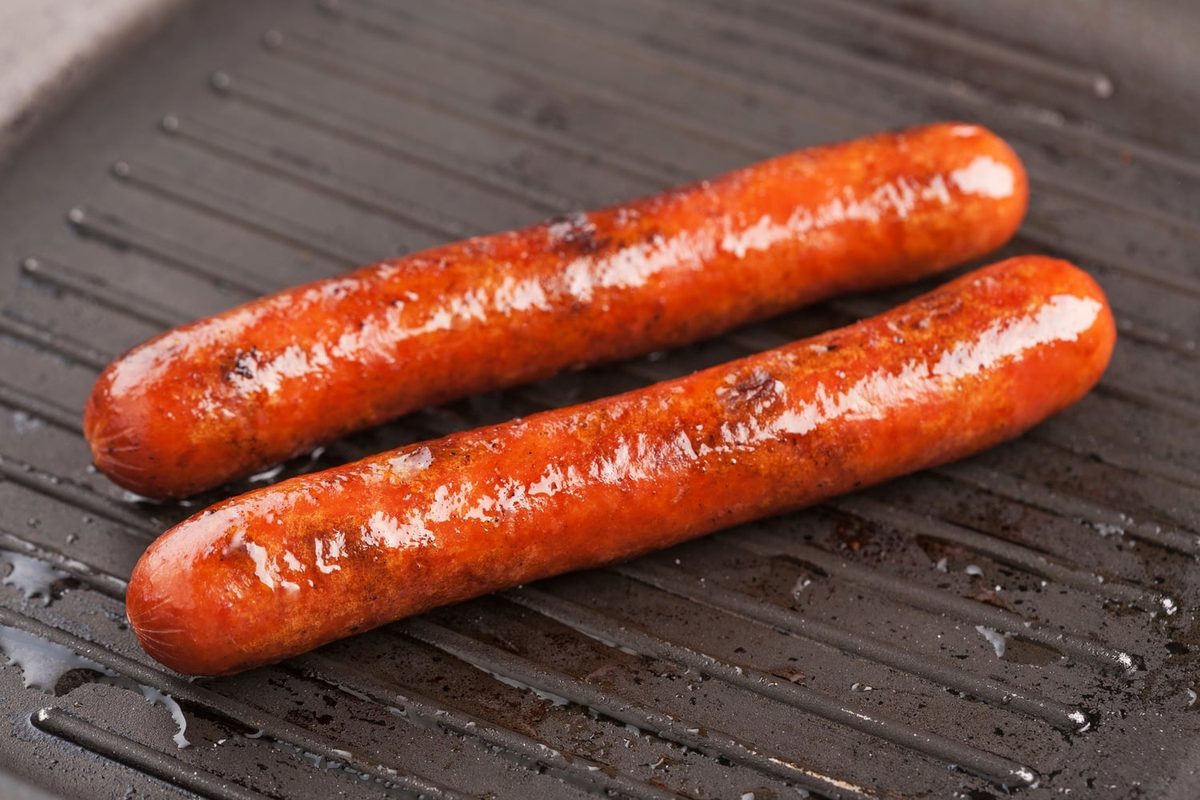
A hot dog gets its flavor in two places: the seasoning ground into the sausage, and the condiments piled on the bun. Inside, extension-service formulas for wieners and franks lean on salt, coriander, nutmeg or mace, pepper, mustard, and onion and garlic. On top, the classic American set is yellow mustard, chopped onion and, in Chicago, celery salt. This page covers what each one does and where the published formulas agree. Quantities appear only where a named source gives them.
At a glance
| Seasoning | Where it goes | Job | Source |
|---|---|---|---|
| Salt | In the meat | Seasoning, and half the flavoring weight in one formula | NDSU1 |
| Coriander | In the meat | Mild, sweet, warm aroma | NDSU; Idaho12 |
| Nutmeg or mace | In the meat | Warm spice note | NDSU (nutmeg); Idaho (mace)12 |
| Black pepper or ground red pepper | In the meat | Pungency | NDSU; Idaho12 |
| Mustard | In the meat | Flavor; yellow mustard also binds water in prepared meats | NDSU; Saskatchewan13 |
| Onion and garlic | In the meat (dried) and on top (fresh onion) | Savory base | NDSU; NPR14 |
| Yellow mustard | On top | Sharp, tangy condiment | Saskatchewan; NPR34 |
| Celery salt | On top (Chicago style) | Salty, green finish | NPR4 |
What counts as a hot dog
USDA’s standard groups frankfurters, franks, hot dogs, wieners, vienna sausage, bologna and knockwurst together as finely ground cooked sausages, seasoned and cured.5 The finished product may not contain more than 30 percent fat.5 The regulation does not list which spices go in, so the seasoning is up to the maker.
The spices inside the sausage
Two extension publications give working formulas. They are one-off recipes from named authors, not an industry standard, but they show the same core set.
| Formula | Pepper | Warm spice | Other spices and aromatics | Other seasoning |
|---|---|---|---|---|
| NDSU Extension, emulsified base for wieners and dinner franks (2022)1 | Ground black pepper, 3.2 oz | Nutmeg, 2.2 oz | Coriander 2.2 oz; mustard 11.2 oz; dehydrated onion and garlic 1.4 oz | Salt 40 oz; corn syrup solids 16 oz; cure 3.2 oz; sodium erythorbate 0.6 oz |
| University of Idaho, “Vienna Sausage,” a mild frank (1981)2 | Ground red pepper | Mace | Coriander; finely minced onion | Salt, sugar, saltpeter |
| University of Idaho, “Spicy Vienna Sausage,” a coarser frankfurter (1981)2 | Ground black pepper | Mace | Garlic (optional) | Curing salt |
The NDSU amounts season a large batch of beef and pork trim plus water; salt makes up 50 percent of the flavoring weight.1 The scanned Idaho bulletin does not show its quantities legibly, so only the ingredient names are given here.2 In the NDSU method, the mixture is stuffed into sheep casings for wieners, then smoked and cooked to 155°F internal temperature.1
Coriander
Coriander appears in both publications.12 A 2023 review describes its flavor as mild, sweet, warm and aromatic, and reports that the seed oil is 60 to 80 percent linalool, a floral-smelling terpene alcohol.6
Nutmeg and mace
NDSU uses nutmeg; the Idaho franks use mace.12 They come from the same fruit: Britannica describes mace as a spice made from the dried covering of nutmeg.7 FAO’s table of nutmeg uses lists meat products, sausages and frankfurters among its industrial applications.8 For how the two differ, see mace vs. nutmeg.
Pepper
Black pepper is in the NDSU base and the spicier Idaho frank; the mild Idaho frank uses ground red pepper instead.12 For a pale sausage, some cooks prefer white pepper (our suggestion); see white pepper vs. black pepper.
Mustard
NDSU’s formula includes mustard at 14 percent of the flavoring weight but does not say whether it means seed, flour or prepared mustard.1 Saskatchewan’s agriculture ministry notes that yellow mustard also works as a water-binding agent and protein extender in prepared meats, so in a sausage it does more than add flavor.3 See mustard powder.
Onion and garlic
NDSU adds dehydrated onion and garlic together; the Idaho mild frank uses fresh minced onion and the spicy one optional garlic.12 See onion powder and garlic powder.
MSG is not a spice
Monosodium glutamate is the sodium salt of glutamic acid. FDA recounts that in 1908 the Japanese professor Kikunae Ikeda extracted glutamate from a broth and identified it as the source of its savory taste; commercial MSG is now made by fermenting starch, sugar beets, sugar cane or molasses.9 FDA considers added MSG generally recognized as safe.9
It is not part of either extension formula above.12 NDSU adds a note that MSG intensifies and enhances flavor but has no flavor of its own,1 while FDA’s account describes glutamate as the source of a broth’s savory taste.9 The two sources are describing the same effect from different angles; neither gives a hot dog dose. For more, see monosodium glutamate, cooking with MSG and MSG vs. salt.
Reading the label
Under USDA’s meat labeling rule, the terms “natural flavor” or “flavoring” may be used to designate spices and powdered onion, garlic and celery, so a hot dog label need not name each one.10 MSG is different: FDA requires added MSG to be listed as “monosodium glutamate” and does not allow it to be listed as “spices and flavoring.”9
The toppings
Yellow mustard
Saskatchewan lists traditional hot dog mustard among the main uses of yellow mustard seed.3 Katzer notes that some brands of mustard contain turmeric for a bright yellow color.11 Yellow (white) mustard is not heatless: its pungent compound is non-volatile, so it gives a bite on the tongue rather than the nose-clearing rush of brown mustard.11 See yellow mustard seeds.
Onion and celery salt
NPR’s Chicago-style recipe dresses the dog with yellow mustard, finely diced onion, green relish, tomato, a dill pickle spear, sport peppers and celery salt on a poppy-seed bun.4 Celery salt is the one dry seasoning in that list; see celery salt.
Related
Footnotes
-
The Art and Practice of Sausage Making (FN176), Marchello and Garden-Robinson, NDSU Extension, 2022. ndsu.edu · Reference work ↩ ↩2 ↩3 ↩4 ↩5 ↩6 ↩7 ↩8 ↩9 ↩10 ↩11 ↩12 ↩13 ↩14 ↩15 ↩16
-
Making Sausages at Home (Bulletin 597), Miller and Petersen, University of Idaho Cooperative Extension Service, 1981. objects.lib.uidaho.edu · Reference work ↩ ↩2 ↩3 ↩4 ↩5 ↩6 ↩7 ↩8 ↩9 ↩10 ↩11
-
Mustard, Government of Saskatchewan, Ministry of Agriculture. saskatchewan.ca · Regulator ↩ ↩2 ↩3 ↩4
-
Chicago-Style Hot Dogs with ‘the Works’, Howard Yoon, NPR. npr.org · Publication ↩ ↩2 ↩3 ↩4
-
9 CFR 319.180, Frankfurter and similar products, eCFR (USDA FSIS). ecfr.gov · Regulator ↩ ↩2
-
Essential Oil from Coriandrum sativum (Al-Khayri et al.), Molecules, 2023. mdpi.com · Peer-reviewed ↩
-
Mace, Encyclopaedia Britannica. britannica.com · Reference work ↩
-
Production, handling and processing of nutmeg and mace, Section VII: Utilization of products, FAO. fao.org · Reference work ↩
-
Questions and Answers on Monosodium glutamate (MSG), U.S. Food and Drug Administration. fda.gov · Regulator ↩ ↩2 ↩3 ↩4
-
9 CFR 317.2, Labels: definition; required features, eCFR (USDA FSIS). ecfr.gov · Regulator ↩
-
White Mustard (Sinapis alba), Gernot Katzer’s Spice Pages. gernot-katzers-spice-pages.com · Reference work ↩ ↩2