Cooking · Cooking with
Cooking With Oregano: Fresh vs. Dried, Timing, Mexican Oregano and Classic Dishes
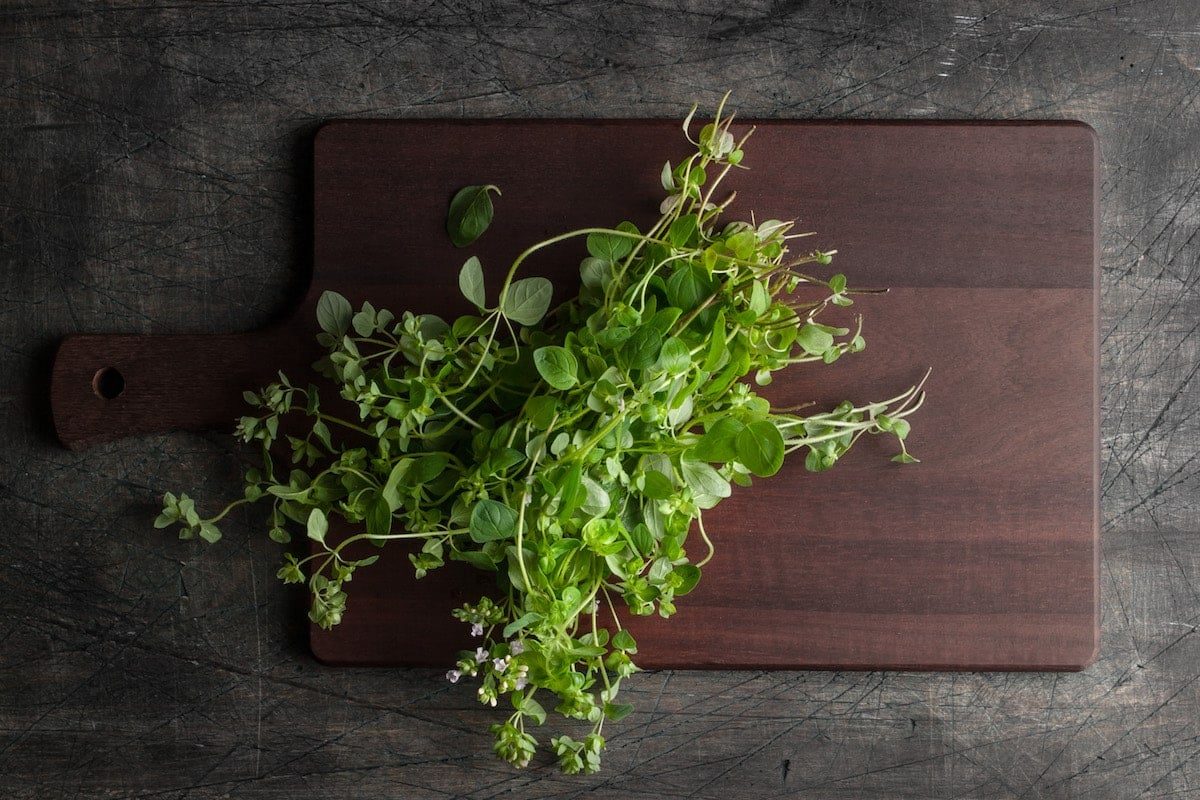
Oregano is one of the few herbs that cooks often prefer dried. In America’s Test Kitchen’s tests of fresh and dried herbs across 24 recipes, tasters picked fresh almost every time; chili was the one exception, and there dried oregano won.1 Oregano is a hearty herb that can go in early, it is about three times as strong dried as fresh, and “oregano” can mean two unrelated plants. This page covers how to use it well. For the plant, its chemistry and buying advice, see oregano.
At a glance
| Question | Short answer |
|---|---|
| Fresh or dried? | Dried for long-cooked dishes; fresh for finishing (see below)1 |
| Fresh-to-dried ratio | 3 parts fresh to 1 part dried, by volume1 |
| How much | 1 to 2 teaspoons for 6 servings, as a starting point from the University of Delaware2 |
| When to add | Sources differ: early (ATK) or in the last 20 to 45 minutes (LSU, Delaware)234 |
| Prep | Crush dried oregano before it goes in; strip fresh leaves from woody stems2 |
| Mexican oregano | A different plant family; ATK found it stronger, with a hint of menthol56 |
Fresh vs. dried oregano
A widely repeated claim says fresh oregano is stronger than dried. The tests point the other way. America’s Test Kitchen found that 1 part dried herb to 3 parts fresh came closest to equal strength, using newly bought jars.1 The University of Delaware’s extension guide says simply that dried herbs are stronger than fresh.2 So 1 teaspoon of dried oregano stands in for about 1 tablespoon of fresh.
Oregano is also one of the herbs that survive drying well. ATK found that dried oregano, rosemary, sage and thyme fared reasonably well in recipes that cooked for more than 20 minutes with plenty of liquid.1 In chili, its tasters preferred dried oregano to fresh.1 Fresh oregano still has a place where its leaves stay visible or barely cooked: scattered over pizza or roasted vegetables after cooking, or chopped into a salsa verde (our judgment). For the full comparison, see fresh oregano vs. dried.
How much to use
Oregano is assertive, but not one of the most dominant herbs. The University of Delaware groups it with mint, savory and thyme as a medium-strength herb, to be used in moderate amounts of 1 to 2 teaspoons for 6 servings.2 Britannica describes the culinary oreganos as having a strong aroma and a warm, pungent taste.5 Start at the low end of Delaware’s range, taste once the dish has simmered, and add more if needed. If a dish has gone over, see too much oregano.
When to add it
Sources disagree on timing. All of this is general herb guidance rather than a test on oregano alone:
| Source | Advice |
|---|---|
| America’s Test Kitchen | Oregano is a hearty herb to add early in cooking; volatile flavor compounds in hearty herbs are somewhat more heat-stable than those in delicate herbs3 |
| LSU AgCenter | Less delicate herbs like oregano can go in about the last 20 minutes of cooking4 |
| University of Delaware | For long simmering, add herbs during the last 45 minutes2 |
A practical reading: dried oregano can go in with the other aromatics in a sauce or chili, where it has time to soften, and fresh oregano does best toward the end. Saveur’s chili con carne, for example, adds oregano with the cumin and flour and cooks them until fragrant.7 Taste before serving and top up with a little fresh or crumbled dried oregano if the aroma has faded.
Preparing oregano
- Dried. The University of Delaware suggests crushing dried herbs first to release some of their oils.2 Rubbing dried oregano between your palms as it goes into the pot does this.
- Fresh. Strip the leaves from the stems by running your fingers down from the tip, then chop. Older stems are woody and are best left out (our judgment).
- Whole sprigs. A fresh sprig can simmer in beans or a stew and be fished out later (our judgment); Saveur’s Cuban-style black beans call for one sprig of fresh oregano.8 Note that oregano is not part of the classic bouquet garni, which Britannica gives as parsley, thyme and a bay leaf.9 See bouquet garni.
Mediterranean vs. Mexican oregano
The two herbs sold as oregano come from different plant families:
| Mediterranean oregano | Mexican oregano | |
|---|---|---|
| Plant | Origanum vulgare and relatives, a perennial of the mint family, Lamiaceae5 | Usually Lippia graveolens, now treated by Kew under Lippia origanoides510 |
| Family | Lamiaceae, which also includes basil511 | Verbenaceae, the verbena family5 |
| Close relatives | Marjoram, thyme, basil | Lemon verbena, also in Verbenaceae12 |
| Native range | Macaronesia to China, for O. vulgare, per Kew13 | Tropical and subtropical America, per Kew10 |
| Flavor in ATK’s tasting | Milder and faintly sweeter6 | Stronger, with a hint of menthol6 |
Both share carvacrol, a phenolic compound.6 It is often said that Mexican oregano is the one to use with cumin and chiles, and Mediterranean oregano with tomato sauce and grilled meat. America’s Test Kitchen tried both in tomato sauce and in mojo-marinated skirt steak and noticed minimal differences.6 So either works in most dishes; Mexican oregano, being stronger, may need a lighter hand. See Mexican oregano vs. oregano and Mexican oregano.
Where oregano goes: dishes from named recipes
| Dish or blend | How oregano is used | Source |
|---|---|---|
| Pizza and pasta sauces | Britannica calls oregano essential in both | Britannica5 |
| Greek salad and gyros | Britannica names both | Britannica5 |
| Gyros (home recipe) | 2 teaspoons dried oregano in the meat seasoning | Jennifer Segal, Once Upon a Chef14 |
| Greek seasoning | 2 tablespoons dried oregano; ATK suggests it for dressings, feta, baked potatoes and grilled chicken | America’s Test Kitchen15 |
| Chili con carne | Oregano cooked with cumin and flour until fragrant | Saveur7 |
| Chili powder | Saveur lists dried chiles, oregano, cumin, garlic and sometimes salt | Saveur16 |
| Cuban black beans | One sprig of fresh oregano | Saveur8 |
| Herbes de Provence (Label Rouge) | Oregano is 26% of the certified blend, with savory, rosemary and thyme | Réussir Les Marchés17 |
Quantities above are those recipes’ own (Attributed). See also good spices for pizza, Greek seasoning, Italian seasoning, herbes de Provence and chili powder.
Pairings
The blends above show oregano’s usual company: savory, rosemary and thyme in herbes de Provence,17 cumin and chiles in chili,716 and garlic in chili powder.16 Basil, marjoram, garlic, lemon and olive oil are the other classic partners; that part is cooking judgment. Comparisons: marjoram vs. oregano, oregano vs. thyme and basil vs. oregano.
Keeping fresh oregano
In the refrigerator. A common tip is to stand oregano sprigs in a glass of water like flowers. America’s Test Kitchen gives different advice for hearty herbs: they take in moisture through their leaves, so it is important to keep them dry; store them in their original packaging or an open zipper-lock bag in the refrigerator.3
Freezing. South Dakota State University Extension lists oregano among herbs to freeze in ice cubes: fill a tray half full of water with about a tablespoon of herbs in each section.18 Use the cubes in cooked dishes. See can you freeze oregano?
Drying. The National Center for Home Food Preservation lists oregano among the herbs with a high moisture content, which mold if not dried quickly.19 See how to dry oregano.
Oregano in oil. Herbs in oil can be a source of Clostridium botulinum, the botulism bacterium, so Oregon State University Extension says the mixture must be refrigerated and used within 4 days, or frozen.20 Do not keep homemade oregano oil at room temperature.
If you have none
Marjoram is the closest stand-in, thyme covers oregano’s sharper side, and Mexican and Mediterranean oregano swap readily (see above). See oregano substitutes and Mexican oregano substitutes.
Footnotes
-
“Science: Substituting Dried Herbs for Fresh”, America’s Test Kitchen. americastestkitchen.com · Publication ↩ ↩2 ↩3 ↩4 ↩5 ↩6
-
“Using Herbs and Spices”, University of Delaware Cooperative Extension, 2025. udel.edu · Reference work ↩ ↩2 ↩3 ↩4 ↩5 ↩6 ↩7
-
Liz Bomze, “Our Guide to Fresh Herbs”, America’s Test Kitchen, 2019. americastestkitchen.com · Publication ↩ ↩2 ↩3
-
“Flavorful Herbs”, LSU AgCenter. lsuagcenter.com · Reference work ↩ ↩2
-
Anoushka Pant, “Oregano”, Encyclopaedia Britannica, 2026. britannica.com · Reference work ↩ ↩2 ↩3 ↩4 ↩5 ↩6 ↩7 ↩8
-
“Oregano: Mediterranean and Mexican”, America’s Test Kitchen. americastestkitchen.com · Publication ↩ ↩2 ↩3 ↩4 ↩5
-
“Chili Con Carne”, Saveur, 2012. saveur.com · Publication ↩ ↩2 ↩3
-
“Frijoles Negros (Cuban-Style Black Beans)”, Saveur, 2007. saveur.com · Publication ↩ ↩2
-
“Bouquet garni”, Encyclopaedia Britannica. britannica.com · Reference work ↩
-
Lippia origanoides Kunth, Plants of the World Online, Royal Botanic Gardens, Kew. powo.science.kew.org · Reference work ↩ ↩2
-
“Basil”, Encyclopaedia Britannica, 2026. britannica.com · Reference work ↩
-
Aloysia citrodora Paláu, Plants of the World Online, Royal Botanic Gardens, Kew. powo.science.kew.org · Reference work ↩
-
Origanum vulgare L., Plants of the World Online, Royal Botanic Gardens, Kew. powo.science.kew.org · Reference work ↩
-
Jennifer Segal, “Gyros”, Once Upon a Chef, 2023. onceuponachef.com · Publication ↩
-
“Homemade Greek Seasoning”, America’s Test Kitchen (Cook’s Country), 2019. americastestkitchen.com · Publication ↩
-
“Chili Powder”, Saveur, 2009. saveur.com · Publication ↩ ↩2 ↩3
-
Sylvie Carriat, “Les vraies herbes de Provence raniment la flamme”, Réussir Les Marchés, 2008. reussir.fr · Publication ↩ ↩2
-
“Preserving Herbs”, South Dakota State University Extension, 2022. extension.sdstate.edu · Reference work ↩
-
“Drying Herbs”, National Center for Home Food Preservation. nchfp.uga.edu · Reference work ↩
-
“Herbs and Vegetables in Oil”, SP 50-701, Oregon State University Extension Service, 2025. extension.oregonstate.edu · Reference work ↩