Spice Substitutes · Substitutes
Oregano Substitutes, Ranked by the Job Oregano Is Doing
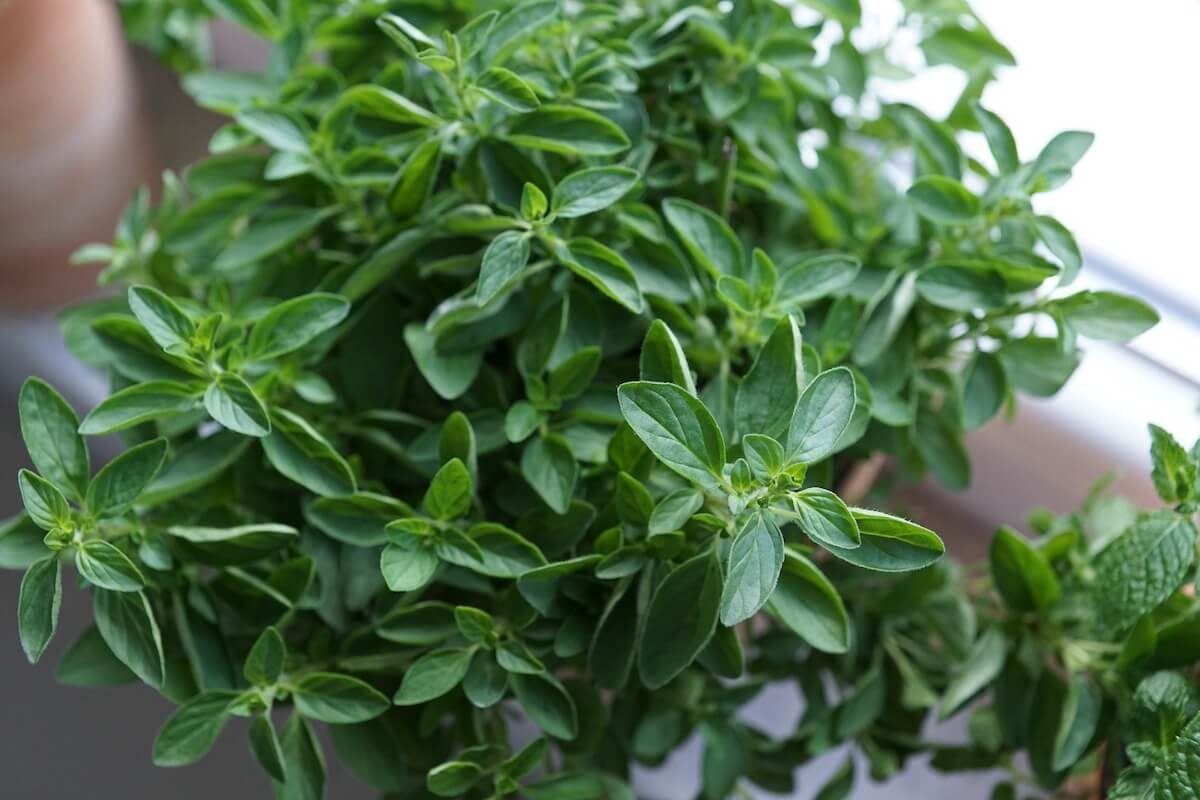
Oregano is Origanum vulgare, an aromatic perennial of the mint family (Lamiaceae).1 Its bite comes from two phenols, carvacrol and thymol, which together make up about 78 to 85 percent of the essential oil.2 Britannica calls it essential in Italian pizza and pasta sauces, Greek salads and gyros.1 Unlike most leafy herbs, it keeps well when dried: America’s Test Kitchen lists oregano among the dried herbs worth having in the pantry.3 The best substitute is the herb that shares the most of that chemistry and suits the dish you are making.
Quick answer
| What oregano is doing | Best substitute | Starting amount, per 1 part oregano | Treatment |
|---|---|---|---|
| Lead herb in tomato sauce, pizza or Greek dishes | Marjoram | 1 part, then up to 1 1/2 parts | Method |
| Same job, basil is what you have | Basil, fresh or dried | 1 part | Attributed |
| Mexican dishes, chili, beans | Mexican oregano | 3/4 part, then taste | Method |
| Background herb in a long-cooked stew or braise | Thyme | 1/2 part dried, 1 part fresh | Method |
| One herb among several | Italian seasoning | 1 part | Method |
| Recipe calls for fresh, you have dried (or the reverse) | The other form of oregano | 1 part dried per 3 parts fresh | Computed |
The rest of the page explains each choice.
How the ratios on this page are labeled
Every ratio carries one of four labels.
- Computed: based on a measurable physical relationship, such as converting dried herbs to fresh, with the source named.
- Attributed: a named source publishes this ratio. We quote it as theirs.
- Disputed: named sources give different answers to the same swap. We show each one and do not average them.
- Method: we found no published ratio. We give a direction and a cautious starting point, and say so.
No published study compares the flavor strength of oregano with any substitute. Apart from fresh-to-dried conversions, the ratios below are cooks’ rules of thumb.
If oregano is the lead herb in a tomato sauce, pizza or Greek dish
Here oregano is the herb you would name if asked. You want its warm, resinous bite more than a generic green note.
1. Marjoram
Marjoram (Origanum majorana) is in the same genus, and the names overlap: Britannica lists wild marjoram and European marjoram as other names for oregano.1 The Spice House says marjoram tastes the most similar to oregano.4 The chemistry explains both the likeness and the difference. A 2022 review describes two main types of marjoram oil, one led by terpinen-4-ol and cis-sabinene hydrate, which it links to marjoram’s sweet flavor, and one led by carvacrol and thymol, oregano’s own compounds.5 Most retail jars do not say which type they hold, so expect a sweeter, softer result.
The University of Delaware’s extension service puts marjoram and oregano in the same medium-strength group,6 and America’s Test Kitchen lists marjoram among the dried herbs worth keeping.3 For long simmering, Delaware advises adding herbs in the last 45 minutes.6
Ratio (Method): The Spice House calls marjoram a bit milder than oregano and suggests using more when substituting, without giving a number.4 We found no published ratio. Start with the same amount, taste near the end, and add up to half as much again.
2. Basil
The Spice House suggests basil for Greek or Mediterranean oregano, noting that basil is sweeter and oregano earthier.4 A Couple Cooks puts basil first and says it has an Italian character much like oregano.7 Its chemistry is different: PROSEA reports a French-type basil oil at 53.3 percent methyl chavicol and describes that oil’s aroma as sweet-spicy, slightly green and fresh,8 a different profile from oregano’s phenols. Basil suits tomato sauce and pizza; it is a weaker fit for Greek salads or grilled meats where oregano’s bite is the point.
Fresh basil is a delicate herb. ATK lists it among the herbs that are better fresh,3 and LSU AgCenter advises adding delicate herbs such as basil at the end of cooking.9
Ratio (Attributed): A Couple Cooks says to use equal parts of fresh or dried basil for fresh or dried oregano.7
3. Italian seasoning
The Spice House describes Italian seasoning as typically a blend of oregano, parsley, thyme and marjoram,4 and A Couple Cooks notes that it already contains oregano.7 For a tomato sauce or pizza it puts oregano back in, along with its usual companions.
Ratio (Method): No published ratio was found. Start with the same amount as the oregano and taste. Blends vary, so read the label: a blend heavy in rosemary or sage will taste stronger.
If oregano is seasoning Mexican food, chili or beans
1. Mexican oregano
Mexican oregano (Lippia graveolens) is from a different plant family, but America’s Test Kitchen tasted both in tomato sauce and in mojo-marinated skirt steak and noticed only minimal differences. Its tasters found the Mexican type stronger, with a hint of menthol, and the Mediterranean type milder and faintly sweeter.10 PROSEA likewise describes Mexican oregano as stronger, sharper and more pungent than Origanum, with an oil led by thymol (40 to 60 percent) rather than carvacrol.11
Ratio (Method): No published ratio was found for this direction. Because Mexican oregano is the stronger of the two, start with about three quarters of the oregano amount and taste. See Mexican oregano substitutes for the reverse swap.
2. Marjoram, thyme or sage
For chili, The Spice House suggests reaching for sage, marjoram or thyme.4 A Couple Cooks also recommends dried marjoram in place of dried oregano for Mexican-style dishes.7 Use the amounts given for each herb in the sections above and below.
If oregano is a background herb in a long-cooked dish
In a bean pot, stew or braise, oregano is one warm note among several and has time to soften. Hardy herbs do well here. ATK’s tests found that dried oregano, rosemary, sage and thyme fared reasonably well in dishes with fairly long cooking, more than 20 minutes, and a good amount of liquid.12
1. Thyme
Thyme is the closest match by chemistry. PROSEA names thymol and carvacrol as the characteristic constituents of thyme oil.13 In a 2023 study of eight thyme species, six oils were thymol-type, and the common thyme sample held 42.44 percent thymol.14 Oregano’s oil also runs on these two phenols, though it usually leads with carvacrol.2
Ratio (Method): No published ratio was found. A Couple Cooks would avoid swapping dried thyme for dried oregano because thyme has a much stronger flavor, and suggests thyme as a fresh substitute only.7 Fresh for fresh, start with the same amount. Dried for dried, start with about half and taste after 20 minutes of cooking.
2. Sage
PROSEA attributes sage’s strong characteristic smell to compounds called thujones, not to oregano’s phenols, and lists sausages, stuffings and soups among its uses.15 The University of Delaware puts sage among the strong, dominant herbs, with rosemary and bay, while oregano sits in the medium group.6 Sage works where its own flavor suits the dish, such as beans, pork or a hearty soup, but it will not taste like oregano.
Ratio (Method): No published ratio was found. Because sage is the stronger herb, start with about half the oregano amount. Dried sage is a reasonable choice here: ATK lists it among the dried herbs worth having.3
Other herbs sometimes suggested
The Spice House also lists parsley, tarragon and dill, and A Couple Cooks says a small handful of tarragon, dill or flat-leaf parsley could work in a pinch.47 None of these shares oregano’s phenols. In our judgment they add a fresh green note to a dish that needs something, not a replacement for oregano’s flavor.
Ratio (Method): No published ratio was found. Use them fresh, at the end of cooking, starting with the same amount as the oregano.
Fresh, dried and ground oregano
Fresh to dried (Computed): The sources agree on about 1 part dried to 3 parts fresh.
| Source | Fresh | Dried |
|---|---|---|
| America’s Test Kitchen, tasting test | 3 parts | 1 part12 |
| The Spice House (oregano) | 1 tablespoon | 1 teaspoon4 |
| A Couple Cooks (oregano) | 1 tablespoon | 1 teaspoon7 |
| NDSU Extension (herbs in general) | 1 tablespoon | 1 teaspoon16 |
| LSU AgCenter (herbs in general) | 1 tablespoon | 1 teaspoon9 |
| University of Delaware (herbs in general) | 2 to 3 teaspoons | 3/4 to 1 teaspoon6 |
ATK’s testing found that 1 part dried to 3 parts fresh came closest to equal strength,12 and ATK’s Danielle Lapierre advises using one third the amount when substituting dried herbs for fresh.3
Dried to ground (Disputed): For powdered herbs, the extension services differ by a factor of two.
| Source | 1 tablespoon fresh equals |
|---|---|
| NDSU Extension | 1/2 teaspoon ground16 |
| Penn State Extension | 1/4 teaspoon powdered17 |
Neither figure is specific to oregano. If you are using ground oregano in place of crumbled, start at the lower figure, 1/4 teaspoon per tablespoon of fresh, and add more to taste.
What isn’t known
- No published measurement compares oregano’s strength with marjoram, thyme, basil, sage or Mexican oregano. Every Method amount above is a starting point.
- How much carvacrol and thymol a particular jar holds depends on the plant, and the figures here describe essential oils, not retail dried leaf.25
- A widely repeated rule says to use three parts marjoram for every two parts oregano. We found no source for it.
- Claims that English and French thyme are the varieties to use in place of oregano could not be traced to a source.
Related
- Oregano, oregano uses, cooking with oregano and fresh vs. dried oregano
- Marjoram and marjoram vs. oregano
- Mexican oregano, Mexican oregano vs. oregano and Mexican oregano substitutes
- Thyme, oregano vs. thyme, basil, basil vs. oregano and sage
- Italian seasoning and good spices for pizza
- Too much oregano? How to fix the dish
Footnotes
-
Anoushka Pant, “Oregano”, Encyclopaedia Britannica, 2026. britannica.com · Reference work ↩ ↩2 ↩3
-
Lombrea et al., “A Recent Insight Regarding the Phytochemistry and Bioactivity of Origanum vulgare L. Essential Oil”, International Journal of Molecular Sciences, 2020. mdpi.com · Peer-reviewed ↩ ↩2 ↩3
-
Danielle Lapierre, “When You Should Actually Use Dried Herbs (and Which Ones to Avoid)”, America’s Test Kitchen, 2022. americastestkitchen.com · Publication ↩ ↩2 ↩3 ↩4 ↩5
-
“The 8 Best Oregano Substitutes”, The Spice House, 2018. thespicehouse.com · Merchant ↩ ↩2 ↩3 ↩4 ↩5 ↩6 ↩7
-
Kakouri et al., “Origanum majorana Essential Oil: A Review of Its Chemical Profile and Pesticide Activity”, Life, 2022. mdpi.com · Peer-reviewed ↩ ↩2
-
“Using Herbs and Spices”, University of Delaware Cooperative Extension, 2025. udel.edu · Reference work ↩ ↩2 ↩3 ↩4
-
Sonja Overhiser, “Best Oregano Substitute”, A Couple Cooks, 2026. acouplecooks.com · Publication ↩ ↩2 ↩3 ↩4 ↩5 ↩6 ↩7
-
N.O. Aguilar, Pham Truong Thi Tho and L.P.A. Oyen, Ocimum basilicum, Plant Resources of South-East Asia (PROSEA). uses.plantnet-project.org · Reference work ↩
-
“Flavorful Herbs”, LSU AgCenter. lsuagcenter.com · Reference work ↩ ↩2
-
“Oregano: Mediterranean and Mexican”, America’s Test Kitchen. americastestkitchen.com · Publication ↩
-
H.C. Ong and M. Brink, Lippia graveolens, Plant Resources of South-East Asia (PROSEA). uses.plantnet-project.org · Reference work ↩
-
“Science: Substituting Dried Herbs for Fresh”, America’s Test Kitchen. americastestkitchen.com · Publication ↩ ↩2 ↩3
-
S.H. Widodo, Thymus vulgaris, Plant Resources of South-East Asia (PROSEA). uses.plantnet-project.org · Reference work ↩
-
Dong et al., “Chemical Compositions of Essential Oil Extracted from Eight Thyme Species and Potential Biological Functions”, Plants, 2023. mdpi.com · Peer-reviewed ↩
-
U.A. Dasuki, Salvia officinalis, Plant Resources of South-East Asia (PROSEA). uses.plantnet-project.org · Reference work ↩
-
Julie Garden-Robinson, Ingredient Substitutions (FN198), NDSU Extension, 2018. ksre.ksu.edu · Reference work ↩ ↩2
-
Stacy Reed, “Preserving Herbs by Drying”, Penn State Extension, 2024. extension.psu.edu · Reference work ↩