Cooking · Dish guide
The Best Spices for Ham: Cloves, Mustard, Brown Sugar and the Glaze That Ties Them Together
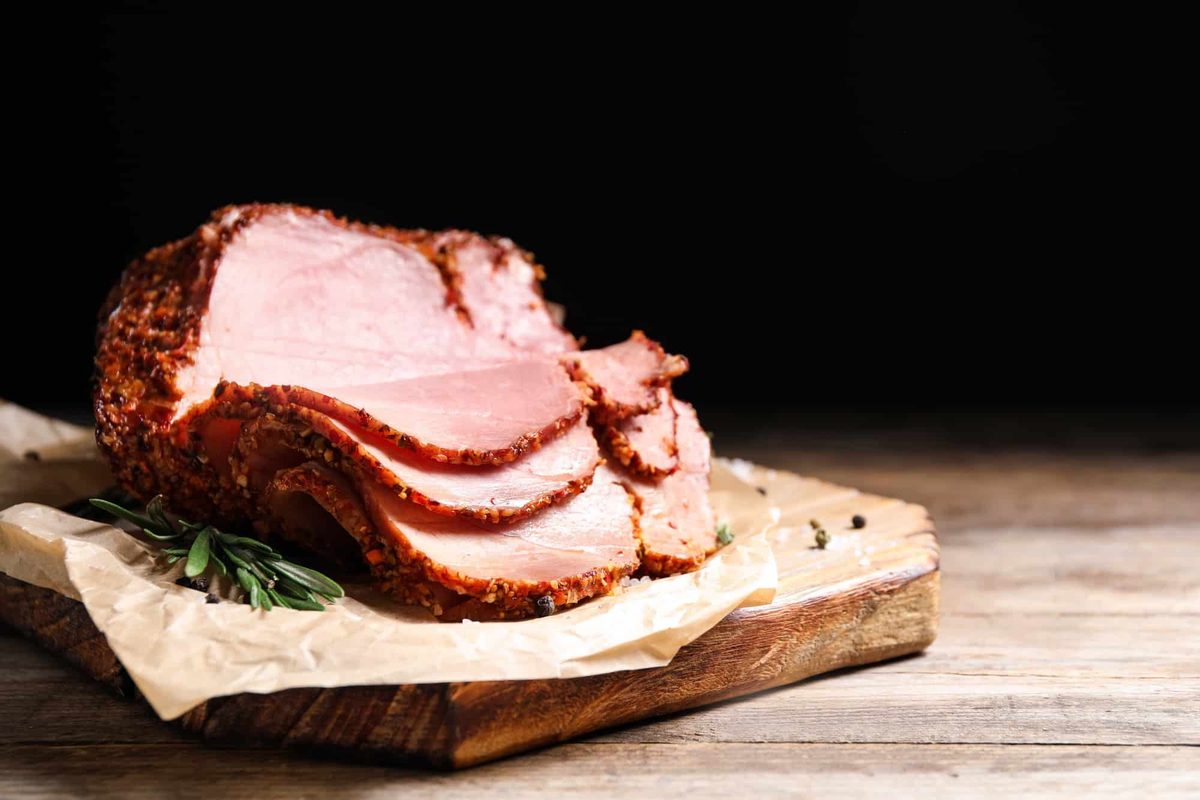
Most hams come already cured, and many come fully cooked, so the spices you add are mainly for the glaze and the surface. USDA FSIS defines ham as the cured leg of pork, and a fully cooked ham needs no further cooking.1 The classic seasonings are whole cloves studded into the fat, mustard, brown sugar or another sweetener, and warm spices such as allspice. This page covers what each one does, the glaze styles a named recipe offers side by side, and how hot a ham needs to get. Quantities appear only where a named recipe gives them.
At a glance
| Seasoning | Job on the ham | Notes |
|---|---|---|
| Cloves, whole | Aroma; decorative studding | ATK: used to stud holiday hams2 |
| Mustard (Dijon or dry) | Sharp, tangy contrast to the sugar | In most glazes in the Food Network recipe3 |
| Brown sugar | Sweetness; caramelizes in the oven | Mustard-orange glaze3 |
| Honey, maple syrup, fruit preserves | Alternative sweeteners | Other glaze options in the same recipe3 |
| Apple cider | Fruity base, reduced | Apple-maple glaze3 |
| Orange | Citrus aroma and juice | Mustard-orange glaze3 |
| Allspice | Warm spice | Apple-maple glaze3 |
| Chinese five-spice | Warm, anise-led blend | Hoisin-spice glaze3 |
| Horseradish | Sharp condiment on the side | Austrian Easter ham4 |
Know your ham first
How much you season, and how long you heat, depends on the type. FSIS’s definitions:1
| Type | What it is | Cook or reheat to |
|---|---|---|
| Fresh ham | Uncured leg of pork | 145°F, then rest at least 3 minutes15 |
| Cook-before-eating ham | Cured but not cooked at the plant | 145°F, then rest at least 3 minutes5 |
| Fully cooked ham, packaged in a USDA-inspected plant | Cooked at the plant | Reheat to 140°F; vacuum-packed whole or half hams and canned hams can also be eaten cold15 |
| Fully cooked ham, any other | Cooked but not packaged under USDA inspection | Reheat to 165°F15 |
| Country ham | Dry-cured; salty | FSIS suggests soaking 4 to 12 hours or longer in the refrigerator to cut the salt before cooking1 |
Dry curing produces a salty product, FSIS notes.1 That saltiness is why most ham seasonings are sweet or sharp rather than salty.
Spiral-cut cooked hams are safe to eat cold, and FSIS says they are best served that way, since heating a sliced ham can make the glaze melt and run off the meat.1
The classic ham spices
Cloves: studded into the fat
Cloves are the dried flower buds of Syzygium aromaticum, an evergreen tree whose native range Kew gives as Maluku (the Moluccas).678 Britannica describes them as strong in aroma and hot and pungent in taste, and notes they flavor many foods, particularly meats and baked goods.7 America’s Test Kitchen lists studding holiday hams among the uses for whole cloves.2
Studding works with scored fat. The Food Network Kitchen recipe scores the fat in a 1-inch crosshatch pattern, then pins orange slices to the ham with 1 or 2 cloves each.3 Pressing a clove into each intersection of the scored diamonds is the more common decorative version; that is kitchen practice. Ground cloves rubbed over the surface are an alternative, but ATK warns that ground cloves are potent and uses them sparingly.2 See ground vs. whole cloves, cooking with cloves and too much clove.
Mustard: the sharp half of the glaze
McCormick describes ground mustard’s taste as sharp, hot and slightly bitter, and lists a honey glazed ham among its recipes.9 Prepared mustard works too: the Food Network Kitchen mustard-orange glaze uses 1/2 cup Dijon, and its pineapple-apricot glaze uses 1/4 cup.3 McCormick says Dijon is the best substitute for ground mustard because they are similar in flavor.9 See mustard powder vs. prepared mustard and mustard powder uses.
Brown sugar and other sweeteners: the glaze
Brown sugar is the base of the mustard-orange glaze (3/4 cup packed light brown sugar, whisked with Dijon and orange juice), which is brushed on in stages until it caramelizes.3 The same recipe offers honey (3 tablespoons in a hoisin-spice glaze), maple syrup and apple jelly, and apricot preserves as other sweeteners.3 The sweet-against-salty logic is common practice rather than something these sources test.
Apple cider and orange
The apple-maple glaze starts from 2 cups of apple cider reduced to 1/2 cup.3 The mustard-orange version uses a whole orange, sliced and pinned to the ham, plus the juice of two more.3 Orange zest is a reasonable addition to any glaze, but none of the sources we opened specifies it.
Allspice and other warm spices
Allspice is named for a flavor that resembles cinnamon, cloves and nutmeg combined.10 It is the defining spice of Jamaican jerk, alongside Scotch bonnet pepper.11 In the Food Network apple-maple ham glaze, 1/2 teaspoon allspice joins nutmeg and whole-grain mustard.3 The hoisin-spice glaze uses 2 teaspoons of five-spice powder, toasted in oil first.3 See allspice vs. cloves and too much allspice.
Glaze styles side by side
All four come from one named recipe, Food Network Kitchen’s Mustard-Orange Glazed Ham, written for a 10- to 12-pound fully cooked bone-in half ham.3
| Glaze | Sweet | Sharp or sour | Spice |
|---|---|---|---|
| Mustard-orange | 3/4 cup light brown sugar | 1/2 cup Dijon; juice of 2 oranges | Whole cloves to pin orange slices |
| Apple-maple | 1/2 cup maple syrup, 1/2 cup apple jelly, cider | 1/4 cup whole-grain mustard | 1/2 tsp allspice, 1/4 tsp nutmeg |
| Hoisin-spice | 1 cup hoisin, 3 tbsp honey | 3 tbsp rice vinegar, 1 tbsp soy sauce | 2 tsp five-spice powder |
| Pineapple-apricot | 1 cup apricot preserves, 2 cups pineapple juice | 1/4 cup Dijon; lime zest and juice | 8 thin slices ginger |
The recipe brushes the glaze on during the last stretch of baking and stops when the glaze is caramelized and the ham registers 140°F,3 which matches FSIS’s reheating temperature for a plant-packaged cooked ham.5
Beyond the glaze
In Austria, Katzer notes, cured ham with horseradish is a traditional Easter meal.4 See horseradish and Christmas spices.
Related
- Spices for pork and best spices for ribs
- Spices for turkey
- Allspice vs. cloves
- The master list of herbs and spices
Footnotes
-
“Hams and Food Safety”, USDA Food Safety and Inspection Service. fsis.usda.gov · Regulator ↩ ↩2 ↩3 ↩4 ↩5 ↩6 ↩7 ↩8
-
“Getting to Know: Baking Spices”, America’s Test Kitchen. americastestkitchen.com · Publication ↩ ↩2 ↩3
-
“Mustard-Orange Glazed Ham”, Food Network Kitchen, Food Network Magazine. foodnetwork.com · Publication ↩ ↩2 ↩3 ↩4 ↩5 ↩6 ↩7 ↩8 ↩9 ↩10 ↩11 ↩12 ↩13 ↩14 ↩15 ↩16 ↩17
-
“Horseradish”, Gernot Katzer’s Spice Pages. gernot-katzers-spice-pages.com · Reference work ↩ ↩2
-
“Safe Minimum Internal Temperature Chart”, USDA Food Safety and Inspection Service, 2025. fsis.usda.gov · Regulator ↩ ↩2 ↩3 ↩4 ↩5
-
“Syzygium aromaticum (L.) Merr. & L.M.Perry”, Plants of the World Online, Royal Botanic Gardens, Kew. powo.science.kew.org · Reference work ↩
-
“Clove”, Encyclopaedia Britannica. britannica.com · Reference work ↩ ↩2
-
E.W.M. Verheij and C.H.A. Snijders, “Syzygium aromaticum”, PROSEA. uses.plantnet-project.org · Reference work ↩
-
“About Ground Mustard: Uses, Pairings and Substitutes”, McCormick. mccormick.com · Merchant ↩ ↩2
-
“Allspice”, Encyclopaedia Britannica. britannica.com · Reference work ↩
-
Vaughn Stafford Gray, “A Brief History of Jamaican Jerk”, Smithsonian Magazine, 2020. smithsonianmag.com · Publication ↩