Spice Substitutes · Substitutes
Celtic Salt Substitutes, with Teaspoon Conversions by Weight and Sodium
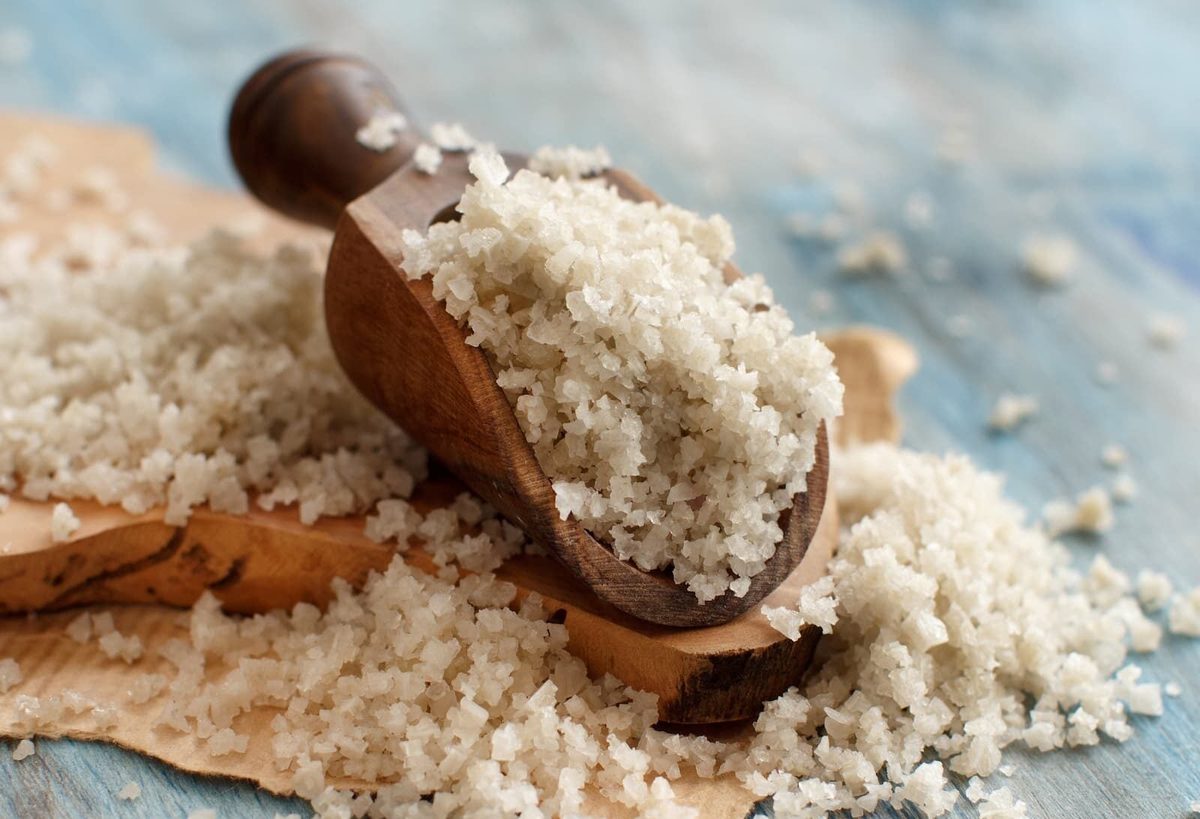
“Celtic salt” usually means Celtic Sea Salt, a brand founded in 1976.1 Its Light Grey Celtic is a coarse gray sea salt, and the brand says natural brine stays in its salt, which keeps it moist.23 The French call this style sel gris, gray salt. In Guérande, on France’s Atlantic coast, the official specification describes gray salt crystallizing on the clay bottom of the salt pans and taking its color from fine clay particles; it may hold up to 12 percent moisture.4 What replaces it depends on whether you want its crunch on top of food or its saltiness inside it.
Quick answer
| What Celtic salt is doing | Best substitute | Starting amount, per 1 teaspoon Light Grey Celtic | Treatment |
|---|---|---|---|
| Finishing: crystals on steak, vegetables, salads | Fleur de sel, or Maldon flakes | By the pinch, to taste | Method |
| Seasoning while cooking | Table salt or fine sea salt | 1 teaspoon by weight; a scant teaspoon by sodium | Computed |
| Seasoning while cooking, with kosher salt | Morton kosher | 1 to 1¼ teaspoons | Disputed |
| Seasoning while cooking, with kosher salt | Diamond Crystal kosher | About 2 teaspoons | Disputed |
| A specialty salt with color | Coarse Himalayan pink salt | 1 teaspoon by weight | Computed |
How the ratios on this page are labeled
- Computed: based on a measurable physical relationship, with the source named.
- Attributed: a named source publishes this ratio. We quote it as theirs.
- Disputed: named sources give different answers to the same swap. We show each one and do not average them.
- Method: we found no published ratio. We give a direction and a cautious starting point, and say so.
The gram figures for Celtic salt below come from the brand’s own Nutrition Facts panel, not from an independent measurement. They apply to Light Grey Celtic, not to every gray salt.
If Celtic salt is finishing a dish
Here the job is texture: large, slightly damp crystals that stay whole on the surface. America’s Test Kitchen recommends sea salts as finishing salts, scattered on food just before serving.5 ATK also found that sea salts vary in color but only slightly in flavor.5
1. Fleur de sel
Fleur de sel is the other salt from the same pans. The Guérande specification describes it forming as crystals floating in sheets on the surface of the pans, skimmed off by hand, while gray salt forms on the clay bottom and is harvested separately.4 Because it never touches the clay, the specification allows it far less insoluble matter: under 0.20 percent, against up to 1 percent for gray salt.4 Expect a whiter, cleaner-looking crystal without the gray color.
Ratio (Method): No published weight per teaspoon was found for fleur de sel. Use it by the pinch and taste.
2. Maldon sea salt
Maldon gives crunch in a different shape. It is made in Maldon, a town in Essex in southeastern England.6 Its maker collects seawater according to the lunar cycle and brings it to “a galloping boil,” and the flat pyramid crystals form at the water’s surface, shaped by surface tension.7 Those thin flakes break more easily than gray salt’s chunky crystals. That last point is our observation.
Ratio (Method): No credible gram figure per teaspoon exists for flake salt that we found. Use it by the pinch.
If Celtic salt is seasoning while you cook
Once salt dissolves into a soup, a sauce or pasta water, its crystal shape no longer matters. America’s Test Kitchen notes that salt in its most basic form is sodium chloride whatever its source, and that sea salt tastes no different from table salt once mixed into food.5 What matters is how much salt is in the spoon.
How much salt is in a teaspoon
Light Grey Celtic’s label gives a serving of ¼ teaspoon as 1.5 grams, with 480 mg of sodium.2 That works out to 6.0 grams and 1,920 mg of sodium per teaspoon (our arithmetic).
By weight, that is the same as table salt. ATK weighs a teaspoon of table salt at about 6 grams, and Morton’s iodized table salt label also gives 1.5 grams per ¼ teaspoon.89 By sodium it is lower: 480 mg in 1.5 grams is about 32 percent sodium, while the American Heart Association says table salt, kosher salt and most sea salts are about 40 percent sodium.210 The label does not explain the gap. Moisture is one possible reason, since the brand says brine stays in its salt,3 but we found no analysis that confirms it.
That leaves two reasonable ways to convert, and they give different answers. Matching weight puts the same number of grams of salt crystals in the pot. Matching sodium puts in the same amount of sodium. We show both.
| Swap for 1 teaspoon Light Grey Celtic | Match by weight | Match by sodium | Sources |
|---|---|---|---|
| Table salt | 1 teaspoon (6.0 g ÷ 6.0 g) | About ⅘ teaspoon (1,920 mg ÷ 2,325 mg) | 8911 |
| Morton fine sea salt | About 1 teaspoon (label: 1.4 g per ¼ teaspoon) | No sodium figure retrieved | 12 |
| Morton kosher salt | 1¼ teaspoons (6.0 g ÷ 4.8 g) | 1 teaspoon (label: 480 mg per ¼ teaspoon, the same as Light Grey Celtic) | 813 |
| Diamond Crystal kosher salt | About 2⅛ teaspoons (6.0 g ÷ 2.8 g) | No sodium figure retrieved | 8 |
| Morton coarse Himalayan pink salt | 1 teaspoon (label: 1.5 g per ¼ teaspoon) | About ⅚ teaspoon (label: 570 mg per ¼ teaspoon) | 14 |
| Fleur de sel, Maldon | No published gram figure | No published figure |
The table-salt sodium figure is Tufts’ general number for a teaspoon of table salt, not a specific brand.11 All the other figures come from manufacturers’ labels and from ATK’s weighings.
The kosher salt conversions disagree
Because Light Grey Celtic weighs the same per teaspoon as table salt, converting it to kosher salt runs into a well-known disagreement among the sources on table salt itself:
| Swap for 1 teaspoon table salt | Morton kosher | Diamond Crystal | Source |
|---|---|---|---|
| ATK’s rule of thumb | 1½ teaspoons | 2 teaspoons | 515 |
| Morton’s conversion chart (Morton products only) | 1¼ teaspoons | not covered | 16 |
| Computed from ATK’s gram weights (6.0 ÷ 4.8 and 6.0 ÷ 2.8) | 1¼ teaspoons | about 2⅛ teaspoons | 8 |
ATK’s own weights match Morton’s chart, not ATK’s rule of thumb.816 We publish the disagreement rather than pick a figure.
Ratio (Disputed, with a Method starting point): For Morton kosher, start with 1 teaspoon per teaspoon of Light Grey Celtic, the sodium match and the lowest figure, and taste before adding the next ¼ teaspoon. For Diamond Crystal, start at 2 teaspoons, the lowest of the figures above. If a recipe gives salt in grams, weigh it; ATK recommends weighing salt rather than measuring by volume.15
If you want a specialty salt with character
Himalayan pink salt
Commercial Himalayan pink salt comes from Pakistan, where the state-owned Pakistan Mineral Development Corporation runs the Khewra mine.1718 It is rock salt, laid down by ancient seas roughly 250 million years ago.19 Its pink color comes from traces of iron oxide.17 It is no mineral supplement: a 2020 analysis of pink salts sold in Australia found that a 5-gram serving made no clinically significant contribution to nutrient intake.17
Ratio (Computed): By weight, one for one: Morton’s coarse Himalayan label gives the same 1.5 grams per ¼ teaspoon as Light Grey Celtic.14 Morton’s chart also treats a teaspoon of its Himalayan salt as equal to a teaspoon of table salt.16 Its label sodium is higher, so by sodium you would use a little less (see the table above).
Notes for every swap
- Iodine. None of these salts is a reliable iodine source unless the label says iodized. The NIH Office of Dietary Supplements lists sea salt, kosher salt, Himalayan salt and fleur de sel among specialty salts that are not usually iodized.20 Celtic Sea Salt says it adds no iodine.3
- Sodium. Swapping salts does not lower sodium unless you use less. A sea salt can carry less sodium per teaspoon simply because fewer large crystals fit in the spoon.10 The FDA’s Daily Value for sodium is less than 2,300 mg a day.21
- Moisture. No substitute reproduces gray salt’s dampness. If a recipe depends on it, for example a salt crust, use the gray salt the recipe was written for.
What isn’t known
- No independent weight-per-teaspoon measurement of Light Grey Celtic was found. The 1.5-gram figure is the brand’s label. A finer or drier grind would differ.
- The brand’s label sodium (about 32 percent of weight) is lower than the roughly 40 percent typical of salt.210 We found no analysis explaining why.
- No credible gram-per-teaspoon figure exists for fleur de sel or Maldon flakes, as far as we found.
- A widely repeated figure says about 3 pounds of fleur de sel are harvested for every 80 pounds of gray salt. We found no source for it.
Related
- Celtic sea salt, Celtic sea salt vs. table salt and Celtic salt vs. Himalayan salt
- Fleur de sel, fleur de sel substitutes and Maldon sea salt
- Kosher salt, kosher salt substitutes and kosher salt vs. table salt
- Himalayan salt, sea salt and table salt
- The best salt for cooking, iodized vs. non-iodized salt and too much salt
Footnotes
-
About Celtic Sea Salt, Celtic Sea Salt (Selina Naturally). celticseasalt.com · Merchant ↩
-
Light Grey Celtic, product page, Celtic Sea Salt (Selina Naturally). celticseasalt.com · Merchant ↩ ↩2 ↩3 ↩4
-
FAQs, Celtic Sea Salt (Selina Naturally). celticseasalt.com · Merchant ↩ ↩2 ↩3
-
Cahier des charges de l’IGP Sel de Guérande / Fleur de sel de Guérande, French Ministry of Agriculture, 2025. info.agriculture.gouv.fr · Regulator ↩ ↩2 ↩3
-
Salt Types and Measurements, America’s Test Kitchen. americastestkitchen.com · Publication ↩ ↩2 ↩3 ↩4
-
Pletcher, Maldon, Encyclopaedia Britannica. britannica.com · Reference work ↩
-
Finney, Clear as crystal: the decades-old traditions of Maldon sea salt, Foodism, 2018. foodism.co.uk · Publication ↩
-
Levine, The Best Kosher Salt, America’s Test Kitchen, 2019. americastestkitchen.com · Publication ↩ ↩2 ↩3 ↩4 ↩5 ↩6
-
Morton Iodized Table Salt, product page, Morton Salt. mortonsalt.com · Merchant ↩ ↩2
-
Sodium Sources: Where Does All That Sodium Come From?, American Heart Association, 2025. heart.org · Reference work ↩ ↩2 ↩3
-
Tufts Health & Nutrition Letter, kosher salt Q&A, 2019. nutritionletter.tufts.edu · Publication ↩ ↩2
-
Morton Fine Sea Salt, product page, Morton Salt. mortonsalt.com · Merchant ↩
-
Morton Kosher Salt Flakes, product page, Morton Salt. mortonsalt.com · Merchant ↩
-
Morton Coarse Himalayan Pink Salt, product page, Morton Salt. mortonsalt.com · Merchant ↩ ↩2
-
Faithfull, The Wrong Brand of Kosher Salt Could Ruin Your Dinner, America’s Test Kitchen, 2022. americastestkitchen.com · Publication ↩ ↩2
-
Salt Conversion Chart, Morton Salt. mortonsalt.com · Merchant ↩ ↩2 ↩3
-
Fayet-Moore et al., An Analysis of the Mineral Composition of Pink Salt Available in Australia, Foods, 2020. mdpi.com · Peer-reviewed ↩ ↩2 ↩3
-
Pakistan Mineral Development Corporation. pmdc.gov.pk · Regulator ↩
-
Hall, Pink Himalayan Sea Salt: An Update, Science-Based Medicine, 2017. sciencebasedmedicine.org · Publication ↩
-
Iodine: Fact Sheet for Health Professionals, NIH Office of Dietary Supplements. ods.od.nih.gov · Regulator ↩
-
Sodium in Your Diet, U.S. Food and Drug Administration. fda.gov · Regulator ↩