Spice Comparisons · Comparison
Coriander vs. Parsley: Seed Spice, Leaf Herb, Same Plant Family
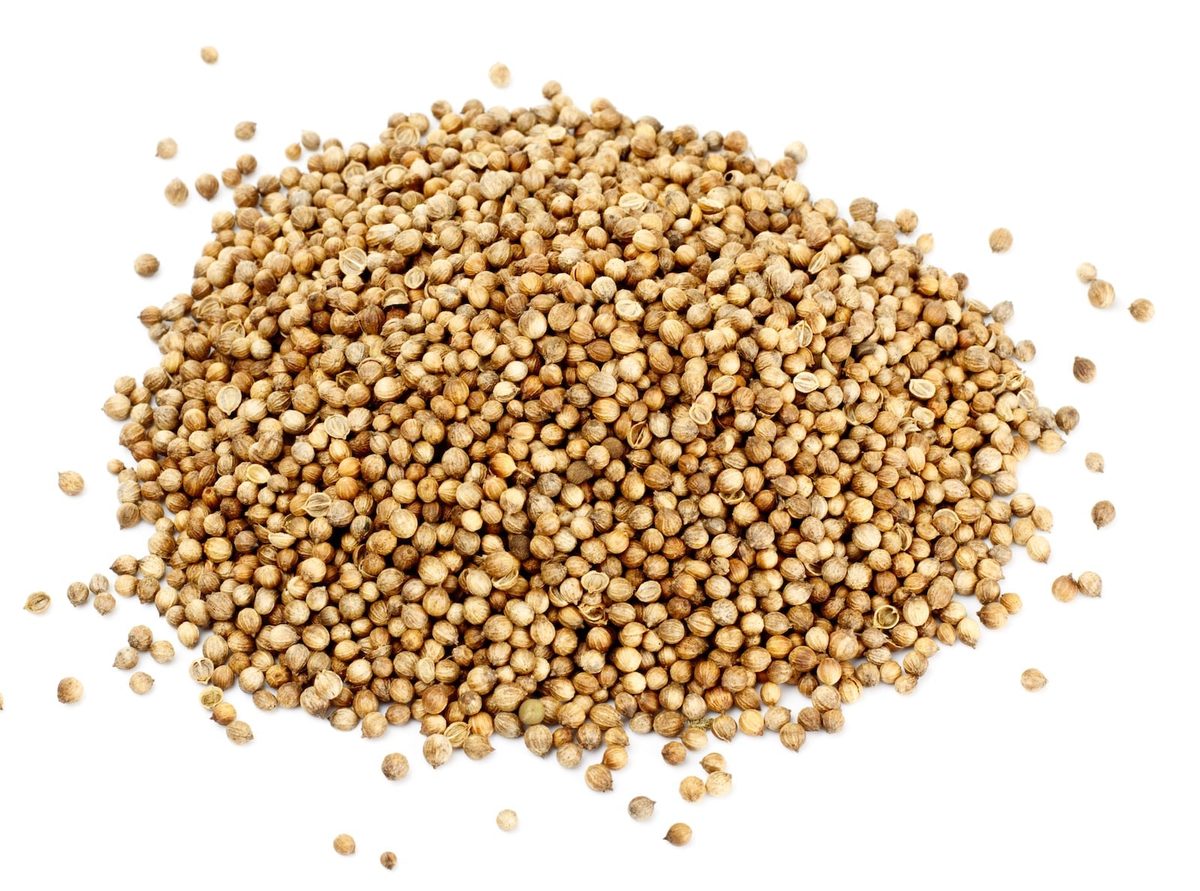
“Coriander” names a whole plant, Coriandrum sativum, which gives cooks both an herb and a spice.1 Oxford’s learner’s dictionary labels “cilantro,” the word for the leaves, as North American English,2 and defines coriander as a plant whose leaves are used as an herb.3 So in a British recipe “coriander” may mean the leaves, while an American recipe usually says “cilantro” for those and “coriander” for the seed. This page compares coriander seed with parsley. For the leaf against parsley, see cilantro vs. parsley.
Coriander and parsley are relatives: both belong to the carrot or parsley family, Apiaceae.14 In the kitchen they do different jobs. Coriander seed is a dried fruit whose oil is mostly linalool,56 used as a warm background spice. Parsley is a fresh leaf with very little oil, used for green, fresh flavor and color.47
Side by side
| Coriander seed | Parsley | |
|---|---|---|
| Species | Coriandrum sativum8 | Petroselinum crispum9 |
| Family | Apiaceae1 | Apiaceae4 |
| Native range | Eastern Mediterranean to western Pakistan8 | Northwest Africa and the Balkan Peninsula (Kew);9 Mediterranean lands (Britannica)4 |
| Part used | The dried fruit, an ovoid to round schizocarp up to 5 mm across5 | The leaves; flat-leaved and curly-leaved types, plus a root type7 |
| Essential oil | 0.18 to 1.40% of the seed (2023 review)6 | Less than 0.5% of the plant (Britannica);4 0.07 to 0.15% of fresh curly herb and 0.04% of flat-leaf (PROSEA)7 |
| Main oil compounds | Linalool, always the main component (PROSEA);5 60 to 80% (2023 review)6 | Leaf oil: 1,3,8-p-menthatriene about 20%, with myristicin 32% (curly) or 9.1% (flat)7 |
| Flavor | Mild, sweet, warm and aromatic (2023 review)6 | Warm, slightly burning and bitter oil (PROSEA);7 editorially, green and fresh |
| Forms | Whole seed, ground seed10 | Fresh leaves, dried flakes |
| Typical uses | Curry powder (up to 40% coriander, per PROSEA);5 pickles, baked goods, soups and sausages11 | Fish, meats, soups, sauces and salads;4 garnish7 |
| When to add | Usually early, as part of a spice base (common practice) | At the end; LSU groups parsley with delicate herbs12 |
| Safety note | No regulator concern found at food amounts | Steady intake matters for people on warfarin (see below)13 |
The oil rows describe different plant parts measured in different ways (seed by weight, fresh leaf by weight), so they are not a strength comparison. They do show that the two plants smell of different compounds.
The differences that change a dish
A seed and a leaf
The most practical difference is the part of the plant. Coriander seed is a hard, dry fruit that keeps well: PROSEA says whole dried fruits keep their oil for several years without loss.5 Parsley is a tender leaf. LSU AgCenter lists it among the delicate herbs that are best added in the last minute or two of cooking, since prolonged heat costs them flavor and aroma.12 So coriander usually goes in early with the other dry spices, and parsley goes in at the end or raw.
Flat-leaf or curly
PROSEA describes three parsley groups: curly-leaved, flat-leaved and turnip-rooted.7 Flat-leaved parsley is the stronger-flavored type, and the fresh leaves of curly cultivars are commonly used for garnishing and seasoning.7 That supports the usual kitchen advice: flat-leaf where flavor matters, curly where looks matter most. See Italian parsley vs. curly parsley.
Where each one belongs
- Coriander seed. PROSEA says the fruits are part of a large number of dishes and that curry powder can contain up to 40% coriander.5 Wisconsin’s extension notes the seeds go whole or ground into cookies, baked goods, soups, casseroles and sausages, and that Arabic cooking uses both the leaves and the seeds in pickles, curries and chutneys.11 Its use in barbecue rubs is common practice rather than anything a source documents.
- Parsley. Britannica says parsley is popular with fish, meats, soups, sauces and salads.4 By common practice, flat-leaf parsley leads in chimichurri, gremolata and tabbouleh, and curly parsley is the classic plate garnish.
Safety
Parsley is on MedlinePlus’s list of vitamin K foods for people taking warfarin. The advice is not to avoid it but to keep the amount steady from day to day.13 Britannica warns that parsley seed oil, or large amounts of other parsley preparations, can cause dangerous reactions;4 that concerns concentrated products, not parsley used as an herb. We found no regulator concern about coriander seed at food amounts.
Can one stand in for the other?
Not really, and no source we found gives a ratio in either direction (Method). They are different parts of different plants doing different jobs.
- Coriander seed in place of parsley. A dry, warm spice will not give a fresh green finish. If parsley is missing, other fresh herbs are the answer; see parsley substitutes.
- Parsley in place of coriander seed. Parsley will not supply coriander’s warm, linalool-led aroma.6 The better options are other seeds, such as cumin or caraway, covered on coriander substitutes.
- If the recipe meant the leaf. Cilantro and flat-leaf parsley do overlap as garnishes. Our cilantro vs. parsley page gives Method starting points: flat-leaf parsley at the same amount in place of cilantro, and cilantro at about half the amount in place of parsley.
If you grind coriander yourself, McCormick gives 1 teaspoon of seeds as equal to 1 1/4 teaspoons ground (Computed, by volume).10
What isn’t known
- No sensory study compares coriander seed with parsley; descriptions beyond the cited ones are editorial.
- No published ratio exists for swapping coriander seed and parsley in either direction.
- The oil figures come from different references and plant parts and cannot be lined up as a strength comparison.
Related
- Coriander and parsley, the full profiles
- Coriander substitutes and parsley substitutes
- Cilantro vs. parsley and coriander vs. cilantro
- Italian parsley vs. curly parsley, fresh parsley vs. dried
- Coriander vs. cumin, chervil vs. parsley, oregano vs. parsley
- Cooking with coriander, too much coriander, too much parsley
Footnotes
-
“Coriander”, Encyclopaedia Britannica. britannica.com · Reference work ↩ ↩2 ↩3
-
“cilantro”, Oxford Learner’s Dictionaries. oxfordlearnersdictionaries.com · Reference work ↩
-
“coriander”, Oxford Learner’s Dictionaries. oxfordlearnersdictionaries.com · Reference work ↩
-
“Parsley”, Encyclopaedia Britannica. britannica.com · Reference work ↩ ↩2 ↩3 ↩4 ↩5 ↩6 ↩7 ↩8
-
Coriandrum sativum, Plant Resources of South-East Asia (PROSEA). uses.plantnet-project.org · Reference work ↩ ↩2 ↩3 ↩4 ↩5 ↩6
-
Al-Khayri et al., “Essential Oil from Coriandrum sativum: A Review on Its Phytochemistry and Biological Activity”, Molecules, 2023. mdpi.com · Peer-reviewed ↩ ↩2 ↩3 ↩4 ↩5
-
I.B. Ipor and L.P.A. Oyen, Petroselinum crispum, Plant Resources of South-East Asia (PROSEA). uses.plantnet-project.org · Reference work ↩ ↩2 ↩3 ↩4 ↩5 ↩6 ↩7 ↩8
-
Coriandrum sativum L., Plants of the World Online, Royal Botanic Gardens, Kew. powo.science.kew.org · Reference work ↩ ↩2
-
Petroselinum crispum, Plants of the World Online, Royal Botanic Gardens, Kew. powo.science.kew.org · Reference work ↩ ↩2
-
“How to Grind Your Own Spices”, McCormick, 2025. mccormick.com · Merchant ↩ ↩2
-
Susan Mahr, “Cilantro”, Wisconsin Master Gardener Program, University of Wisconsin-Madison Extension, 2017. mastergardener.extension.wisc.edu · Reference work ↩ ↩2
-
“Flavorful Herbs”, LSU AgCenter. lsuagcenter.com · Reference work ↩ ↩2
-
“Taking warfarin”, MedlinePlus, U.S. National Library of Medicine. medlineplus.gov · Regulator ↩ ↩2