Spice Substitutes · Substitutes
Creole Seasoning Substitutes: Homemade, Cajun and What to Use Without Either
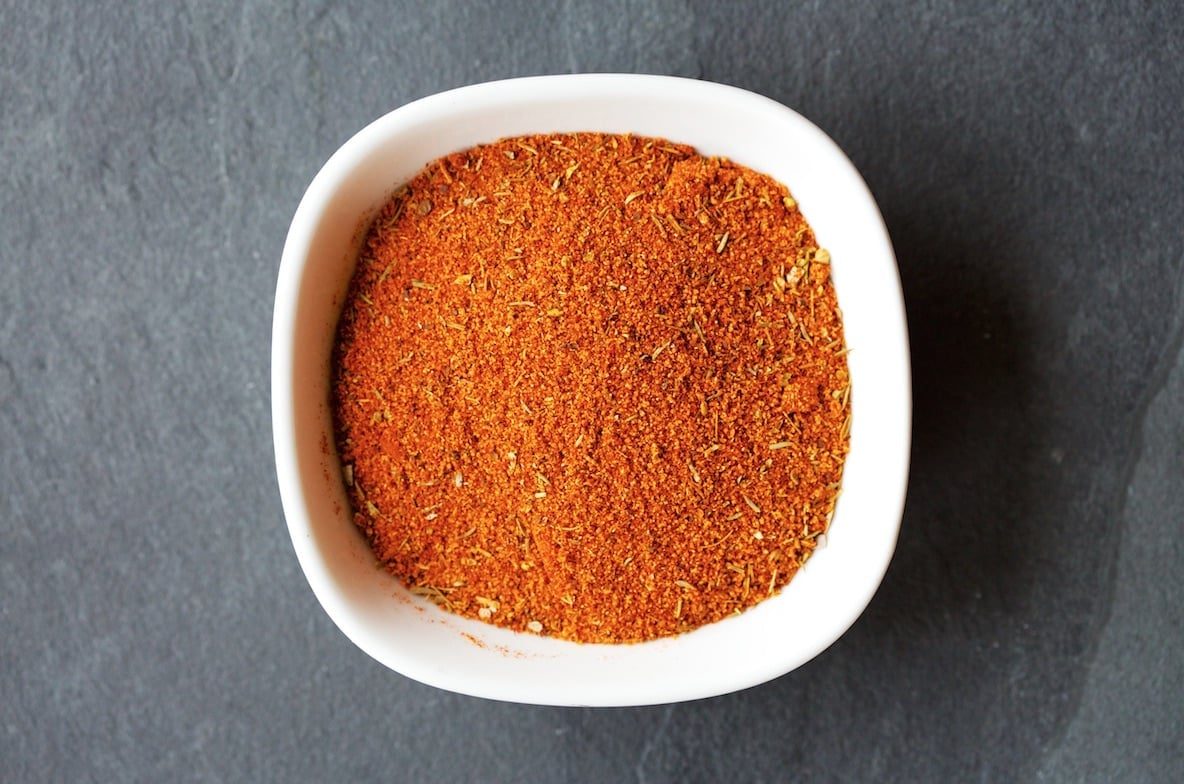
Creole seasoning is a ground blend from Louisiana with no fixed recipe. Cook’s Country, which tests Cajun and Creole seasonings as one category, found that most commercial blends combine paprika, garlic, salt and pepper with some heat from cayenne or red pepper, and that some add dried thyme or oregano.1 The best-known jar, Tony Chachere’s Original, lists salt first.2 A substitute has to cover four jobs: salt, garlic and pepper, chile heat, and, in paprika- and herb-led blends, color and a savory herb note.
Quick answer
| What Creole seasoning is doing | Best substitute | Starting amount, per 1 part Creole seasoning | Treatment |
|---|---|---|---|
| All-round seasoning for jambalaya, sauce piquant, shrimp or a rub | Homemade Louisiana seasoning | 1 part, then salt to taste | Attributed (formula), Method (amount) |
| The same, from a jar | Cajun seasoning | 1 part for a salt-first blend; for a lower-salt blend, 1 part plus about 1/3 part table salt | Attributed (interchangeable), Computed (salt) |
| Salt, garlic and herbs, with no Louisiana blend on hand | Greek seasoning, plus paprika and cayenne | 1 part, plus a pinch of each, then salt to taste | Computed (salt), Method (heat, color) |
| Salt and garlic | Adobo seasoning, plus paprika and cayenne | About 2/3 part, plus a pinch of each | Computed (salt), Method (heat, color) |
| Chile color and warmth | Chili powder, plus salt | 1 part, plus about 1/2 part table salt | Method (spice), Computed (salt) |
How the ratios on this page are labeled
Every ratio carries one of four labels.
- Computed: based on a measurable physical relationship, with the source named.
- Attributed: a named source publishes this ratio. We quote it as theirs.
- Disputed: named sources give different answers to the same swap. We show each one and do not average them.
- Method: we found no published ratio. We give a direction and a cautious starting point, and say so.
The Computed figures here cover salt only. They are arithmetic from the sodium printed on Nutrition Facts labels, so they apply to the products named. We found no credible published ratio for replacing Creole seasoning with any other blend, and no published heat measurement for any Creole blend.
What you are replacing
| Blend | Ingredients, in order given | Sodium per 1/4 tsp | Source |
|---|---|---|---|
| Tony Chachere’s Original Creole Seasoning | Salt, red pepper, black pepper, chili powder (chili pepper, spices, salt, garlic powder), dehydrated garlic, silicon dioxide | 340 mg | 2 |
| Cook’s Country homemade Louisiana seasoning | 5 tbsp paprika; 2 tbsp garlic powder; 1 tbsp each dried thyme, cayenne, celery salt, salt and black pepper | Not given | 1 |
| USDA purchasing specification, Creole minimum list | Salt, paprika, granulated garlic, cayenne pepper, ground black pepper, mustard, fresh lemon peel | Not specified | 3 |
The jar is led by salt and the homemade version by paprika.12 Check which kind your recipe was written for. A recipe built around a salt-first blend may not tell you to add salt separately.
The flavors come from familiar sources. Chile heat comes from capsaicinoids,4 paprika’s red color mainly from capsanthin and capsorubin,5 and thyme’s character from thymol and carvacrol, the characteristic constituents of its oil.6 Oregano’s oil is dominated by the same two compounds, carvacrol and thymol, at about 78 to 85 percent in one review,7 which is why oregano and thyme can stand in for each other in a Creole-style blend.
If you want the closest overall match
1. Make your own
Every ingredient in a Creole blend is a standard pantry spice, so a homemade blend comes closest.
Formula (Attributed): Cook’s Country’s Louisiana seasoning, offered for both Cajun and Creole cooking, uses 5 tablespoons paprika, 2 tablespoons garlic powder, and 1 tablespoon each of dried thyme, cayenne pepper, celery salt, salt and pepper. It makes about 3/4 cup and keeps for a few months.1 Cook’s Country suggests it for chicken jambalaya, chicken sauce piquant and pork grillades.1
Amount (Method): Cook’s Country gives no swap ratio. Its blend is led by paprika: by our arithmetic, plain salt is 1 of about 12 tablespoons, plus a tablespoon of celery salt.1 A salt-first jar like Tony Chachere’s will be saltier spoon for spoon.2 Use the homemade blend 1:1 for flavor, then taste and add salt.
The USDA’s purchasing specification, written for government buyers rather than home cooks, lists mustard and fresh lemon peel in its Creole minimum but not in its Cajun one.3 If you want that difference in a homemade blend, a little dry mustard and grated lemon zest are the place to start. That is our reading of the specification, not a tested recipe.
2. Cajun seasoning
Cajun and Creole name different people and, in Louisiana, different cooking. “Cajun” comes from les Acadiens.8 Britannica describes Cajuns as descendants of French Canadians whom the British drove from the captured colony of Acadia in the 18th century, and who settled in the bayou country of southern Louisiana.9 Creole originally referred to people born in the colony to French and Spanish settler families, and the state tourism office’s guide calls Creole cooking “city food” centered on New Orleans and Cajun cooking “country food.”8
On the spice shelf the line is thin. Cook’s Country tests the two seasonings as one category.1 Slap Ya Mama Original Cajun lists salt, black pepper, red pepper and granulated garlic,10 close to Tony Chachere’s Creole.2 Tasting Table, citing MasterClass, says the two can be used interchangeably, with Cajun the spicier and Creole the more earthy.11 The same guide says Cajun food is well seasoned rather than necessarily hot: cayenne “is seasoning, not the main event.”8
Ratio (Attributed, with Computed salt): Tasting Table treats the two as interchangeable but gives no figure.11 Salt decides the amount:
| Cajun blend | Sodium per 1/4 tsp | A 1:1 swap for Tony Chachere’s gives | Adjustment | Source |
|---|---|---|---|---|
| Slap Ya Mama Original | 310 mg | About 91% of the sodium | None needed | 210 |
| McCormick Signature Seasonings Cajun | 160 mg | About 47% of the sodium | Add about 1/3 tsp table salt per teaspoon of Cajun seasoning | 21213 |
The 1/3 teaspoon is arithmetic: a teaspoon of Tony Chachere’s carries about 1,360 mg of sodium and a teaspoon of McCormick Signature about 640 mg, and Morton lists its table salt at 590 mg per quarter teaspoon.21213 If your recipe was written for a paprika-led homemade Creole blend, skip the extra salt.
If you have no Louisiana blend at all
Greek seasoning, with paprika and cayenne
Greek seasoning shares the salt, garlic and black pepper of a Creole jar, and adds oregano. Cavender’s All Purpose Greek Seasoning lists salt, black pepper, corn starch, garlic, monosodium glutamate, oregano, a flavor base, parsley and other spices.14 McCormick’s Greek seasoning lists salt, spices, garlic, sugar, maltodextrin, onion, autolyzed yeast and lactic acid.15 Neither label names red pepper or paprika,1415 so on its own Greek seasoning brings no heat and little color. Its MSG and yeast make it more savory in a way a Creole jar is not.
Ratio (Computed salt, Method heat and color): Cavender’s carries 241 mg of sodium per quarter teaspoon,14 about 71 percent of Tony Chachere’s.2 Use it 1:1, add a pinch each of paprika and cayenne per teaspoon, and taste before adding salt. The pinches are our starting point, not a measured equivalence. McCormick’s Greek seasoning lists salt first but its sodium figure was not available to us.15
Adobo seasoning, with paprika and cayenne
Goya’s adobo lists salt, garlic, black pepper, oregano and turmeric,16 and TASTE describes most adobo blends as garlic, pepper, salt and oregano.17 The name comes from a marinade: the Real Academia Española defines adobo, among other senses, as a broth of vinegar, salt, oregano, garlic and pimentón used to season and preserve meat.18 The dry blend contains no vinegar.16 It has no chile, so it brings no heat, and its turmeric adds a yellow tint.
Ratio (Computed salt, Method heat and color): Goya’s adobo carries 520 mg of sodium per quarter teaspoon.16 To match Tony Chachere’s salt (340 mg), use about 2/3 as much adobo (340 ÷ 520).216 Then add paprika and cayenne to taste, starting with a pinch of each per teaspoon. The pinches are a starting point only.
Chili powder, with salt
The USDA’s purchasing specification says chili powder should include ground chili pepper, cumin, oregano, salt and garlic powder.3 So it brings chile, garlic and oregano, as a Creole blend can, but also cumin, which pulls the dish toward chili con carne. The blend is a Texas product: UTSA’s archive records that the Texas businessman Gebhardt registered the Eagle Brand Chili Powder trademark in 1896.19 It carries little salt: USDA FoodData Central’s reference sample works out to about 77 mg of sodium per teaspoon (2,870 mg per 100 g, at 2.7 g per teaspoon).20
Ratio (Method spice, Computed salt): Start with chili powder 1:1 for the spice. To match the sodium in a teaspoon of Tony Chachere’s (about 1,360 mg), add about 1/2 teaspoon of table salt per teaspoon of chili powder.22013 The 1:1 amount is our starting point; chili powders vary in heat, so taste before adding cayenne.
What isn’t known
- No credible source we found publishes a ratio for replacing Creole seasoning with any other blend. The salt figures are arithmetic from the labels of the products named.
- No published heat measurement exists for any Creole or Cajun blend, so how much cayenne to add is a matter of taste.
- Brands do not publish the proportions of their spices beyond the order of ingredients.
- No source we found draws a consistent ingredient line between retail Creole and Cajun blends; the USDA’s minimum lists are a purchasing specification, not a description of what is on store shelves.13
Related
- Creole seasoning and Cajun vs. Creole seasoning
- Cajun seasoning and Cajun seasoning substitutes
- Greek seasoning, adobo seasoning, chili powder
- Paprika, cayenne pepper, garlic powder, thyme, oregano, celery salt
- Old Bay vs. Creole seasoning, jambalaya spices, all-purpose seasoning substitutes
Footnotes
-
Louisiana Cajun or Creole Seasoning, Cook’s Country, America’s Test Kitchen, 2019. americastestkitchen.com · Publication ↩ ↩2 ↩3 ↩4 ↩5 ↩6 ↩7 ↩8
-
Tony Chachere’s Original Creole Seasoning, ingredients and nutrition label, via Giant Food Stores. giantfoodstores.com · Merchant ↩ ↩2 ↩3 ↩4 ↩5 ↩6 ↩7 ↩8 ↩9 ↩10 ↩11
-
Commercial Item Description A-A-20001C, Spices and Spice Blends, USDA Agricultural Marketing Service, 2023. ams.usda.gov · Regulator ↩ ↩2 ↩3 ↩4
-
Bosland and Walker, Measuring Chile Pepper Heat, New Mexico State University, 2010. pubs.nmsu.edu · Reference work ↩
-
Paprika extract, Chemical and Technical Assessment, 77th JECFA, FAO/WHO. fao.org · Regulator ↩
-
Widodo, Thymus vulgaris (PROSEA), via Pl@ntUse. uses.plantnet-project.org · Reference work ↩
-
Lombrea et al., A Recent Insight Regarding the Phytochemistry and Bioactivity of Origanum vulgare L. Essential Oil, International Journal of Molecular Sciences, 2020. mdpi.com · Peer-reviewed ↩
-
Jay D. Ducote, Cajun vs. Creole Food: What is the Difference?, Explore Louisiana. explorelouisiana.com · Publication ↩ ↩2 ↩3
-
“Cajun”, Encyclopaedia Britannica. britannica.com · Reference work ↩
-
Slap Ya Mama Original Blend Cajun Seasoning, ingredients and nutrition label, via Giant Food Stores. giantfoodstores.com · Merchant ↩ ↩2
-
Stephanie Friedman, Is It Possible To Substitute Creole Seasoning For Cajun Seasoning?, Tasting Table, 2023. tastingtable.com · Publication ↩ ↩2
-
McCormick Signature Seasonings Cajun, ingredients and nutrition label, via Giant Food Stores. giantfoodstores.com · Merchant ↩ ↩2
-
Morton Iodized Table Salt, product page, Morton Salt. mortonsalt.com · Merchant ↩ ↩2 ↩3
-
Cavender’s All Purpose Greek Seasoning, ingredients and nutrition, via Food Lion. foodlion.com · Merchant ↩ ↩2 ↩3
-
McCormick Culinary Greek Seasoning, product page, McCormick. mccormick.com · Merchant ↩ ↩2 ↩3
-
Goya Foods, Adobo All-Purpose Seasoning with Pepper, trade product page. trade.goya.com · Merchant ↩ ↩2 ↩3 ↩4
-
Alicia Kennedy, article on adobo seasoning, TASTE, 2018. tastecooking.com · Publication ↩
-
“adobo”, Diccionario de la lengua española, Real Academia Española. dle.rae.es · Reference work ↩
-
Mexican Foods Company Collection (Gebhardt), UTSA Libraries Special Collections. lib.utsa.edu · Reference work ↩
-
Spices, chili powder (FDC ID 171319), USDA FoodData Central. fdc.nal.usda.gov · Regulator ↩ ↩2