Seasonings · Profile
Greek Seasoning: What’s in the Blend, Where It Came From, and How to Use It
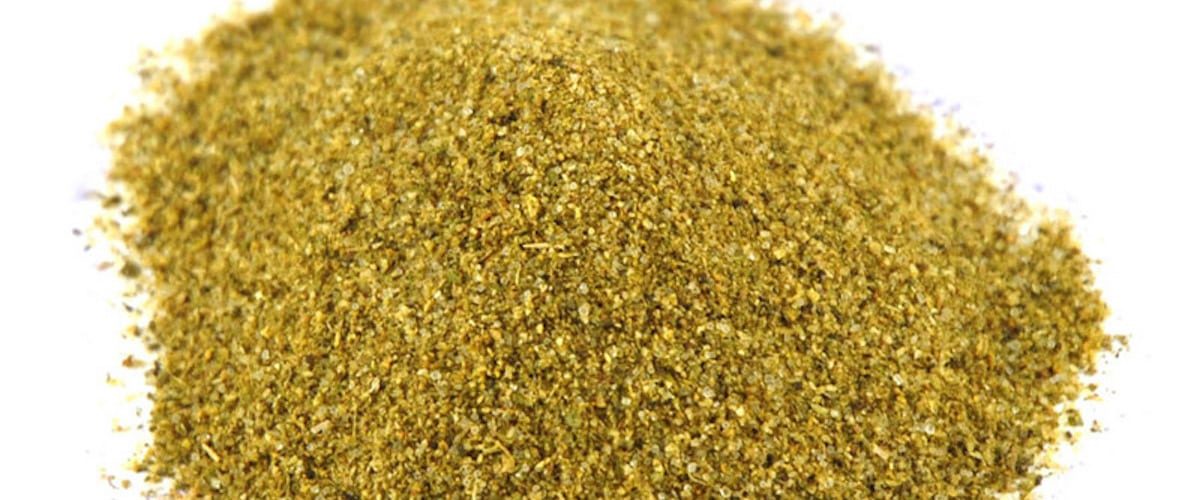
Greek seasoning is a dried, all-purpose blend sold in American supermarkets, usually built on salt, garlic and oregano. The best-known example, Cavender’s All Purpose Greek Seasoning, was created in Harrison, Arkansas, by Lester “Spike” Cavender from a recipe by a Greek chef friend, and the family began selling it in 1968.1 Labels differ a great deal, from a salt-and-pepper-led mix with MSG to a salt, garlic and herb blend.23 This page covers what is in the major blends, the herbs behind the flavor, how to use it, and what to watch for on the label.
At a glance
| What it is | A dried seasoning blend sold as “Greek”; no fixed recipe |
| Best-known brand | Cavender’s, Harrison, Arkansas; first sold 19681 |
| Common ingredients | Salt, garlic, oregano, black pepper, onion23 |
| Key herb | Oregano, Origanum vulgare, mint family45 |
| Sodium | Cavender’s: 241 mg per ¼ tsp (10% of the Daily Value)2 |
| Official standard | None found; the USDA spice-blend specification does not include it6 |
| Watch for | Salt, MSG and soy-derived protein in some brands2 |
Measured values
1 figure, sourced| Measure | Value | Scope | Source |
|---|---|---|---|
| Sodium | 241 mg per 1/4 teaspoon (10% of the Daily Value) | Cavender's All Purpose Greek Seasoning label, 8 oz canBrand label figure; company's own figures | foodlion.com |
Each figure is quoted as its source states it, with the samples or standard it applies to. Where sources differ, both are shown; nothing is averaged. All measured values
What is in it
There is no standard recipe, and the two labels checked for this page share little beyond salt and garlic:
| Product | Ingredients, as labeled | Source |
|---|---|---|
| Cavender’s All Purpose Greek Seasoning | Salt, black pepper, corn starch, garlic, monosodium glutamate, oregano, flavor base seasoning (hydrolyzed corn soy protein, sugar, onion powder, spice extractives), parsley and five other spices | 2 |
| McCormick Culinary Greek Seasoning | Salt, spices, garlic, sugar, maltodextrin, onion, autolyzed yeast, lactic acid | 3 |
McCormick describes its blend as oregano, garlic and onion with a touch of mint, though its label groups the herbs under “spices.”3 Neither label lists lemon peel, cinnamon or nutmeg. The USDA’s purchasing specification for spice blends has no entry for Greek seasoning.6
Where it came from
The Encyclopedia of Arkansas credits Lester “Spike” Cavender of Harrison, working with his son Ronald Stephen Cavender, with creating Cavender’s in the late 1960s.1 The blend was adapted from a recipe by a Greek chef Cavender and his brother had befriended in Texas, whose seasoning ingredients were a closely guarded secret; the encyclopedia reports, with a “reportedly,” that the chef willed the recipe to Cavender.1 The family began selling it in 1968, mixed its first commercial batch on July 4, 1970, and incorporated the S-C Seasoning Company in 1978.1 The company now makes four to five tons a day for sale in all 50 states and Canada.1
Who first used the name “Greek seasoning” for a dried blend could not be traced.
Flavor and the herbs behind it
Most Greek seasonings taste first of salt, then garlic and a resinous, peppery oregano. That description is ours. Oregano is the herb that most labels and descriptions name.23
| Ingredient | What the source says | Source |
|---|---|---|
| Oregano | Origanum vulgare, mint family (Lamiaceae); strong aroma and warm, pungent taste | 5 |
| Oregano oil | Carvacrol and thymol make up about 78 to 85% of the essential oil | 7 |
| Greek oregano | O. vulgare subsp. hirtum is one of the subspecies Kew accepts; the review notes denser, larger peltate trichomes (glandular hairs) in Greek oregano | 47 |
| Marjoram | Origanum majorana, a separate species in the same genus | 8 |
Britannica names Greek salads and gyros among the dishes where oregano is essential.5
Origin of the herbs. Oregano is often said to have originated in Greece. Kew gives its native range as Macaronesia to China, which takes in the Mediterranean but is far wider.4 Marjoram’s native range is southern Türkiye and Cyprus.8 Garlic has a long Greek history: a review of its historical use notes it was found in ancient Greek temples.9
How to use it
McCormick suggests its blend for grilled chicken with lemon, chicken and vegetables, burgers, steak, gyros and souvlaki, and on anything you would season with salt and pepper.3 Rubs for lamb and fish, and a pinch in vinaigrette for a Greek salad, follow the same logic; those are kitchen uses rather than sourced recommendations. Because salt leads both labels,23 add other salt only after tasting.
Buying and quality
Read the ingredient list first: both labels checked here start with salt.23 If you want the herbs without the salt, buy dried oregano and mix your own.
In an EU coordinated control plan on herbs and spices run from 2019 to 2021, 48% of oregano samples were at risk of contamination, most often with olive leaves.10 That finding is for oregano sold on its own, not for Greek seasoning blends.
Storage
No source gives a shelf life for Greek seasoning. Keep it airtight, cool and away from light, as for any dried herb blend.
Safety
Sodium. Cavender’s lists 241 mg of sodium per ¼ teaspoon, 10% of the Daily Value.2 A full teaspoon would therefore carry about 964 mg (our arithmetic), against an FDA Daily Value of less than 2,300 mg a day.11
MSG. Cavender’s lists monosodium glutamate.2 The FDA says MSG must be named on the label, not hidden under “spices and flavoring,” and that reports of reactions such as headache and nausea have never been confirmed as caused by MSG in controlled studies.12
Allergens. Cavender’s flavor base contains hydrolyzed corn soy protein,2 and soybeans are one of the nine major US food allergens.13
Health claims
Claims that Greek seasoning improves digestion, protects against oxidative damage or helps control blood sugar could not be traced to any regulator or systematic review, and this page makes none.
Substitutes and comparisons
- Greek seasoning substitutes
- The main herb: oregano, oregano uses, cooking with oregano, marjoram vs oregano
- Other components: garlic powder, onion powder, black pepper, marjoram, mint, rosemary, thyme
- Other American herb blends: Italian seasoning, all-purpose seasoning, lemon pepper, zaatar
Footnotes
-
Cody Lynn Berry, “Cavender’s All-Purpose Greek Seasoning”, CALS Encyclopedia of Arkansas. encyclopediaofarkansas.net · Reference work ↩ ↩2 ↩3 ↩4 ↩5 ↩6
-
Cavender’s All Purpose Greek Seasoning, product label as listed by Food Lion. foodlion.com · Merchant ↩ ↩2 ↩3 ↩4 ↩5 ↩6 ↩7 ↩8 ↩9 ↩10 ↩11
-
McCormick Culinary Greek Seasoning, product page, McCormick. mccormick.com · Merchant ↩ ↩2 ↩3 ↩4 ↩5 ↩6 ↩7 ↩8
-
Origanum vulgare L., Plants of the World Online, Royal Botanic Gardens, Kew. powo.science.kew.org · Reference work ↩ ↩2 ↩3
-
Anoushka Pant, “Oregano”, Encyclopaedia Britannica. britannica.com · Reference work ↩ ↩2 ↩3
-
Commercial Item Description A-A-20001C, Spices and Spice Blends, USDA Agricultural Marketing Service, 2023. ams.usda.gov · Regulator ↩ ↩2
-
Lombrea et al., “A Recent Insight Regarding the Phytochemistry and Bioactivity of Origanum vulgare L. Essential Oil”, International Journal of Molecular Sciences, 2020. mdpi.com · Peer-reviewed ↩ ↩2
-
Origanum majorana L., Plants of the World Online, Royal Botanic Gardens, Kew. powo.science.kew.org · Reference work ↩ ↩2
-
Rivlin, “Historical perspective on the use of garlic”, Journal of Nutrition, 2001. synapse.mskcc.org · Peer-reviewed ↩
-
“Herbs and spices (2019-2021): EU coordinated action”, European Commission. food.ec.europa.eu · Regulator ↩
-
“Sodium in Your Diet”, U.S. Food and Drug Administration. fda.gov · Regulator ↩
-
“Questions and Answers on Monosodium glutamate (MSG)”, U.S. Food and Drug Administration. fda.gov · Regulator ↩
-
“Food Allergies”, U.S. Food and Drug Administration. fda.gov · Regulator ↩