Spice Substitutes · Substitutes
Cubeb Pepper Substitutes, Ranked by the Job Cubeb Is Doing
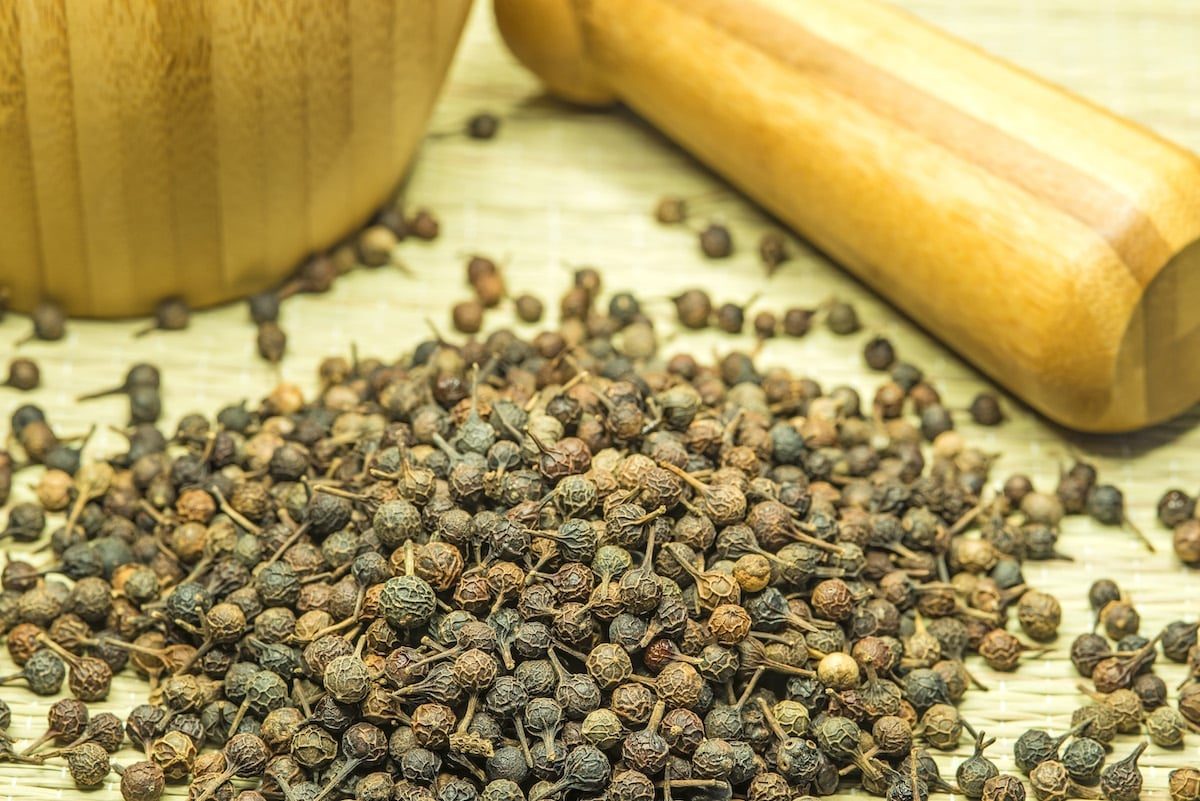
Cubeb is the dried, unripe berry of Piper cubeba, a relative of black pepper that keeps a short stalk on each fruit.1 It is hot and bitter, with an aroma Gernot Katzer describes as dry and woody, warm and camphor-like, or spicy and peppery.2 Today it is used mostly in North Africa, especially Tunisia and Morocco,2 where Moroccan cooks put it in savory dishes and in pastries such as markouts.3 No single spice copies it, so the best stand-in depends on what cubeb is doing in your recipe.
Quick answer
| What cubeb is doing | Best substitute | Starting amount, per 1 part cubeb | Treatment |
|---|---|---|---|
| Peppery bite (rubs, roast meat, a pepper mill) | Black pepper | 1/2 part, then taste | Method |
| Warm, clove-like aroma (pastries, sweet-savory dishes) | Equal parts allspice and black pepper | 1/2 part of the mix, then taste | Method |
| One spice among many in a blend (ras el hanout) | Quatre épices, or leave it out | 1/2 part, or none | Method |
| You want the closest berry | Ashanti pepper (Piper guineense), if you can find it | 1 part, then taste | Method |
| Switching between whole and ground pepper | Ground black pepper for whole | 1 tsp whole = 1½ tsp ground | Computed |
The rest of the page explains each choice and lists the alternatives.
How the ratios on this page are labeled
Every ratio carries one of four labels.
- Computed: based on a measurable physical relationship, with the source named.
- Attributed: a named source publishes this ratio. We quote it as theirs.
- Disputed: named sources give different answers to the same swap. We show each one and do not average them.
- Method: we found no published ratio. We give a direction and a cautious starting point, and say so.
We found no credible published ratio for replacing cubeb with anything. Every amount marked Method is a starting point for tasting, not a measured equivalence.
Why cubeb is hard to copy
Cubeb’s heat comes from a different kind of compound than black pepper’s. Katzer attributes cubeb’s pungency to the lignan cubebin, at about 2%, and says the amides that make black and long pepper hot play no significant role in it.2 Black pepper’s chief pungent compound is piperine, at 4.9 to 7.7% of the dried berry in PROSEA’s figures.4 Katzer also notes that the source of cubeb’s bitterness has not been identified,2 so there is no known compound to match.
The aroma overlaps with two common spices, depending on which analysis you read:
- With black pepper. Katzer gives cubeb oil as dominated by monoterpenes, with sabinene at about 50%.2 Sabinene is also a major part of black pepper oil: 17.9% and 19.0% in two analyses PROSEA reports.4
- With allspice. One cubeb oil analysis cited in a 2022 review found methyl eugenol (41.31%) and eugenol (33.95%) as its main compounds.3 Eugenol, methyl eugenol and myrcene are the three main constituents of allspice oil.5
These two cubeb analyses come from different samples and disagree sharply, so neither tells you exactly how a given jar will taste. Together they explain why cooks reach for black pepper and allspice.
If cubeb is the peppery bite
1. Black pepper
Black pepper is the spice cubeb historically stood in for. Katzer calls cubeb a once-popular substitute for black pepper that later fell from favor,2 and the 1918 Dispensatory of the United States said cubeb had been used like black pepper but was found “much less powerful.”1 Both belong to the genus Piper; black pepper’s family is Piperaceae, the pepper family.6
What you lose is the bitterness and the resinous, woody note.2 Black pepper’s flavor comes mainly from piperine,6 so the result is cleaner and sharper.
Ratio (Method): No published ratio was found. Because the 1918 Dispensatory calls cubeb much less powerful than black pepper,1 start with about half as much black pepper as cubeb, taste, and add more.
Whole or ground (Computed): If the recipe calls for crushed whole berries and you only have ground pepper, McCormick’s conversion is 1 teaspoon peppercorns = 1½ teaspoons ground pepper.7 That is a volume figure for black pepper alone. It says nothing about how black pepper compares with cubeb.
2. Grains of paradise
Grains of paradise played the same historical role: Katzer describes them as a common substitute for black pepper in 15th-century Europe.8 He calls their taste spicy, hot and warm, a little bitter, with heat less strong than pepper’s but more subtle.8 The bitterness brings them a little closer to cubeb than black pepper is. The heat comes from ginger-family compounds, (6)-paradol, (6)-shogaol and (6)-gingerol,8 so the flavor leans toward ginger rather than resin.
Ratio (Method): No published ratio was found. Start with about three quarters the cubeb amount, freshly ground, and taste.
If cubeb is a warm, clove-like aroma
1. Allspice with black pepper
Allspice brings the eugenol side of cubeb’s aroma. Britannica says allspice was so named because its flavor resembles a combination of cloves, cinnamon and nutmeg,9 and PROSEA gives eugenol as 50 to 80% of the berry oil.10 It adds warmth but little bite, so a share of black pepper puts the heat back.
The two berries are easy to confuse. Katzer notes that some sources mix up cubeb with allspice, “which looks somewhat similar,”2 and that in India names of the kabab chini type can mean either one.2 The 1918 Dispensatory said ground cubeb was sometimes cut with pimenta, which is allspice.1 Neither berry has cubeb’s stalk, which is 5 to 7 mm long.1
Ratio (Method): No published ratio was found. Mix allspice and black pepper in equal parts, use half as much of the mix as the cubeb called for, then taste. Go lighter on the allspice in savory dishes and heavier in pastries.
Whole or ground (Computed): For allspice, McCormick gives 1 teaspoon allspice berries (5 whole berries) = 1 teaspoon ground allspice.7
2. Allspice alone
If the dish already has plenty of pepper, allspice alone covers the aroma.
Ratio (Method): No published ratio. Start with a quarter to a half of the cubeb amount; allspice’s clove note takes over quickly.
If cubeb is one spice in a blend
In a long blend such as ras el hanout, cubeb is one of many voices. You can use a pepper-led blend in its place or simply leave it out.
1. Quatre épices
Quatre épices means “four spices.” Katzer lists much white pepper (some variants use black pepper), nutmeg, cloves and ginger, and calls the blend a kind of enhanced, fortified pepper that can be used wherever black pepper is called for but a richer aroma is wanted.11 Saveur says the blend usually contains cloves, cinnamon, nutmeg and pepper, and its recipe is half pepper by weight (10 of 20 grams).12 That pepper-plus-clove profile is close to the allspice and black pepper mix above. A claim that some versions are made with cubeb could not be traced to any source.
Ratio (Method): No published ratio. Start with half the cubeb amount.
2. Leave it out
Ratio (Method): No published ratio. If the blend already has black pepper, allspice or cloves, add a pinch more of one of them, finish the dish and taste before adding anything else.
If you want the closest berry
Ashanti pepper (Piper guineense)
Katzer identifies the so-called false cubeb, also called Ashanti pepper, as the Central African species Piper guineense.2 He writes that Ashanti pepper tastes similar to cubeb pepper, “but fresher and less bitter.”2 It is the nearest match in this list, but it is no easier to find than cubeb. For its use in West African cooking, see Nigerian spices.
Ratio (Method): No published ratio. Start with an equal amount, crushed, and taste.
A substitute to use with care: Sichuan pepper
Sichuan pepper is not a pepper at all. It is the dried fruit husk of several species of prickly ash (Zanthoxylum), in the rue and citrus family.13 Katzer describes its aroma as lemon-like with warm, woody overtones, and notes that it produces a numbing, almost anaesthetic feeling on the tongue.14 No source we read describes cubeb as numbing. The woody note can echo cubeb’s, but the tingle will be new to the dish.
Ratio (Method): No published ratio. Start with about a quarter of the cubeb amount, ground, and only in dishes where a tingle would be welcome.
What isn’t known
- No published ratio exists for replacing cubeb with black pepper, allspice, quatre épices, grains of paradise, Ashanti pepper or Sichuan pepper. Every amount above is a starting point.
- No study compares the heat of cubeb with that of black pepper. The only comparison we found is the 1918 Dispensatory’s “much less powerful.”1
- Published analyses of cubeb oil disagree on its main compounds (sabinene in one account, methyl eugenol and eugenol in another),23 and the reasons were not explained in the sources we could open.
- It is sometimes said that cubeb tastes of nutmeg. Katzer’s description does not mention it, and no source we found supports it.
Related
- Cubeb pepper, the full profile
- Black pepper, black pepper substitutes and allspice vs. black pepper
- Allspice, allspice substitutes and too much allspice
- Grains of paradise and grains of paradise substitutes
- Quatre épices, Sichuan pepper, long pepper
- Moroccan spices, Tunisian spices, ras el hanout
Footnotes
-
Cubeba, The Dispensatory of the United States of America, 1918 (transcription, Henriette’s Herbal Homepage). henriettes-herb.com · Reference work ↩ ↩2 ↩3 ↩4 ↩5 ↩6
-
Gernot Katzer, Cubeb Pepper (Piper cubeba), Gernot Katzer’s Spice Pages. gernot-katzers-spice-pages.com · Reference work ↩ ↩2 ↩3 ↩4 ↩5 ↩6 ↩7 ↩8 ↩9 ↩10 ↩11 ↩12
-
Cubeb (Piper cubeba L.f.): A comprehensive review, Frontiers in Nutrition, 2022. frontiersin.org · Peer-reviewed ↩ ↩2 ↩3
-
Piper nigrum (PROSEA), Pl@ntUse. uses.plantnet-project.org · Reference work ↩ ↩2
-
Andrade Avila, Cruz-Olivares and Pérez-Alonso, Antioxidant Effect and Medicinal Properties of Allspice Essential Oil, IntechOpen. intechopen.com · Peer-reviewed ↩
-
Black pepper, Encyclopaedia Britannica. britannica.com · Reference work ↩ ↩2
-
How to Grind Your Own Spices, McCormick. mccormick.com · Merchant ↩ ↩2
-
Gernot Katzer, Grains of Paradise (Aframomum melegueta), Gernot Katzer’s Spice Pages. gernot-katzers-spice-pages.com · Reference work ↩ ↩2 ↩3
-
Allspice, Encyclopaedia Britannica. britannica.com · Reference work ↩
-
Pimenta dioica (PROSEA), Pl@ntUse. uses.plantnet-project.org · Reference work ↩
-
Gernot Katzer, Nutmeg and Mace (Myristica fragrans), Gernot Katzer’s Spice Pages. gernot-katzers-spice-pages.com · Reference work ↩
-
Papach, Quatre Épices, Saveur. saveur.com · Publication ↩
-
Petruzzello, Sichuan pepper, Encyclopaedia Britannica. britannica.com · Reference work ↩
-
Gernot Katzer, Sichuan pepper (Zanthoxylum species), Gernot Katzer’s Spice Pages. gernot-katzers-spice-pages.com · Reference work ↩