Spice Substitutes · Substitutes
Long Pepper Substitutes: What Works When You Can’t Find Pippali
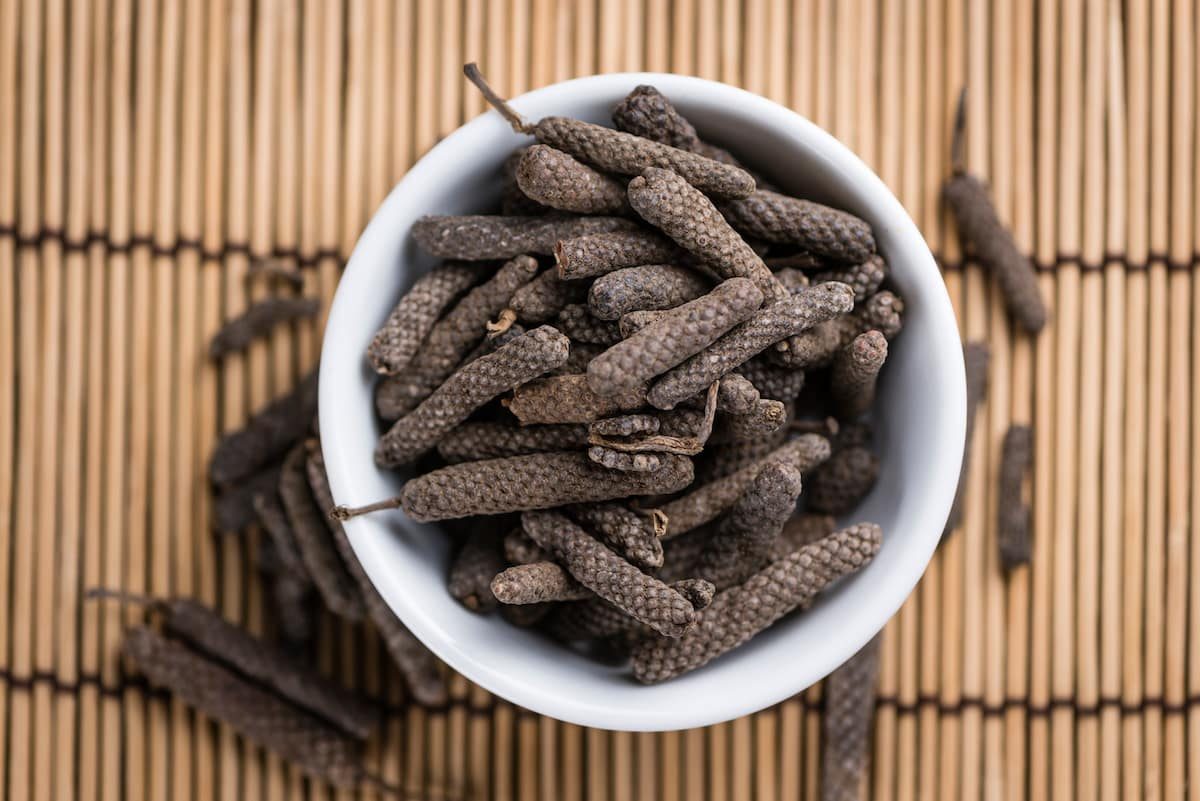
Long pepper is the dried fruiting spike of Piper longum, a climbing relative of the black pepper vine.12 Its bite comes from piperine, the same compound that makes black pepper hot, at about 3 to 5 percent of the fruit’s dry weight in one 2026 review.2 Writers describe it as similar to black pepper but sweeter and more complex.34 It is hard to find in much of the West,3 so here is what to use instead, and why the obvious answer, black pepper, is not the best one.
Quick answer
| What long pepper is doing | Best substitute | Starting amount, per 1 part long pepper | Treatment |
|---|---|---|---|
| Any use, if you can find it | Javanese long pepper (Piper retrofractum) | 1 part | Method |
| Pepper heat with a sweet, warm edge (rubs, braises, sweets, finishing) | White pepper plus a little mace | 3/4 part white pepper plus a pinch of mace | Method |
| Plain pepper heat, when that’s all you have | Freshly ground black pepper | 3/4 part, then taste | Method |
| Whole spikes steeped in a pickle, stew or braise | Whole white or black peppercorns | A few peppercorns per spike | Method |
| A different heat for a warm-spiced dish | Grains of paradise | 1 part, then taste | Method |
How the ratios on this page are labeled
- Computed: based on a measurable physical relationship, with the source named.
- Attributed: a named source publishes this ratio. We quote it as theirs.
- Disputed: named sources give different answers to the same swap. We show each one and do not average them.
- Method: we found no published ratio. We give a direction and a starting point, and say so.
Every ratio on this page is Method. We found no published quantity for any long pepper substitute. The merchants we checked describe long pepper as usable wherever black pepper is, but none gives an amount.56
Hotter or milder than black pepper? Sources disagree
How much of a substitute to use depends on how hot long pepper is, and the sources don’t agree:
| Source | What it says about long pepper’s heat |
|---|---|
| Gernot Katzer’s Spice Pages7 | More pungent than black pepper; “must be used with care” |
| The Spice House5 | “A bit more heat than traditional black peppercorns” |
| Atlas Obscura food entry3 | Not as hot as black pepper |
There is also no side-by-side piperine measurement. The 2026 review’s 3 to 5 percent for long pepper and PROSEA’s 4.9 to 7.7 percent for black pepper come from different sources and samples, so they show the same order of magnitude, not which is hotter.28 The starting amounts below err on the low side for that reason.
If long pepper is giving pepper heat with a sweet, warm edge
This covers most uses: rubs, braises, dressings, poached fruit and finishing. The Spice House describes notes of nutmeg, cinnamon and ginger beyond the heat,5 and Atlas Obscura calls the flavor sweeter than black pepper, with a citrusy bite.3
1. Javanese long pepper, if you find it
A second species is sold under the same name. Piper retrofractum is a separate species that Kew gives as native to the Philippines.9 Katzer says the two are often not clearly distinguished in the spice trade, and that the Indonesian species has slightly smaller spikes.7
Ratio (Method): No published ratio was found. Use it one for one and taste.
2. White pepper plus a little mace
This is Katzer’s suggestion. He says long pepper cannot be replaced by ordinary black pepper because its aroma lacks black pepper’s terpene components, and suggests trying white pepper plus a little mace instead.7 The logic fits what is known about white pepper: it is the same species as black pepper with the outer layer (pericarp) removed,10 and Katzer notes that this outer layer holds part of the volatile aroma, so white pepper is less aromatic than black.11 Mace adds the warm, sweet spice note. See mace.
Sources also disagree about white pepper’s heat. Britannica calls it less pungent than black pepper; Katzer says it keeps the full pungency.1211
Ratio (Method): No quantities are given. Start with 3/4 teaspoon ground white pepper and a pinch (about 1/8 teaspoon) of ground mace per teaspoon of long pepper, then taste and adjust.
3. Black pepper, preferably a good grade
If black pepper is all you have, it will give you the heat. Both get their bite from piperine.28 What you lose, by Katzer’s account, is long pepper’s particular aroma.7 Zingerman’s, a merchant that sells long pepper, suggests using long pepper any way you would black pepper,6 which supports the swap in the other direction for everyday use.
A high grade helps. Tellicherry is an origin-and-size grade of Piper nigrum from India’s Malabar Coast, not a separate plant;13 the McCormick Science Institute calls it widely considered the highest quality and most flavorful black pepper,14 and one seller describes a citrus-forward brightness.13 That brightness overlaps with the citrusy note Atlas Obscura finds in long pepper.3 Neither claim has been measured. See Tellicherry pepper vs. black pepper.
Ratio (Method): No published ratio was found. Start with about 3/4 as much freshly ground black pepper as the long pepper called for, taste, and add more. For sweeter dishes, a pinch of mace or nutmeg covers some of the missing warmth; that is our judgment.
If whole long pepper is steeping in a pickle, stew or braise
Katzer says long pepper’s main use in India is in spicy vegetable pickles, and that it usually appears in traditional Ethiopian meat stews.7 The Spice House notes it can go in whole in a stew or slow-roasted lamb.5
Ratio (Method): A long pepper spike is roughly 2 cm long.2 We found no published count of peppercorns per spike. Start with three or four whole white or black peppercorns per spike, and fish them out before serving if you want a milder result.
If you want a different kind of heat
1. Grains of paradise
Grains of paradise, the seeds of Aframomum melegueta, are also sold as Guinea grains, melegueta pepper or alligator pepper.15 In 15th-century Europe they were a common substitute for black pepper.15 Their heat comes from a different group of pungent compounds, hydroxyarylalkanones, not piperine, and Katzer describes it as less strong than pepper and more subtle, with a flavor that is spicy, hot, warm and a little bitter.15
Ratio (Method): No published ratio was found. Start one for one, freshly ground, and taste.
2. Cubeb pepper
Cubeb is another Piper species, but its pungency comes from the lignan cubebin, and Katzer says the amides that make black and long pepper hot play no significant role in it.16 He describes it as pungent and bitter.16
Ratio (Method): Start with half as much cubeb as long pepper and taste; the bitterness is easy to overdo. See cubeb pepper substitutes.
3. Cayenne, for heat alone
Atlas Obscura says long pepper faded from European kitchens after Columbus brought chiles back from the Americas.3 Chile heat comes from capsaicin, which in a laboratory study on the human heat receptor TRPV1 was a much more potent activator than piperine.17 That is a cell study, not a taste test, but it is a reason for caution. Cayenne gives heat and none of long pepper’s aroma.
Ratio (Method): Start with a small pinch, well under a quarter of the long pepper amount, and taste.
What isn’t known
- No published ratio exists for any long pepper substitute; every figure above is a starting point.
- Sources disagree on whether long pepper is hotter or milder than black pepper, and no study has measured both side by side.
- No source gives a peppercorn equivalent for a whole long pepper spike.
Related
- Long pepper and long pepper vs. black pepper
- Black pepper, white peppercorns, white pepper vs. black pepper, Tellicherry pepper
- Grains of paradise, grains of paradise substitutes, cubeb pepper, cayenne pepper
- Black pepper substitutes, white pepper substitutes, too much pepper
Footnotes
-
Piper longum L., Plants of the World Online, Royal Botanic Gardens, Kew. powo.science.kew.org · Reference work ↩
-
Bhatia et al., “From Ancient Spice to Advanced Science: Insights into the Fruits of Piper longum”, Drug Design, Development and Therapy, 2026. dovepress.com · Peer-reviewed ↩ ↩2 ↩3 ↩4 ↩5
-
Jared Rydelek, “Long Pepper”, Atlas Obscura. atlasobscura.com · Publication ↩ ↩2 ↩3 ↩4 ↩5 ↩6
-
Andrew Coletti, guide to different kinds of pepper, Atlas Obscura, 2025. atlasobscura.com · Publication ↩
-
Long Pepper product page, The Spice House. thespicehouse.com · Merchant ↩ ↩2 ↩3 ↩4
-
“The Loveliness of Long Pepper”, Zingerman’s Delicatessen, 2023. zingermansdeli.com · Merchant ↩ ↩2
-
Gernot Katzer, “Long Pepper (Piper longum, P. retrofractum)”, Gernot Katzer’s Spice Pages. gernot-katzers-spice-pages.com · Reference work ↩ ↩2 ↩3 ↩4 ↩5
-
Piper nigrum, Plant Resources of South-East Asia (PROSEA). uses.plantnet-project.org · Reference work ↩ ↩2
-
Piper retrofractum Vahl, Plants of the World Online, Royal Botanic Gardens, Kew. powo.science.kew.org · Reference work ↩
-
Standard for Black, White and Green Peppers (CXS 326-2017), Codex Alimentarius. fao.org · Standard ↩
-
Gernot Katzer, “Black Pepper (Piper nigrum)”, Gernot Katzer’s Spice Pages. gernot-katzers-spice-pages.com · Reference work ↩ ↩2
-
“Black pepper”, Encyclopaedia Britannica. britannica.com · Reference work ↩
-
Tellicherry Special Extra Bold Peppercorns product page, Pure Indian Foods. pureindianfoods.com · Merchant ↩ ↩2
-
“Black Pepper”, McCormick Science Institute. mccormickscienceinstitute.com · Merchant ↩
-
Gernot Katzer, “Grains of Paradise (Aframomum melegueta)”, Gernot Katzer’s Spice Pages. gernot-katzers-spice-pages.com · Reference work ↩ ↩2 ↩3
-
Gernot Katzer, “Cubeb Pepper (Piper cubeba)”, Gernot Katzer’s Spice Pages. gernot-katzers-spice-pages.com · Reference work ↩ ↩2
-
McNamara, Randall and Gunthorpe, “Effects of piperine at the human vanilloid receptor (TRPV1)”, British Journal of Pharmacology, 2005. pmc.ncbi.nlm.nih.gov · Peer-reviewed ↩