Cooking · Dish guide
Gyro Spices: The Seasonings Behind Gyro Meat and What Each One Does
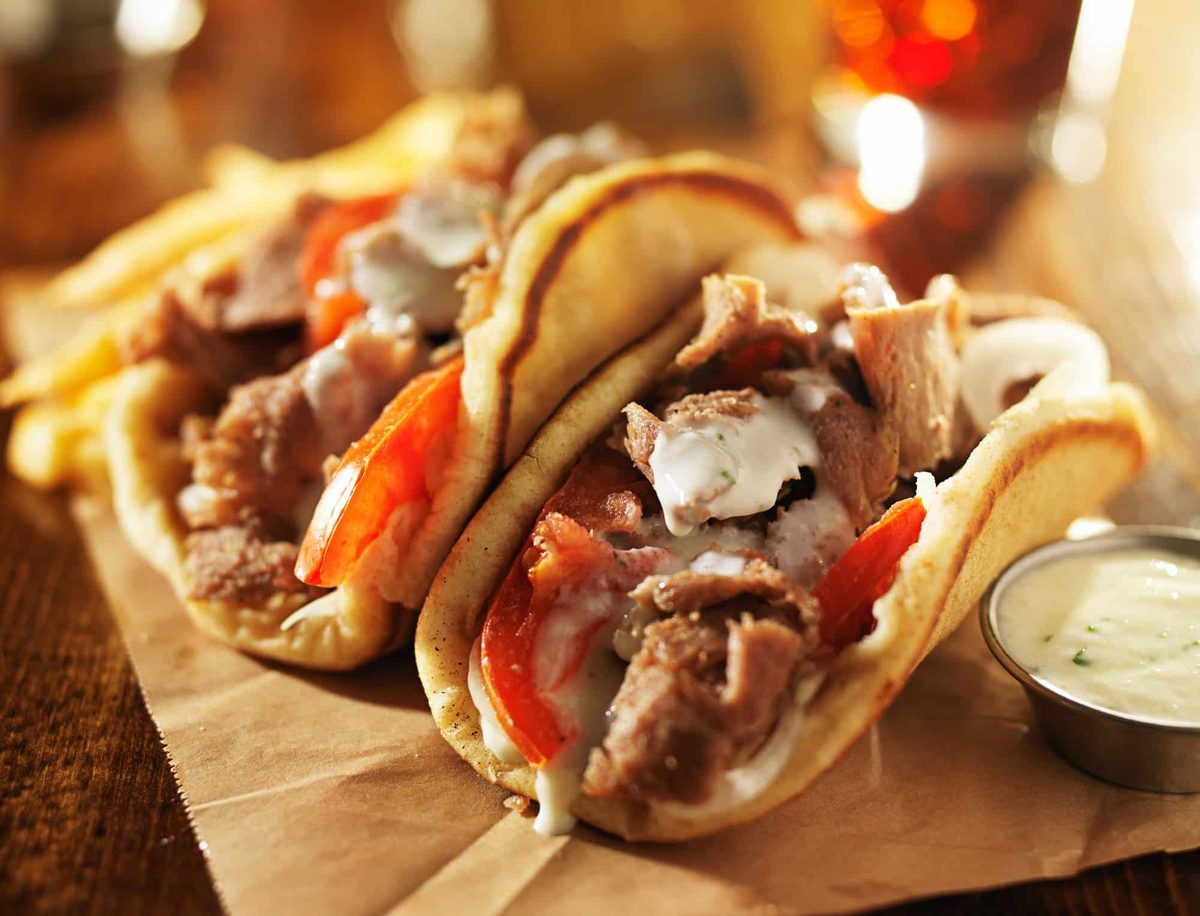
A gyro, in Merriam-Webster’s definition, is a sandwich especially of lamb and beef, with tomato, onion and yogurt sauce on pita bread. The name comes from Modern Greek gyros, “turn,” for the way the meat rotates on a spit.1 The meat carries most of the seasoning, and oregano is the herb that every source we checked puts at the center: Britannica names gyros as one of the dishes where oregano is essential.2 Garlic, onion, black pepper and often cumin build around it. There is no single gyro recipe, so this page shows named versions side by side and explains what each seasoning does.
At a glance
| Seasoning | Role in gyro meat | Named source that uses it |
|---|---|---|
| Oregano, dried | The main herb; resinous, warm | Segal recipe;3 McCormick Greek seasoning4 |
| Garlic or garlic powder | Savory base | Segal recipe;3 McCormick4 |
| Onion powder | Savory base | Segal recipe;3 McCormick (onion)4 |
| Black pepper | Pungency | Segal recipe3 |
| Cumin | Warm, earthy note | Segal recipe3 |
| Mint | A light cool note | McCormick (“a touch of mint”)4 |
| Salt | Seasoning | Segal recipe;3 McCormick4 |
Two named versions side by side
| Jennifer Segal, Once Upon a Chef (home gyro meat from ground beef and lamb)3 | McCormick Culinary Greek Seasoning (a commercial blend sold for gyros)4 | |
|---|---|---|
| Meat | 1 lb 80% lean ground beef and 1 lb ground lamb, with 1/2 cup bread crumbs | Not applicable; McCormick suggests seasoning a gyro or souvlaki before grilling |
| Salt | 1 1/2 teaspoons | Listed first on the label |
| Oregano | 2 teaspoons dried | Named in the description; grouped under “spices” on the label |
| Garlic | 1 teaspoon garlic powder | Garlic |
| Onion | 1 teaspoon onion powder | Onion |
| Black pepper | 1 teaspoon, freshly ground | Not listed by name |
| Cumin | 1/2 teaspoon ground | Not listed by name |
| Mint | none | “A touch of mint” in the description |
| Other | none | Sugar, maltodextrin, autolyzed yeast, lactic acid |
The two agree on the core: oregano, garlic, onion and salt.34 Segal’s version adds black pepper and cumin; McCormick’s adds mint.34 Neither includes allspice, dill or thyme, which are discussed below.
Oregano
Oregano (Origanum vulgare) is in the mint family, and Britannica describes its leaves as having a strong aroma and a warm, pungent taste.2 Most of that comes from two phenols, carvacrol and thymol, which make up roughly 78 to 85% of oregano essential oil.5 Greek oregano, O. vulgare subsp. hirtum, has denser and larger oil glands (peltate trichomes) on its leaves than other oreganos, according to a 2020 review.5 A widely repeated claim says Greek oregano is the most important herb in Greek cooking; that may be so, but we found no source ranking it. For more, see Mexican oregano vs oregano and oregano vs mint.
Garlic and onion
Garlic is a perennial in the amaryllis family (Amaryllidaceae).6 Segal’s recipe uses garlic powder and onion powder rather than fresh.3 Garlic also usually appears in the yogurt sauce served with a gyro; Merriam-Webster’s definition mentions only “yogurt sauce,”1 and we did not open a named tzatziki recipe for this page.
Black pepper and cumin
Segal uses a full teaspoon of black pepper for two pounds of meat, plus half a teaspoon of ground cumin.3 Cumin’s aroma comes mostly from cuminaldehyde, which makes up 20 to 72% of the oil depending on the study.7 A common claim is that cumin in gyros is a holdover from the dish’s roots in the Middle East. We could not trace that, and it is left out here.
Mint
McCormick’s Greek seasoning, which it suggests for gyros, is described as oregano, garlic and onion with a touch of mint.4 Spearmint is rich in carvone, while peppermint’s character comes mostly from menthol and menthone.8 McCormick does not say which mint it uses.
Allspice, dill and thyme
These three are often listed as gyro spices, but none of the named gyro recipes or blends we checked uses them.34 They can work in Greek-style meat, so here is what each would contribute.
- Allspice is the dried berry of Pimenta dioica, also called Jamaican pepper or pimento.9 Its oil is 50 to 80% eugenol.10 Spanish explorers in the 16th century named it pimienta, “pepper,” later anglicized to pimento,10 and PROSEA describes Jamaican allspice as the best quality.10
- Dill is in the parsley family (Apiaceae), and the principal component of its essential oil is carvone.11 See cooking with dill.
- Thyme oil’s characteristic constituents are thymol and carvacrol,12 the same two phenols that dominate oregano oil.5 See fresh vs dried thyme.
A starting point for your own blend
If you want to season gyro meat without a recipe, Segal’s proportions are a reasonable starting point: for 2 pounds of ground meat, 2 teaspoons dried oregano, 1 teaspoon each garlic powder, onion powder and black pepper, 1/2 teaspoon cumin and 1 1/2 teaspoons salt.3 If you use a store-bought Greek seasoning instead, check the label first: McCormick’s lists salt as the first ingredient,4 so cut back on added salt.
Related
- Greek seasoning and Greek seasoning substitutes
- Spices for lamb
- Shawarma spice
- Oregano vs mint
- Marjoram vs oregano
- Garlic powder vs garlic
- Cooking with oregano
Footnotes
-
Gyro, Merriam-Webster Dictionary. merriam-webster.com · Reference work ↩ ↩2
-
Oregano, Encyclopaedia Britannica. britannica.com · Reference work ↩ ↩2
-
Gyros, Jennifer Segal, Once Upon a Chef. onceuponachef.com · Publication ↩ ↩2 ↩3 ↩4 ↩5 ↩6 ↩7 ↩8 ↩9 ↩10 ↩11 ↩12 ↩13
-
McCormick Culinary Greek Seasoning, McCormick. mccormick.com · Merchant ↩ ↩2 ↩3 ↩4 ↩5 ↩6 ↩7 ↩8 ↩9 ↩10 ↩11
-
Lombrea et al., International Journal of Molecular Sciences, 2020. mdpi.com · Peer-reviewed ↩ ↩2 ↩3
-
Garlic, Encyclopaedia Britannica. britannica.com · Reference work ↩
-
Cuminum cyminum (PROSEA). uses.plantnet-project.org · Reference work ↩
-
Singh and Pandey, Frontiers in Plant Science, 2018. frontiersin.org · Peer-reviewed ↩
-
Allspice, Encyclopaedia Britannica. britannica.com · Reference work ↩
-
Pimenta dioica (PROSEA). uses.plantnet-project.org · Reference work ↩ ↩2 ↩3
-
Dill, Encyclopaedia Britannica. britannica.com · Reference work ↩
-
Thymus vulgaris (PROSEA). uses.plantnet-project.org · Reference work ↩