Cooking · Dish guide
Corned Beef and Cabbage Spices: Peppercorns, Bay and the Pickling-Spice Blend
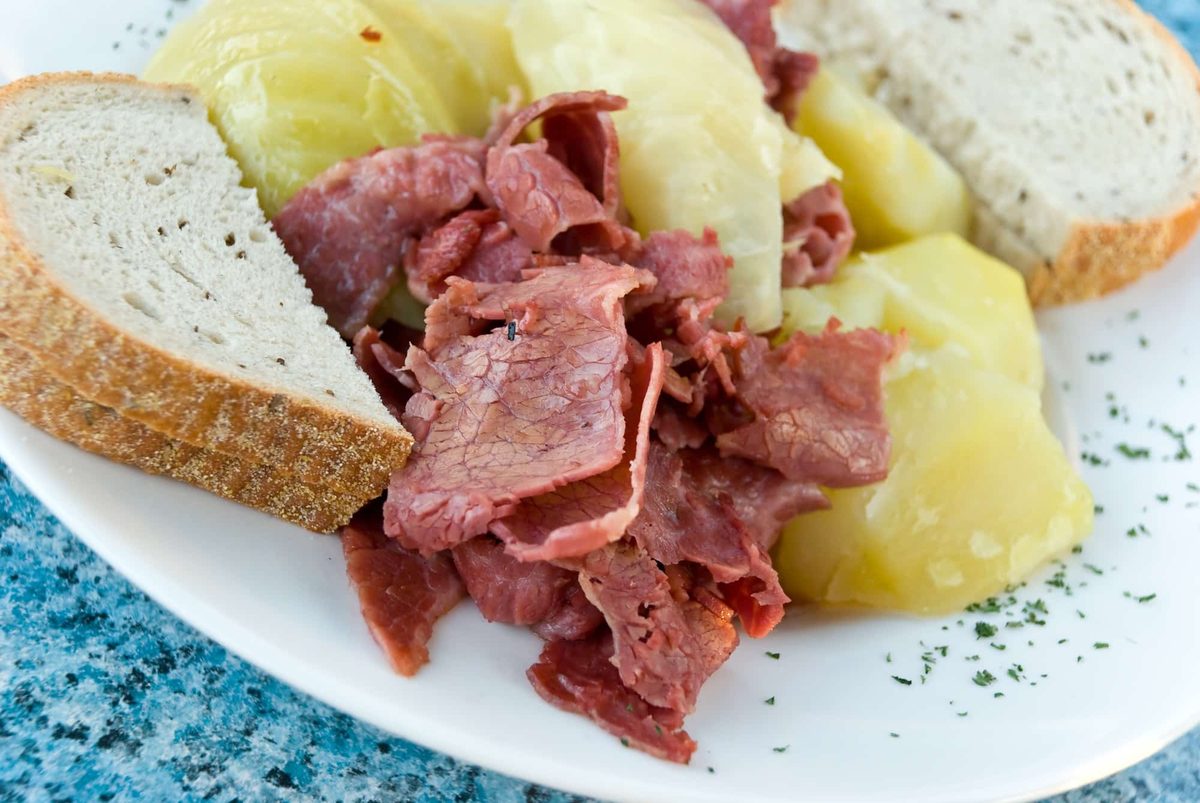
Corned beef gets most of its flavor before it reaches the pot: it is beef cured in a salt brine, and the brine is where the spices go. The USDA’s food-safety guide names the two that give corned beef its distinctive flavor: peppercorns and bay leaf.1 Beyond those, the usual seasoning is a pickling-spice blend of whole mustard seed, coriander, allspice, cloves and more, used in the brine, in the simmering water, or both. This page covers what each spice does, how three named recipes and blends differ, when the cabbage goes in, and the safety points that matter for a cured meat.
At a glance
| Spice | Job in the dish | Where it appears |
|---|---|---|
| Black peppercorns | Mild heat, the core spice | USDA and Ohio State name it;12 every recipe below |
| Bay leaves | Savory background; remove before serving | USDA and Ohio State name it;12 every recipe below |
| Mustard seed | Pungency, a classic match for boiled meat | All recipes and blends below3456 |
| Coriander seed | Floral, citrusy note | Leite’s, McCormick, Spice House465 |
| Allspice | Warm, clove-like note | All recipes and blends below346 |
| Cloves | Strong warm note; use sparingly | All recipes and blends below346 |
| Juniper berries | Piney, resinous note | Alton Brown’s brine only, of the recipes checked3 |
| Chile (red pepper flakes) | Extra heat | Leite’s recipe; McCormick’s blend46 |
| Garlic, onion, celery | Savory aromatics | Leite’s brine (garlic); Alton Brown’s simmer (onion, celery)43 |
What “corned” means, and where the dish comes from
“Corned” has nothing to do with corn. USDA explains that corning is a form of curing: meat was dry-cured with coarse “corns” of salt, some the size of corn kernels.1 Today a salt-water brine has replaced the dry cure, and nitrite is used in the curing process.1 The cuts are tougher ones such as brisket, rump or round.1
When the name arose is disputed:
| Account | Source |
|---|---|
| The name dates from Anglo-Saxon times, before refrigeration | USDA FSIS1 |
| The British coined “corned beef” in the 17th century for the salt crystals used in the cure | Smithsonian Magazine7 |
Corned beef and cabbage as a St. Patrick’s Day meal is Irish-American more than Irish. Smithsonian reports that beef was not part of the diet for most of Ireland’s population, where pork was the most eaten meat, and that Irish immigrants in New York bought their meat almost entirely from kosher butchers, eating corned beef in place of bacon.7 The Irish Times adds that Cork was a center of corned beef production in the 18th and 19th centuries, mainly for export, while bacon was the accessible treat at home; it presents the Jewish-butcher link as what is “thought” to have happened.8 Smithsonian calls cabbage the most affordable vegetable of the time.7
Three recipes and blends side by side
| Alton Brown brine (Food Network)3 | Leite’s Culinaria pickling spice4 | McCormick Pickling Spice label6 | |
|---|---|---|---|
| Black pepper | 1 tsp peppercorns | 2 tbsp peppercorns | Yes |
| Bay leaves | 2, crumbled | 2 to 4, crumbled | Yes |
| Mustard seed | 1 tsp | 2 tbsp | Yes |
| Coriander seed | No | 2 tbsp | Yes |
| Allspice | 8 berries | 2 tbsp berries | Yes |
| Cloves | 8 whole | 2 tbsp whole | Yes |
| Cinnamon | 1 stick | 2 small sticks | Yes |
| Ginger | 1/2 tsp ground | 1 tbsp ground | Yes |
| Juniper | 12 berries | No | No |
| Mace | No | 1 tbsp ground | Yes |
| Chile | No | 2 tbsp red pepper flakes | Red pepper |
| Cardamom | No | No | Yes |
Alton Brown’s brine also includes kosher salt, brown sugar and saltpeter, and his cooking pot adds coarsely ground black pepper, ground allspice and 2 more bay leaves.3 Leite’s brine adds 3 minced garlic cloves and 2 tablespoons of its pickling spice, and another 2 tablespoons go into the cooking water.4 The Spice House calls its own pickling spice ideal for corned beef and suggests mixing five parts of it with one part whole coriander seed.5 These are each publisher’s own formula. There is no standard recipe; see pickling spice for three commercial blends compared.
The core spices and what each one does
Black peppercorns
USDA and Ohio State Extension both name peppercorns as one of the two spices behind corned beef’s distinctive flavor.12 Pepper’s pungency comes principally from piperine.9 It is not always the only source of heat: Leite’s adds red pepper flakes and McCormick’s blend includes red pepper.46 Whole peppercorns suit a long simmer because they can be strained out. See black pepper.
Bay leaves
Bay is the other spice USDA names.1 J. Kenji López-Alt, speaking to The Splendid Table, says bay leaves bring out the meaty flavors of beef and chicken.10 Take them out before serving. Dried leaves stay tough, which López-Alt compares to eating a fish bone,10 and a medical case report describes swallowed bay leaves as rigid, with sharp points and margins.11 Alton Brown removes the bay leaves at the end of cooking.3 See cooking with bay leaves and too much bay leaf.
Mustard seed
Mustard seed is in every recipe and blend above,346 and The Spice House lists it first on its blend.5 Katzer notes that the dried seeds have no fragrance and taste pungent only after some chewing.12 He also describes mustard as a common condiment for boiled or broiled meat in Central and Northern Europe.12 See mustard seed uses and mustard powder.
Coriander, allspice and cloves
These three supply the warm, sweet side of the blend. The main component of coriander seed oil is always linalool, according to PROSEA.13 Allspice and cloves both appear in all three formulas above.346 Cloves are the strongest of the group; Alton Brown uses 8 whole cloves for a full brine.3 See allspice vs. cloves.
Juniper berries
Juniper berries are not berries but fleshy, berry-like cones of a conifer.14 Lisa Bramen, writing for Smithsonian, describes their flavor as slightly piney and fruity, and advises using them sparingly.15 Katzer notes their long use in Central European cooking and calls them indispensable for venison.16 Of the formulas checked here, only Alton Brown’s brine uses them, at 12 berries;3 they are absent from Leite’s spice mix and McCormick’s blend.46 They are an option for a more resinous corned beef, not a standard ingredient. See juniper berries.
Garlic, onion and celery
Leite’s brine includes 3 minced garlic cloves,4 and Alton Brown simmers the brined brisket with quartered onion, carrot and celery.3 These are aromatics rather than spices, and recipes vary on whether to use them.
Thyme
None of the recipes or blends checked here uses thyme. It is a reasonable addition to the cooking water for cooks who want an herbal note, but it is not part of the classic profile.
When the cabbage goes in
Sources disagree on timing, and the difference reflects the cooking method:
| Advice | Source |
|---|---|
| Cabbage wedges on top of the brisket during the last 3 hours of cooking | USDA FSIS guide1 |
| Add chopped cabbage after the potatoes have cooked 15 minutes, then cook 15 to 20 minutes more until tender | Alton Brown3 |
In Alton Brown’s recipe the spices go into the pot at the start with the meat, and the cabbage comes last.3
Food safety and sodium
USDA says to cook raw corned beef to at least 145°F, measured with a food thermometer, and to let it rest at least three minutes before carving.1 It may stay pink after cooking; that is the effect of the nitrite cure.1 USDA does not recommend one cooking method over another: stovetop, oven, microwave and slow cooker all work.1
Corned beef is salty. Ohio State Extension reports 964 mg of sodium in a 3-ounce serving of corned beef brisket, compared with 54 mg in regular beef brisket.2
Related
- Pickling spice and pickling spice substitutes
- Beef stew spices
- Juniper berry substitutes
- Bay leaf substitutes
- The master list of herbs and spices
Footnotes
-
“Corned Beef and Food Safety”, USDA Food Safety and Inspection Service, revised 2011. govinfo.gov · Regulator ↩ ↩2 ↩3 ↩4 ↩5 ↩6 ↩7 ↩8 ↩9 ↩10 ↩11 ↩12 ↩13
-
Martha Filipic, “Watch portions with corned beef”, Chow Line, Ohio State University Extension, 2007. news-archive.cfaes.ohio-state.edu · Reference work ↩ ↩2 ↩3 ↩4
-
“Corned Beef and Cabbage”, recipe courtesy of Alton Brown, Food Network. foodnetwork.com · Publication ↩ ↩2 ↩3 ↩4 ↩5 ↩6 ↩7 ↩8 ↩9 ↩10 ↩11 ↩12 ↩13 ↩14 ↩15
-
“Homemade Corned Beef”, Leite’s Culinaria. leitesculinaria.com · Publication ↩ ↩2 ↩3 ↩4 ↩5 ↩6 ↩7 ↩8 ↩9 ↩10 ↩11 ↩12 ↩13
-
“Pickling Spices Blend”, The Spice House. thespicehouse.com · Merchant ↩ ↩2 ↩3 ↩4
-
McCormick Pickling Spice, label text via Hannaford product listing. hannaford.com · Merchant ↩ ↩2 ↩3 ↩4 ↩5 ↩6 ↩7 ↩8 ↩9 ↩10
-
Shaylyn Esposito, “Is Corned Beef Really Irish?”, Smithsonian Magazine, 2013. smithsonianmag.com · Publication ↩ ↩2 ↩3
-
Aoife McElwain, “Why did Irish-Americans make corned beef an Irish dish?”, The Irish Times. irishtimes.com · Publication ↩
-
“Black pepper”, Encyclopaedia Britannica. britannica.com · Reference work ↩
-
David Leite with J. Kenji López-Alt, “Bay leaves are an optional ingredient, ‘but things are definitely better with them’”, The Splendid Table, 2014. splendidtable.org · Publication ↩ ↩2
-
Bell and Mustard, “Bay leaf perforation of Meckel’s diverticulum”, Canadian Journal of Surgery, 1997. canjsurg.ca · Peer-reviewed ↩
-
Gernot Katzer, “White Mustard (Sinapis alba)”, Gernot Katzer’s Spice Pages. gernot-katzers-spice-pages.com · Reference work ↩ ↩2
-
“Coriandrum sativum”, PROSEA. uses.plantnet-project.org · Reference work ↩
-
“Common juniper”, Encyclopaedia Britannica. britannica.com · Reference work ↩
-
Lisa Bramen, “What the Heck Do I Do With Juniper Berries?”, Smithsonian Magazine, 2011. smithsonianmag.com · Publication ↩
-
Gernot Katzer, “Juniper (Juniperus communis L.)”, Gernot Katzer’s Spice Pages. gernot-katzers-spice-pages.com · Reference work ↩