Cooking · Dish guide
The Best Spices for Roasted Beets, and What to Know About the Oil
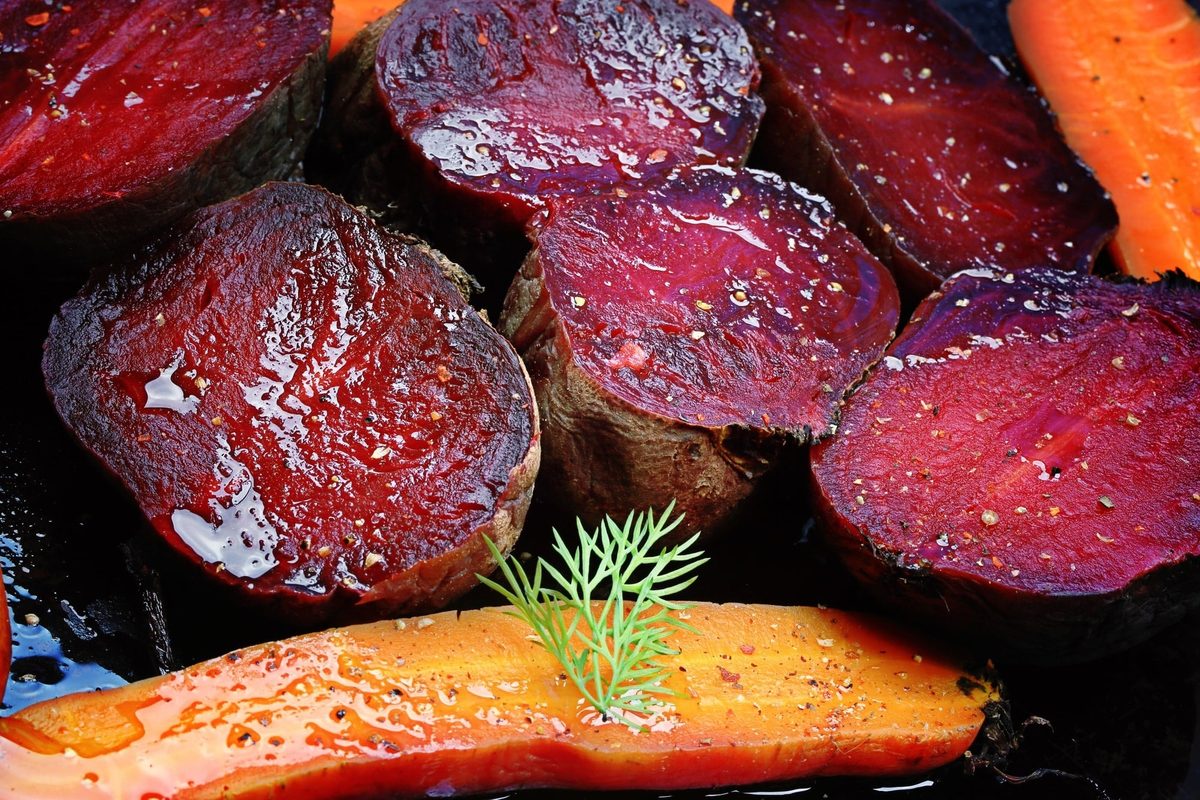
Roasted beets need little more than oil, salt and pepper. Oregon State University’s Food Hero recipe roasts a pound of beets at 400°F with 2 teaspoons of vegetable oil, 1/4 teaspoon each of salt and black pepper, and suggests trying thyme or cumin.1 Rutgers Cooperative Extension uses olive oil, salt, pepper and a sprinkle of Italian herbs at the same oven temperature.2 This page covers what each seasoning does, the facts behind the “low smoke point” warning about olive oil, and sweet glazes. Quantities appear only where a named recipe gives them.
At a glance
| Seasoning | Job | Notes |
|---|---|---|
| Oil (olive or vegetable) | Carries heat and seasoning | 2 tsp vegetable oil per lb (OSU); 2 tbsp olive oil for 8 to 10 beets (Rutgers)12 |
| Salt | Seasoning | 1/4 tsp per lb in the OSU recipe1 |
| Black pepper | Gentle bite | 1/4 tsp per lb in the OSU recipe1 |
| Thyme | Woodsy herbal counterpoint to the sweetness | Suggested by OSU1 |
| Cumin | Warm, earthy spice | Suggested by OSU1 |
| Italian herbs | Mixed herbal note | Rutgers recipe2 |
| Balsamic glaze, honey or maple syrup | Sweet, glossy finish | Optional; in neither recipe |
Two baseline recipes
| Oregon State Food Hero (4 servings)1 | Rutgers Cooperative Extension2 | |
|---|---|---|
| Beets | 1 lb (3 to 4 medium) | 8 to 10 fresh beets |
| Oil | 2 tsp vegetable oil | 2 tbsp olive oil |
| Seasoning | 1/4 tsp salt, 1/4 tsp black pepper; try thyme or cumin | A sprinkle of salt, pepper and Italian herbs |
| Oven | 400°F, 45 to 60 minutes | 400°F, 35 minutes |
These are the extension services’ own recipes, not a house standard.
Why beets taste earthy
Beet is Beta vulgaris, a member of the Amaranthaceae.3 Its earthy aroma comes from geosmin, a volatile terpenoid, and a 2019 study in the Journal of the American Society for Horticultural Science found that genotype is the main source of variation in geosmin concentration among table beets.4 Seasoning choices that play against that earthiness (herbs, a bright acid, something sweet) are a matter of taste.
The seasonings and what each one does
Oil, and the olive oil smoke point question
Both recipes coat the beets in oil before roasting at 400°F: vegetable oil in the OSU recipe, olive oil in Rutgers’.12
A widely repeated warning says extra virgin olive oil has a low smoke point and turns toxic at roasting temperatures. One laboratory study does not support treating smoke point as the test. De Alzaa, Guillaume and Ravetti (Modern Olives Laboratory Services, Australia) heated a range of commercial oils and found that smoke point does not predict how an oil performs when heated.5 In their tests, extra virgin olive oil produced low levels of polar compounds and oxidative by-products, and its smoke point after both heating treatments averaged 191.6°C (about 377°F).5 That is one laboratory study, not a regulator’s ruling. Either oil in the recipes above is a reasonable choice; flavor is the main difference, and that is a matter of taste.
Salt and black pepper
The OSU recipe uses 1/4 teaspoon each of salt and black pepper per pound of beets.1 Black pepper’s characteristic flavor comes mainly from piperine.6 Fresh grinding is a matter of preference; we found no measurement of fresh versus pre-ground pepper on vegetables. See black pepper and sea salt.
Thyme
The OSU recipe suggests thyme as an added seasoning.1 Thyme (Thymus vulgaris) is in the mint family, Lamiaceae,7 and its sharp, savory character comes from an oil whose characteristic constituents are thymol and carvacrol.8 Fresh and dried both work. A common claim says dried thyme is weaker than fresh; the University of Delaware’s general rule is that dried herbs are stronger, with 3/4 to 1 teaspoon dried equal to 2 to 3 teaspoons fresh.9 See thyme, fresh vs. dried thyme and lemon thyme.
Cumin and other spices
Cumin is the OSU recipe’s other suggestion.1 Its warm, earthy flavor is a natural match for an earthy vegetable; that pairing judgment is ours. See cumin and cumin uses.
Sweet glazes: balsamic, honey, maple syrup
Neither extension recipe uses a glaze.12 Balsamic glaze, honey and maple syrup are common finishes for roasted root vegetables. Balsamic adds acidity and fruit along with sweetness; honey adds a floral sweetness; maple syrup is the usual swap for honey in vegan cooking. These are flavor judgments, not sourced claims. A practical starting point (Method): toss the hot roasted beets in a spoonful of glaze after they come out of the oven, then season again with salt.
Related
- Sweet potato spices and spices for butternut squash
- Kale spices and eggplant spices
- Thyme substitutes and cumin substitutes
- The master list of herbs and spices
Footnotes
-
“Roasted Beets”, Food Hero, Oregon State University Extension Service. extension.oregonstate.edu · Reference work ↩ ↩2 ↩3 ↩4 ↩5 ↩6 ↩7 ↩8 ↩9 ↩10 ↩11 ↩12
-
“Roasted Beets”, Rutgers Cooperative Extension. extension.rutgers.edu · Reference work ↩ ↩2 ↩3 ↩4 ↩5 ↩6
-
“Beta vulgaris L.”, Plants of the World Online, Royal Botanic Gardens, Kew. powo.science.kew.org · Reference work ↩
-
“Genotype Is Primarily Responsible for Variance in Table Beet Geosmin Concentration…”, Journal of the American Society for Horticultural Science, 2019. journals.ashs.org · Peer-reviewed ↩
-
De Alzaa, Guillaume and Ravetti, “Evaluation of Chemical and Physical Changes in Different Commercial Oils during Heating”, Acta Scientific Nutritional Health, 2018. actascientific.com · Peer-reviewed ↩ ↩2
-
“Black pepper”, Encyclopaedia Britannica. britannica.com · Reference work ↩
-
“Thymus vulgaris L.”, Plants of the World Online, Royal Botanic Gardens, Kew. powo.science.kew.org · Reference work ↩
-
S.H. Widodo, “Thymus vulgaris”, PROSEA. uses.plantnet-project.org · Reference work ↩
-
“Using Herbs and Spices”, University of Delaware Cooperative Extension, revised 2025. udel.edu · Reference work ↩