Cooking · Dish guide
Sweet Potato Spices: Cinnamon for the Sweet Side, Rosemary and Cayenne for the Savory
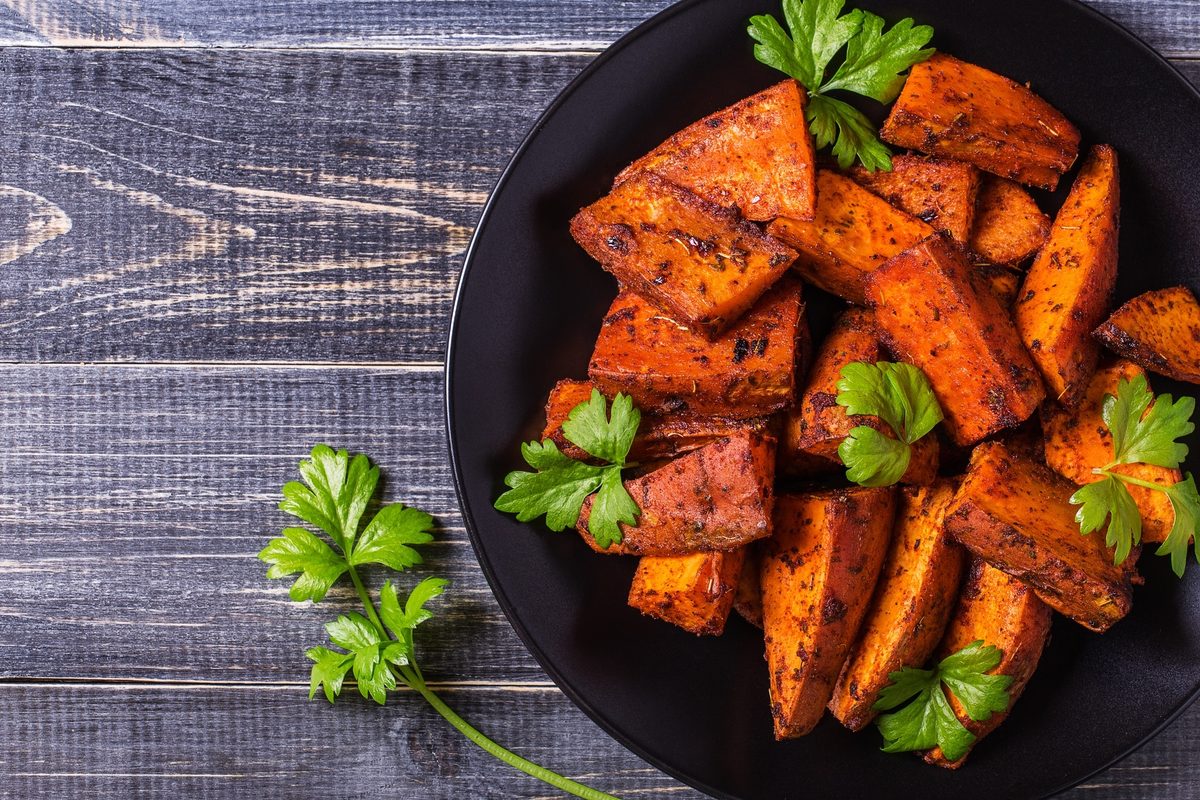
Sweet potatoes go two ways, and the seasoning follows. On the sweet side, cinnamon does nearly all the work: in the two simplest public-health recipes below, it is the only spice besides black pepper. On the savory side, rosemary, black pepper and a little cayenne or chili powder take over. Britannica notes that the roots are served as a cooked vegetable, whole or mashed, and as pie filling,1 so the same tuber ends up in both camps. This page shows what three named recipes use, what each seasoning contributes, and the one safety point worth knowing about the most common spice.
At a glance
| Seasoning | Job | In the recipes below |
|---|---|---|
| Cinnamon | Warm, sweet aroma | Two of three23 |
| Brown sugar | Extra sweetness, light caramel note | One2 |
| Olive oil | Roasting fat | Two of three34 |
| Black pepper | Mild heat | Two of three34 |
| Rosemary | Piney, savory herb | One (dried)4 |
| Cayenne and chili powder | Heat against the sweetness | One4 |
| Pumpkin pie spice | Cinnamon, ginger, nutmeg and allspice in one jar | Suggested by its maker5 |
| Salt | Seasoning | Two of three34 |
Three recipes side by side
| USDA Sweet Potato Casserole2 | Durham County Roasted Sweet Potatoes3 | Taste of Home Roasted Rosemary Sweet Potatoes4 | |
|---|---|---|---|
| Sweet potatoes | 2 3/4 cups canned, drained | 2, in 1-inch cubes (serves 4) | 2 large, in 3/4-inch rounds (serves 4) |
| Fat | None | 2 tbsp olive oil | 1 tbsp olive oil |
| Spice | 1 tsp ground cinnamon | 1/2 tsp ground cinnamon | 1 tsp dried rosemary, 1/2 tsp chili powder, 1/8 tsp cayenne |
| Sweetener | 1 1/2 tsp brown sugar | None | None |
| Salt and pepper | None | 1/4 tsp salt, 1/2 tsp pepper | 1/2 tsp salt, 1/2 tsp pepper |
| Other | Milk and quick oats as a topping | ||
| Cooking | 350°F, 20 minutes | 375°F, 25 to 30 minutes | 425°F, 20 minutes covered, then 10 to 12 uncovered |
These are the publishers’ recipes, not a house standard. The pattern is clear enough: one sweet spice for a sweet dish, or a savory herb plus heat for a roasted side.
The sweet side
Cinnamon: the default
Both government recipes use cinnamon as their only warm spice: a teaspoon in the USDA casserole, half a teaspoon in Durham County’s roasted version.23 Its warm, sweet smell comes mainly from cinnamaldehyde, which a systematic review puts at roughly 49.9 to 62.8% of true cinnamon’s bark oil.6
Most cinnamon sold in North America is cassia rather than Ceylon cinnamon, according to NCCIH.7 That matters only for heavy daily use: Germany’s BfR says a 60 kg adult reaches the tolerable daily intake for coumarin at about 2 g of average cassia a day.8 The recipes above use 1/2 to 1 teaspoon for a whole dish of four or more servings.23 NCCIH’s summary is that research doesn’t clearly support cinnamon for any health condition,7 so there is no reason to add more than tastes right. See Ceylon vs. cassia cinnamon and too much cinnamon.
Pie-spice blends: cinnamon plus
McCormick suggests its pumpkin pie spice on roasted sweet potatoes, carrots or acorn squash; the blend’s label lists cinnamon, ginger, nutmeg and allspice.5 It suggests its apple pie spice for sweet potatoes too.9 A blend is the easy way to add the other warm spices: ginger brings pungency from its gingerols,10 and nutmeg a warm, slightly sweet taste.11 See pumpkin pie spice, ginger, nutmeg and allspice.
Brown sugar and honey
The USDA casserole adds 1 1/2 teaspoons of brown sugar to its cinnamon and oat topping.2 Honey and maple syrup are common alternatives in glazed and candied sweet potatoes (kitchen practice); none of the three recipes here uses them.
The savory side
Rosemary
Taste of Home’s recipe tosses the potatoes with a teaspoon of crushed dried rosemary before roasting.4 Britannica describes rosemary as having a pungent, slightly bitter taste and lists vegetables among the foods it commonly seasons;12 PROSEA attributes its warm, piny scent to α-pinene.13 Kew now classifies it as Salvia rosmarinus, in the same genus as sage.14 See dried vs. fresh rosemary and cooking with rosemary.
Infusing rosemary into butter or oil for a topping is a reasonable variation; none of these recipes does it.
Cayenne and chili powder
The same recipe uses 1/8 teaspoon of cayenne and 1/2 teaspoon of chili powder for two large potatoes,4 a small amount for a strong spice. Capsicum heat comes from capsaicinoids, mainly capsaicin and dihydrocapsaicin.15 McCormick’s science institute notes that ground red pepper is sometimes called cayenne pepper.16 Heat against sweetness is the appeal; how much is a matter of taste. See cayenne pepper uses and chipotle powder for a smoky alternative.
Black pepper and salt
Both roasted recipes use half a teaspoon of pepper with their salt.34 Pepper’s bite comes principally from piperine.17 Grinding it fresh is a common preference rather than something these recipes specify. See cracked vs. ground black pepper.
Olive oil
The two roasted recipes use olive oil, 1 to 2 tablespoons for four servings.34 Melted butter or another oil is a matter of preference.
Sweet potato or yam?
Sweet potatoes (Ipomoea batatas) belong to the morning glory family and are native to tropical America.1 Britannica stresses that they are unrelated to true yams; US growers use “yam” for soft, orange-fleshed sweet potatoes.1 Orange-fleshed varieties are high in carotene.1 Every spice on this page works the same way whichever name is on the bin.
Related
- Thanksgiving herbs and spices
- Pumpkin soup spices and baked potato spices
- Hash brown spices
- Cinnamon vs. nutmeg
- The master list of herbs and spices
Footnotes
-
“Sweet potato”, Encyclopaedia Britannica, 2026. britannica.com · Reference work ↩ ↩2 ↩3 ↩4
-
“Sweet Potato Casserole”, USDA Food Distribution Program on Indian Reservations, via MyPlate. myplate.gov · Regulator ↩ ↩2 ↩3 ↩4 ↩5 ↩6
-
“Roasted Sweet Potatoes”, Durham County Public Health (SNAP-funded). dconc.gov · Regulator ↩ ↩2 ↩3 ↩4 ↩5 ↩6 ↩7 ↩8 ↩9
-
Kristin Stone, “Roasted Rosemary Sweet Potatoes”, Taste of Home, 2023. tasteofhome.com · Publication ↩ ↩2 ↩3 ↩4 ↩5 ↩6 ↩7 ↩8 ↩9 ↩10
-
“McCormick Pumpkin Pie Spice”, McCormick & Company. mccormick.com · Merchant ↩ ↩2
-
Ranasinghe et al., “Medicinal properties of ‘true’ cinnamon”, BMC Complementary and Alternative Medicine, 2013. link.springer.com · Peer-reviewed ↩
-
“Cinnamon: Usefulness and Safety”, NCCIH, 2024. nccih.nih.gov · Regulator ↩ ↩2
-
“Cassia cinnamon with high coumarin contents to be consumed in moderation”, BfR. bfr.bund.de · Regulator ↩
-
“McCormick Apple Pie Spice”, McCormick & Company. mccormick.com · Merchant ↩
-
Sutarno, Hadad and Brink, “Zingiber officinale”, PROSEA. uses.plantnet-project.org · Reference work ↩
-
“Nutmeg”, Encyclopaedia Britannica. britannica.com · Reference work ↩
-
“Rosemary”, Encyclopaedia Britannica, 2026. britannica.com · Reference work ↩
-
C.C. de Guzman, “Rosmarinus officinalis”, PROSEA. uses.plantnet-project.org · Reference work ↩
-
“Salvia rosmarinus Spenn.”, Plants of the World Online, Royal Botanic Gardens, Kew. powo.science.kew.org · Reference work ↩
-
Bosland and Walker, “Measuring Chile Pepper Heat”, New Mexico State University, 2010. pubs.nmsu.edu · Reference work ↩
-
“Red Pepper”, McCormick Science Institute. mccormickscienceinstitute.com · Merchant ↩
-
“Black pepper”, Encyclopaedia Britannica. britannica.com · Reference work ↩