Blog · Dish guide
Thanksgiving Herbs and Spices: Ten Seasonings, Dish by Dish
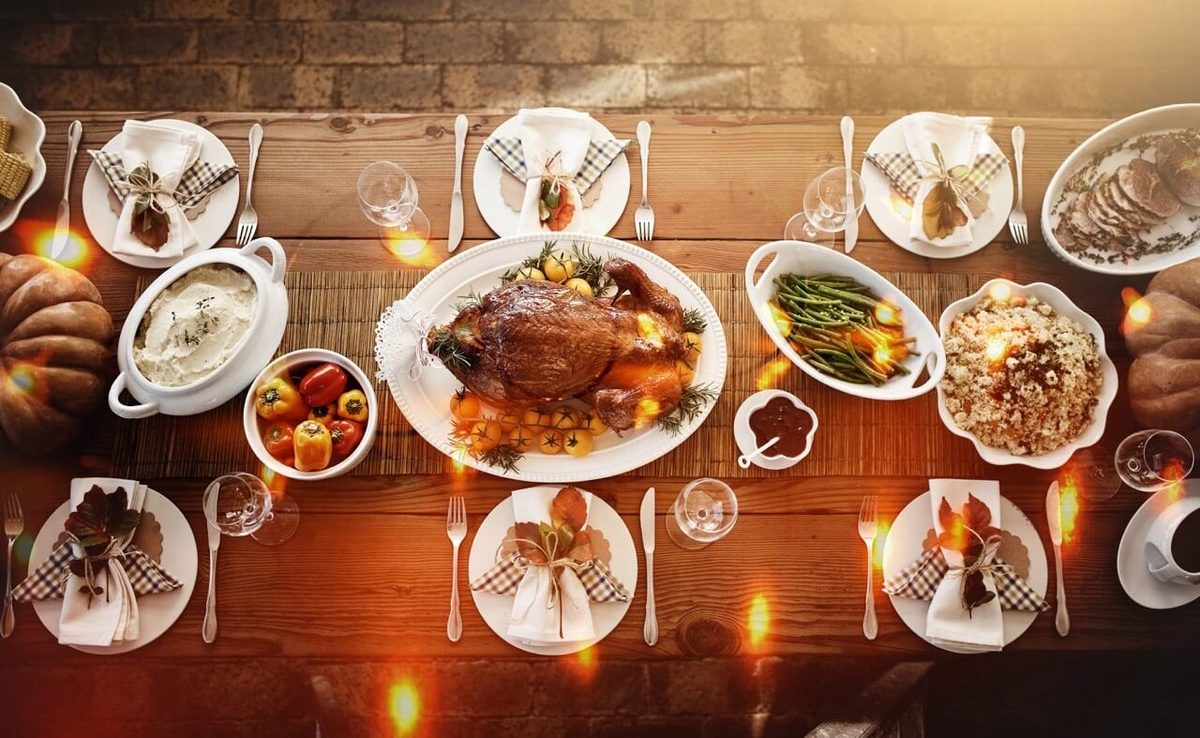
A Thanksgiving table runs on two sets of seasonings. The savory side (turkey, stuffing, gravy) is built on four herbs: sage, thyme, rosemary and marjoram, often bought together as poultry seasoning, plus a bay leaf in the gravy. The sweet side (pumpkin pie, cranberry sauce, sweet potatoes) uses the warm baking spices: cinnamon, ginger, nutmeg, allspice and cloves. Those ten are the essentials. Some of these pairings are old: Amelia Simmons’s American Cookery, printed in 1796, already spices its “pompkin” pies with nutmeg, mace, allspice and ginger.1 This page lists the ten dish by dish, with what each one does and the few safety points worth knowing.
At a glance
| Seasoning | Where it shows up at Thanksgiving | Main aroma compound or note |
|---|---|---|
| Sage | Stuffing; poultry seasoning; optional in gravy234 | Thujones give its strong smell2 |
| Thyme | Gravy; stuffing; poultry seasoning5463 | Thymol and carvacrol7 |
| Rosemary | Poultry seasoning; optional in gravy34 | Pungent, slightly bitter8 |
| Marjoram | Poultry seasoning39 | Warm, slightly sharp, bitterish10 |
| Bay leaf | Gravy broth54 | See bay leaves |
| Cinnamon | Pumpkin pie spice, cranberry sauce, sweet potatoes111213 | See cinnamon |
| Ginger | Pumpkin pie spice, cranberry sauce, 1796 pumpkin pies11141 | Gingerols give its bite15 |
| Nutmeg | Pumpkin pie spice; 1796 pumpkin pie111 | Warm, slightly sweet16 |
| Allspice | Pumpkin pie spice; 1796 pumpkin pie; gravies11117 | Eugenol17 |
| Cloves | Some pumpkin pie spice recipes; cranberry sauce1814 | Eugenol, 70 to 90% of bud oil19 |
The savory side: turkey, stuffing and gravy
Sage
Sage is the classic stuffing herb. PROSEA lists stuffings among its main uses as a spice and names the United States as the biggest user, at about 4,000 tonnes a year.2 Yankee Magazine describes New England bread stuffing as lightly seasoned, with sage and thyme the dominant herbs.6 Its strong, characteristic smell comes from thujones.2 NCCIH says sage is likely safe in the amounts commonly found in foods.20 Fresh or dried both work. See good stuffing spices, fresh vs. dried sage and too much sage.
Thyme
Thyme is sage’s partner in stuffing6 and the one herb both turkey gravy recipes we checked agree on: America’s Test Kitchen simmers four sprigs in its giblet broth, Food Network three sprigs of thyme and/or other herbs.54 Its oil’s characteristic constituents are thymol and carvacrol.7 America’s Test Kitchen allows dried thyme in place of fresh.5 See turkey gravy spices and fresh vs. dried thyme.
Rosemary
Britannica describes rosemary’s pungent, slightly bitter taste and says it is commonly used to season meats, vegetables and soups.8 At Thanksgiving it usually arrives inside poultry seasoning (it is in McCormick Culinary’s blend)3 or as an optional sprig in the gravy broth.4 One sprig is enough to start (our suggestion). See rosemary vs. thyme and rosemary vs. sage.
Marjoram
Marjoram is the quiet member of the group. Britannica describes a warm, aromatic, slightly sharp and bitterish flavor.10 It appears in both of the poultry seasoning blends below.39 See marjoram vs. oregano and marjoram substitutes.
Poultry seasoning: four herbs in one jar
Poultry seasoning puts several of these herbs in one jar. McCormick Culinary’s lists thyme, sage, marjoram, rosemary, black pepper and nutmeg.3 Bell’s, the New England blend, lists rosemary, oregano, sage, ginger, marjoram, thyme and pepper,9 and the Hagley Museum dates it to 1867.21 Yankee’s history notes that this was four years after Abraham Lincoln declared Thanksgiving a federal holiday in 1863.9 See poultry seasoning and poultry seasoning substitutes.
Bay leaf
Both gravy recipes simmer one bay leaf in the giblet broth,54 and America’s Test Kitchen strains the broth before making the gravy.5 J. Kenji López-Alt, speaking to The Splendid Table, says bay brings out the meaty flavors of beef and chicken, a cook’s view rather than a measured effect, and compares biting into a leaf to eating a fish bone.22 Take it out. A widely repeated claim says bay leaves tenderize meat; no source we checked supports it. See cooking with bay leaves.
The sweet side: pies, cranberry sauce and sweet potatoes
Pumpkin pie spice: the blend
There is no single formula. McCormick’s pumpkin pie spice, which the company says it has sold since 1934, lists cinnamon, ginger, nutmeg and allspice;11 Oregon State University Extension’s homemade version uses 2 tablespoons cinnamon, 1 tablespoon ginger, and 1 1/2 teaspoons each of nutmeg and cloves.18 Simmons’s two 1796 recipes use mace, nutmeg and ginger in one, allspice and ginger in the other.1 McCormick also suggests the blend for roasted sweet potatoes.11 See pumpkin pie spice and pumpkin pie spice substitutes.
Cinnamon
Cinnamon is listed first in McCormick’s blend and is the largest quantity in Oregon State’s recipe.1118 It is also the most common cranberry sauce spice, at 1/2 teaspoon in two of the three recipes on our cranberry sauce page,1412 and the only warm spice in the USDA’s sweet potato casserole.13 Most cinnamon sold in North America is cassia.23 See sweet potato spices and Ceylon vs. cassia cinnamon.
Ginger
Ginger is in the McCormick blend, the Oregon State recipe and both 1796 pumpkin pies.11181 Stephanie Hua’s cranberry sauce for KQED uses a tablespoon of grated fresh ginger.14 Its bite comes from the gingerols, non-volatile phenolic compounds.15 See fresh vs. ground ginger.
Nutmeg
Britannica describes nutmeg’s distinctive pungent fragrance and warm, slightly sweet taste.16 Simmons’s first pumpkin pie uses it with mace and ginger.1 Grating it fresh is common advice; see fresh vs. ground nutmeg and cinnamon vs. nutmeg.
Allspice
Allspice is a single spice, the dried berry of Pimenta dioica; Britannica says it was named because its flavor resembles a combination of cinnamon, nutmeg and cloves.24 It is in McCormick’s blend and Simmons’s second pumpkin pie.111 It also crosses to the savory side: PROSEA notes that whole berries are used in meat broth and gravies, and that eugenol is 50 to 80% of the berry oil.17 See allspice vs. cloves and allspice vs. nutmeg.
Cloves
Britannica describes cloves as strong in aroma and hot and pungent in taste, used particularly for meats and bakery products.25 Eugenol makes up 70 to 90% of clove bud oil.19 Cloves go into Oregon State’s pumpkin pie spice and, at 1/8 teaspoon, into the KQED cranberry sauce.1814 Studding a holiday ham with whole cloves is common practice rather than something these sources document. See ground vs. whole cloves and too much clove.
Safety notes
- Nutmeg in large amounts. The National Capital Poison Center says nutmeg tastes great in cookies and eggnog but too much can cause hallucinations; kitchen spices are not dangerous used as recommended.26 The Tennessee Poison Center puts reported effects at 15 to 20 grams, about two to three tablespoons of ground nutmeg, far above any pie recipe.27 See too much nutmeg.
- Cassia and coumarin. Germany’s BfR says a 60 kg adult reaches the tolerable daily intake for coumarin at about 2 g a day of average cassia.28 That matters for heavy daily use, not a holiday meal. NCCIH’s summary is that research doesn’t clearly support cinnamon for any health condition.23
- Stuffing temperature. USDA’s Food Safety and Inspection Service recommends cooking stuffing in a casserole and checking that it reaches 165°F on a food thermometer.29
Related
- Spices for turkey
- Christmas spices
- Pumpkin soup spices
- Green bean casserole spices
- The master list of herbs and spices
Footnotes
-
Amelia Simmons, American Cookery, 1796, via Project Gutenberg. gutenberg.org · Reference work ↩ ↩2 ↩3 ↩4 ↩5 ↩6 ↩7 ↩8
-
U.A. Dasuki, “Salvia officinalis”, PROSEA. uses.plantnet-project.org · Reference work ↩ ↩2 ↩3 ↩4
-
“Poultry Seasoning, 12 oz”, McCormick Culinary. mccormick.com · Merchant ↩ ↩2 ↩3 ↩4 ↩5 ↩6 ↩7
-
“Classic Turkey Gravy”, Food Network Kitchen, Food Network. foodnetwork.com · Publication ↩ ↩2 ↩3 ↩4 ↩5 ↩6 ↩7
-
“Make-Ahead Giblet Turkey Gravy”, America’s Test Kitchen, 2011. americastestkitchen.com · Publication ↩ ↩2 ↩3 ↩4 ↩5 ↩6
-
“Bread Stuffing”, Yankee Magazine, 2007. newengland.com · Publication ↩ ↩2 ↩3
-
S.H. Widodo, “Thymus vulgaris”, PROSEA. uses.plantnet-project.org · Reference work ↩ ↩2
-
“Rosemary”, Encyclopaedia Britannica, 2026. britannica.com · Reference work ↩ ↩2
-
Aimee Tucker, “Bell’s Seasoning: A New England Thanksgiving Classic”, Yankee Magazine, 2021. newengland.com · Publication ↩ ↩2 ↩3 ↩4
-
“Marjoram”, Encyclopaedia Britannica. britannica.com · Reference work ↩ ↩2
-
“McCormick Pumpkin Pie Spice”, McCormick & Company. mccormick.com · Merchant ↩ ↩2 ↩3 ↩4 ↩5 ↩6 ↩7 ↩8 ↩9
-
“Simple Cranberry Sauce”, Texas A&M AgriLife Extension. efnep.tamu.edu · Reference work ↩ ↩2
-
“Sweet Potato Casserole”, USDA Food Distribution Program on Indian Reservations, via MyPlate. myplate.gov · Regulator ↩ ↩2
-
Stephanie Hua, “Orange and Ginger Spiced Cranberry Sauce”, KQED Bay Area Bites, 2011. kqed.org · Publication ↩ ↩2 ↩3 ↩4 ↩5
-
Sutarno, Hadad and Brink, “Zingiber officinale”, PROSEA. uses.plantnet-project.org · Reference work ↩ ↩2
-
“Nutmeg”, Encyclopaedia Britannica. britannica.com · Reference work ↩ ↩2
-
D. Sulistiarini, “Pimenta dioica”, PROSEA. uses.plantnet-project.org · Reference work ↩ ↩2 ↩3
-
“Pumpkin Pie Spice”, Food Hero, Oregon State University Extension Service. extension.oregonstate.edu · Reference work ↩ ↩2 ↩3 ↩4 ↩5
-
Verheij and Snijders, “Syzygium aromaticum”, PROSEA. uses.plantnet-project.org · Reference work ↩ ↩2
-
“Sage”, NCCIH, 2025. nccih.nih.gov · Regulator ↩
-
Chris Cascio, “A Seasoning for the Holiday Season”, Hagley Museum and Library, 2025. hagley.org · Reference work ↩
-
David Leite with J. Kenji López-Alt, “Bay leaves are an optional ingredient”, The Splendid Table, 2014. splendidtable.org · Publication ↩
-
“Cinnamon: Usefulness and Safety”, NCCIH, 2024. nccih.nih.gov · Regulator ↩ ↩2
-
“Allspice”, Encyclopaedia Britannica. britannica.com · Reference work ↩
-
“Clove”, Encyclopaedia Britannica. britannica.com · Reference work ↩
-
Rose Ann Gould Soloway, “Kitchen surprises and cautions”, National Capital Poison Center. poison.org · Reference work ↩
-
Nena Bowman, “Nutmeg, a Potentially Uninvited Holiday Guest?”, Tennessee Poison Center, 2020. vumc.org · Reference work ↩
-
“Cassia cinnamon with high coumarin contents to be consumed in moderation”, BfR. bfr.bund.de · Regulator ↩
-
“Stuffing and Food Safety”, USDA Food Safety and Inspection Service, 2013. fsis.usda.gov · Regulator ↩