Spice Substitutes · Substitutes
Tajín Substitutes: A Homemade Chili-Lime Salt and What Else Works
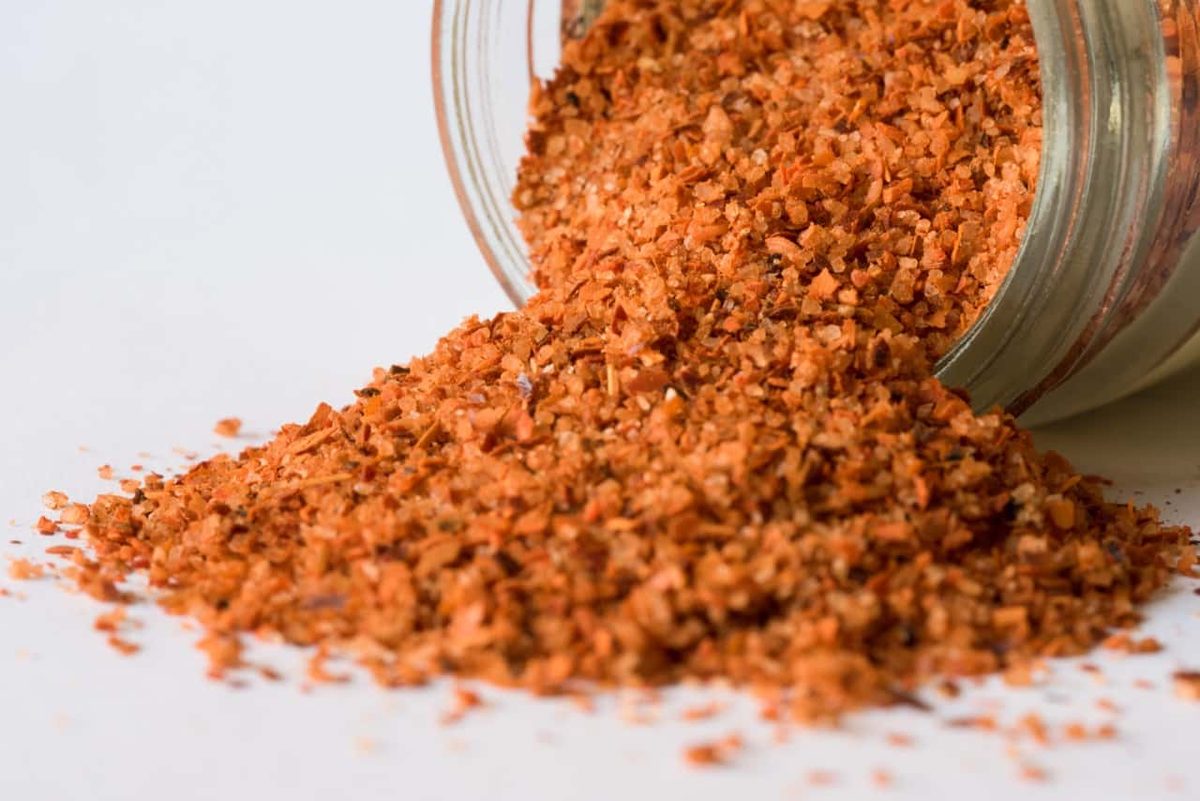
Tajín Clásico has a short label: chili peppers, sea salt, citric acid, then “contains 0.5% or less of dehydrated lime juice,” and silicon dioxide to keep it flowing.1 Three things follow. It is salty: one 1/4-teaspoon serving carries 190 mg of sodium.1 Its sourness comes mostly from citric acid, since the lime juice is half a percent or less.1 And its chile is mild; the retailer listing calls it a blend of lime, mild chili peppers and sea salt.1 A good substitute needs all three: salt, sour and mild chile.
Quick answer
| What the Tajín is doing | Best substitute | Starting amount, per 1 teaspoon Tajín | Treatment |
|---|---|---|---|
| On fresh fruit or vegetables | Homemade chili-lime salt | About 1/3 tsp table salt, 2/3 tsp mild chile powder, a pinch of citric acid | Computed (salt), Method (rest) |
| On a margarita or michelada rim | The same homemade mix, or salt plus lime zest and chile | As above | Computed (salt), Method (rest) |
| Seasoning chicken, fish or corn, where chile is optional | Lemon pepper | 1 tsp | Computed (salt) |
| Savory dishes, when you have chili powder and za’atar | Chili powder plus a little za’atar, plus salt | 1/2 tsp each, plus about 1/3 tsp table salt | Computed (salt), Method (spices) |
| A wet dish, where liquid is fine | Cholula hot sauce plus lime juice | A few dashes, then taste | Method |
How the ratios on this page are labeled
Every ratio carries one of four labels.
- Computed: based on a measurable physical relationship, with the source named.
- Attributed: a named source publishes this ratio. We quote it as theirs.
- Disputed: named sources give different answers to the same swap. We show each one and do not average them.
- Method: we found no published ratio. We give a direction and a cautious starting point, and say so.
Every Computed figure here concerns salt only, worked out from sodium on Nutrition Facts labels and USDA data. We found no credible published recipe that copies Tajín and no published ratio for any substitute.
If it is on fresh fruit or vegetables
TODAY describes Tajín’s classic use as a sprinkle on fruit such as mango and watermelon.2 Here the salt and sourness matter as much as the chile.
Homemade chili-lime salt
Salt (Computed): A teaspoon of Tajín is four servings, about 760 mg of sodium.1 Morton table salt lists 590 mg per 1/4 teaspoon,3 so about 1/3 teaspoon of table salt carries the same.
Chile and acid (Method): Make up the rest of the teaspoon, about 2/3 teaspoon, with a mild, pure ground chile rather than a chili powder blend, plus a small pinch of citric acid or 1/4 teaspoon of finely grated lime zest. Tajín’s label does not name its chiles, and TODAY reports that the blend of chiles varies by product.12 Forbes notes that the chile de árbol de Jalisco appears in Tajín’s logo,4 but that is not an ingredient list. Taste the mix on a slice of fruit and adjust the sour first.
Citric acid gives the cleanest match, since it is what Tajín itself relies on.1 Fresh lime zest gives a more aromatic, less sharply sour result. Fresh lime juice will turn the powder into a paste; use it only if you are seasoning the fruit right away. Those last points are cooking judgment.
If it is on a margarita or michelada rim
TODAY notes Tajín’s use on margarita and michelada rims.2 The homemade mix above works. So does a simpler rim of coarse salt with finely grated lime zest and a pinch of chile.
Ratio (Method): No published ratio. For a rim, texture matters more than an exact match: keep the salt coarse enough to stick, and add chile a pinch at a time.
If it is seasoning chicken, fish or corn
Lemon pepper
McCormick describes its lemon pepper as black pepper, lemon oil, salt and a touch of onion and garlic.5 It shares Tajín’s salt and citrus, but its heat comes from black pepper, not chile, and it lists FD&C Yellow No. 5 Lake, so it colors food yellow rather than red.5 It is a better fit for savory food than for fruit.
Ratio (Computed, salt only): McCormick’s lemon pepper lists 170 mg of sodium per 1/4 teaspoon,5 about 89 percent of Tajín’s 190 mg.1 Use it 1:1.
If it is in a savory dish and you have chili powder and za’atar
Chili powder plus za’atar
This combination supplies chile from one jar and sourness from the other. The USDA’s purchasing specification lists ground chili pepper, cumin, oregano, salt and garlic powder for chili powder,6 so the cumin and oregano will show. Za’atar brings the sour: UC Cooperative Extension Master Food Preservers describe it at its most basic as sumac, thyme, oregano and sesame seeds,7 and Gernot Katzer lists malic, citric and tartaric acids among sumac’s components.8 The herbs and sesame take it well away from Tajín, so it suits grilled meat or roasted vegetables better than fruit.
Ratio (Computed for the salt, Method for the spices): Start with 1/2 teaspoon of each per teaspoon of Tajín. USDA data put chili powder’s sodium at 2,870 mg per 100 g, with 2.7 g in a teaspoon,9 which is only about 77 mg a teaspoon. Za’atar recipes may or may not include salt. Half a teaspoon of chili powder adds under 40 mg, so unless your za’atar is salted, add about 1/3 teaspoon of table salt to match Tajín’s sodium (our arithmetic from the labels).139
If it is in a wet dish
Cholula and lime juice
Cholula Original lists water, árbol and piquín peppers, salt, vinegar, garlic powder, spices and xanthan gum.10 It brings chile, salt and acid, but as a liquid, with vinegar in place of citrus and some garlic. It works in a marinade, a ceviche-style dressing or a michelada itself, not as a sprinkle.
Ratio (Method): No published ratio, and the listing we read gave no sodium figure. Add a few dashes, then a squeeze of lime, and taste before salting.
Loomi (dried lime), for the sour only
Loomi is made from ripe limes boiled in salt water and dried in the sun until the inside turns dark, and is sold whole or powdered.11 Saveur describes its flavor as at once sour and musky.12 Powdered loomi can add sourness to a homemade chili-lime mix, but its musky, fermented note is not Tajín’s clean citric tang.
Ratio (Method): No published ratio. Use it in place of the citric acid in the homemade mix above, starting with about 1/4 teaspoon per teaspoon of mix, and taste for salt.
What isn’t known
- Tajín does not publish which chiles it uses or in what proportions, so no homemade mix can be shown to match it.
- A widely repeated claim says Tajín is made from guajillo, chile de árbol and pasilla. The label does not say so, and we found no source that confirms it.
- We found no published recipe from a test kitchen, extension service or bylined cookbook author that recreates Tajín.
- No sodium figure was available for Cholula on the listing we read, so its salt contribution is not computed.
Related
- Tajín seasoning
- Chili powder, chili powder substitutes, chile de árbol powder, guajillo powder, ancho powder, chipotle powder
- Lemon pepper and lemon pepper substitutes
- Loomi and loomi substitutes, sumac, za’atar
- Sea salt, good Mexican spices for chicken
Footnotes
-
Tajín Clásico Seasoning, H-E-B retailer listing. heb.com · Merchant ↩ ↩2 ↩3 ↩4 ↩5 ↩6 ↩7 ↩8 ↩9
-
“The rise of Tajín”, TODAY.com. today.com · Publication ↩ ↩2 ↩3
-
Morton Iodized Table Salt, Morton Salt. mortonsalt.com · Merchant ↩ ↩2
-
Chloe Sorvino, “Meet Mexico’s first Chili-onaire”, Forbes Australia, 2025. forbes.com.au · Publication ↩
-
McCormick Lemon & Pepper Seasoning, McCormick & Company. mccormick.com · Merchant ↩ ↩2 ↩3
-
Commercial Item Description A-A-20001C, Spices and Spice Blends, USDA Agricultural Marketing Service, 2023. ams.usda.gov · Regulator ↩
-
Za’atar Spice Blend, UC Cooperative Extension Master Food Preservers of El Dorado County. ccfruitandnuts.ucanr.edu · Reference work ↩
-
Gernot Katzer, Sumac, Gernot Katzer’s Spice Pages. gernot-katzers-spice-pages.com · Reference work ↩
-
Spices, chili powder, FDC ID 171319, USDA FoodData Central. fdc.nal.usda.gov · Regulator ↩ ↩2
-
Cholula Hot Sauce Original, product page, Whole Foods Market. wholefoodsmarket.com · Merchant ↩
-
Gernot Katzer, Lime (Citrus aurantifolia), Gernot Katzer’s Spice Pages. gernot-katzers-spice-pages.com · Reference work ↩
-
Gabriella Gershenson, “Sour Power: Cooking With Dried Limes”, Saveur, 2011. saveur.com · Publication ↩