Spices · Profile
Bajan Seasoning: The Wet Herb, Onion and Pepper Paste of Barbados
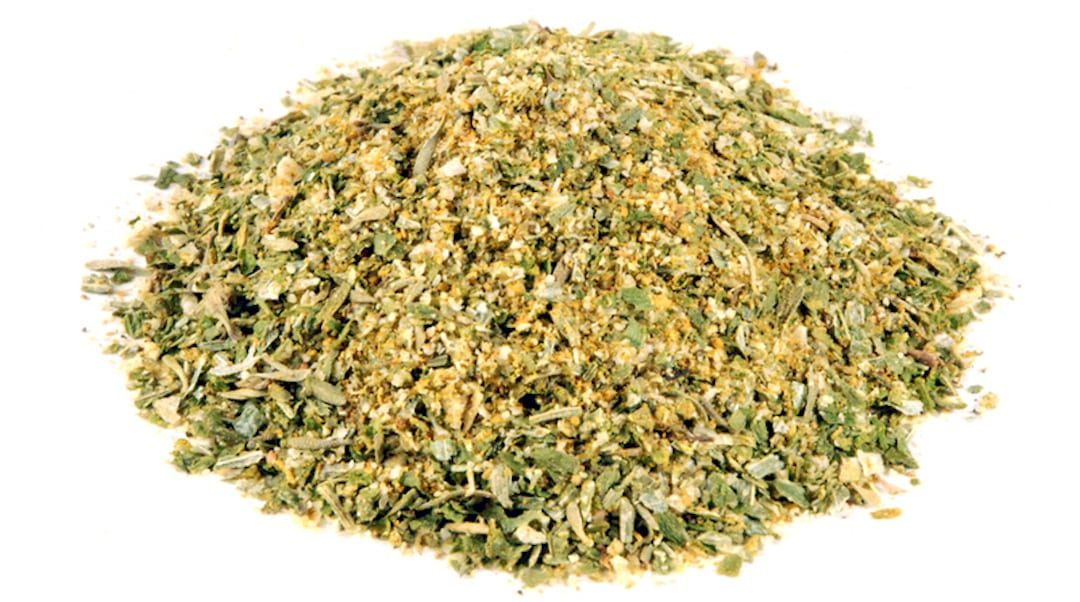
Bajan seasoning is a wet, green paste from Barbados, made by grinding onion, green onion, garlic, fresh thyme and marjoram, parsley and hot pepper, usually with salt and often with vinegar and a warm spice such as cloves or allspice.12 It is rubbed into slits in fish or pushed under the skin of chicken before cooking.12 “Bajan” means a native or inhabitant of Barbados, a shortened form of “Barbadian.”3 This page covers what goes into it, where those ingredients come from, the compounds behind its flavor, and how to make, use and store it.
At a glance
| What it is | A fresh herb, allium and hot-pepper paste, not a dry spice blend12 |
| Where it is from | Barbados, an island country in the southeastern Caribbean Sea4 |
| Core ingredients | Onion, green onion, garlic, thyme, marjoram, parsley, hot pepper, salt12 |
| Warm spice | Ground cloves in one recipe, allspice berries in another12 |
| Fixed recipe? | No; the two recipes below differ in spice, acid and proportion12 |
| Typical uses | Fish (in the cavity or rubbed into slits); chicken (under the skin)12 |
| Keeping | From 1 week to at least 6 months in the refrigerator, depending on the recipe12 |
What is in it
There is no single recipe. Two bylined versions show the common ground and the differences:
| Dave DeWitt, from Ann Marie Whittaker (yields 2 to 3 cups)1 | Ainsley Harriott, fish seasoning (enough for 2 whole fish)2 | |
|---|---|---|
| Onion | 1 lb onions | 1 red onion |
| Green onion | 5 oz | 2 spring onions (scallions) |
| Garlic | 8 cloves | 2 cloves |
| Hot pepper | 4 bonney peppers, or habaneros | 1/2 Scotch bonnet, seeded |
| Thyme | 2 oz fresh | 2 sprigs |
| Marjoram | 2 oz fresh | 1 sprig |
| Parsley | 2 oz fresh | 1 small bunch |
| Warm spice | 1 tsp ground cloves | 3 allspice berries, finely ground |
| Black pepper | 1/4 tsp | none |
| Acid and other | 1 1/2 cups vinegar, 2 tbsp Worcestershire sauce | none |
| Salt | 3 tbsp | 1/2 tsp |
Both are ground to a paste.12 The DeWitt version is a large, vinegary, salty batch meant to be kept; the Harriott version is a small fresh batch for one meal. Whittaker, quoted by DeWitt, says this seasoning is found in almost every home in Barbados.1
Where the ingredients come from
A common claim is that every ingredient in Bajan seasoning came from the Mediterranean. The native ranges recorded by Kew’s Plants of the World Online show a wider spread:
| Ingredient | Native range | Source |
|---|---|---|
| Thyme (Thymus vulgaris) | Southwestern Europe and southeastern Italy | 5 |
| Marjoram (Origanum majorana) | Southern Türkiye and Cyprus | 6 |
| Parsley (Petroselinum crispum) | Northwestern Africa and the Balkan Peninsula | 7 |
| Garlic (Allium sativum) | Central Asia to northeastern Iran | 8 |
| Onion (Allium cepa) | Known as a cultigen from Central Asia | 9 |
| Allspice (Pimenta dioica) | Southern Mexico to Central America and the Caribbean | 10 |
| Cloves (Syzygium aromaticum) | Maluku (the Moluccas) | 11 |
So the herbs are Mediterranean, the alliums are Central Asian, the cloves come from the Moluccas and the allspice is from the Caribbean region. The hot pepper is a Capsicum chinense type (Scotch bonnet or the local “bonney” pepper),12 and Gernot Katzer’s Spice Pages notes that the extreme heat of chinense cultivars matters in Caribbean cookery.12
The name Barbados
The island’s name is usually traced to Portuguese: a 2024 Cari-Bois News report republished by Global Voices says the Portuguese called it “Los Barbados,” meaning “the bearded ones,” after the bearded fig trees that dominated the landscape.13 Stories crediting a particular Portuguese navigator with naming the island on a voyage to Brazil were not documented in any source we could open, and we found no source tying Bajan seasoning’s herbs to Portuguese influence.
Flavor and the compounds behind it
Bajan seasoning tastes green, oniony and hot, with thyme’s sharpness, a sweet herbal note from marjoram and a clove-like warmth in the background. That description is ours. The chemistry belongs to the ingredients:
| Ingredient | Compounds named in the sources | Source |
|---|---|---|
| Thyme | Thymol and carvacrol are the characteristic constituents of the oil | 14 |
| Marjoram | Cis-sabinene hydrate is credited with the sweet marjoram flavor | 15 |
| Cloves | Eugenol makes up 70 to 90% of bud oil | 16 |
| Allspice | Eugenol makes up 50 to 80% of berry oil | 17 |
| Hot pepper | Heat from Capsicum chinense | 12 |
Cloves and allspice share eugenol,1617 which is why the two recipes can use one or the other for a similar warm note. That last point is our inference from the shared compound, not a tested swap.
Compared with jerk. Jerk shares several ingredients: the Smithsonian’s history of jerk names pimento (allspice) and Scotch bonnet as essential, and lists scallions, garlic and thyme among modern ingredients.18 Bajan seasoning as written in the recipes above leans harder on fresh herbs (marjoram and parsley as well as thyme) and uses only a little warm spice.12 See jerk seasoning.
How Bajan seasoning is used
- Fish. Harriott says the seasoning is usually stuffed into the fish’s cavity in Barbados; he cuts four or five deep slashes on each side instead and rubs it in, then leaves the fish 20 minutes before cooking.2
- Chicken. DeWitt reports that a favorite use is to place it between the meat and skin of chicken pieces before grilling, baking or frying.1
- The national dish. Cou-cou and flying fish is Barbados’s national dish.1319 Saveur describes cou-cou as a cornmeal-and-okra porridge; its version seasons the fish with thyme, scallions, garlic and Scotch bonnet, though it does not call that mixture Bajan seasoning.19 Global Voices reports that flying fish landings have fallen by almost half since 2011, according to Barbados’s Chief Fisheries Officer.13
Pork, beef and curries are also seasoned this way in home cooking, but we found no source that documents it.
Making and storing it
Grind everything to a paste in a food processor.12 DeWitt’s version processes the onions, green onion, garlic and peppers to a coarse paste, blends the herb leaves with the vinegar, then combines both with the remaining ingredients.1
How long it keeps depends on the recipe:
| Recipe | Storage | Source |
|---|---|---|
| DeWitt/Whittaker (with vinegar and 3 tbsp salt) | Refrigerate and let sit 1 week before using; keeps at least 6 months in the refrigerator | 1 |
| Harriott (no vinegar, 1/2 tsp salt) | Clean, airtight jar in the refrigerator, up to 1 week | 2 |
Those figures are each recipe author’s own. We found no tested shelf life for homemade Bajan seasoning from a food-safety agency, so treat the low-salt, vinegar-free version as a fresh paste and keep it cold.
Safety
Bajan seasoning raises no safety issue specific to the blend. The hot pepper is the part to handle with care: seed it, as Harriott does,2 and keep it away from eyes. The DeWitt batch carries 3 tablespoons of salt in 2 to 3 cups of paste,1 so taste before salting the dish.
Health claims
Claims that Bajan seasoning helps with constipation, prevents food poisoning or stimulates digestive enzymes could not be traced to any study of the blend or of its herbs at seasoning amounts. This page makes no health claim for it.
Substitutes and comparisons
- Jerk seasoning and jerk seasoning substitutes
- Caribbean spices and Jamaican spices
- Jamaican curry powder
The individual ingredients: thyme, marjoram (and marjoram vs. oregano), parsley, garlic, chives vs. green onions, cloves, allspice (and allspice vs. cloves), habanero powder and black pepper.
Footnotes
-
Dave DeWitt, “Bajan Seasoning” (recipe from Ann Marie Whittaker), Fiery Foods Central, 2015. fieryfoodscentral.com · Publication ↩ ↩2 ↩3 ↩4 ↩5 ↩6 ↩7 ↩8 ↩9 ↩10 ↩11 ↩12 ↩13 ↩14 ↩15 ↩16 ↩17 ↩18
-
Ainsley Harriott, “Bajan fish seasoning”, from Ainsley Harriott’s Street Food, SBS Food. sbs.com.au · Publication ↩ ↩2 ↩3 ↩4 ↩5 ↩6 ↩7 ↩8 ↩9 ↩10 ↩11 ↩12 ↩13 ↩14 ↩15 ↩16
-
“Bajan”, Merriam-Webster. merriam-webster.com · Reference work ↩
-
Christopher Stewart Jackson, “Barbados”, Encyclopaedia Britannica. britannica.com · Reference work ↩
-
“Thymus vulgaris L.”, Plants of the World Online, Royal Botanic Gardens, Kew. powo.science.kew.org · Reference work ↩
-
“Origanum majorana L.”, Plants of the World Online, Royal Botanic Gardens, Kew. powo.science.kew.org · Reference work ↩
-
“Petroselinum crispum”, Plants of the World Online, Royal Botanic Gardens, Kew. powo.science.kew.org · Reference work ↩
-
“Allium sativum L.”, Plants of the World Online, Royal Botanic Gardens, Kew. powo.science.kew.org · Reference work ↩
-
“Allium cepa L.”, Plants of the World Online, Royal Botanic Gardens, Kew. powo.science.kew.org · Reference work ↩
-
“Pimenta dioica (L.) Merr.”, Plants of the World Online, Royal Botanic Gardens, Kew. powo.science.kew.org · Reference work ↩
-
“Syzygium aromaticum (L.) Merr. & L.M.Perry”, Plants of the World Online, Royal Botanic Gardens, Kew. powo.science.kew.org · Reference work ↩
-
“Chiles (Capsicum)”, Gernot Katzer’s Spice Pages. gernot-katzers-spice-pages.com · Reference work ↩ ↩2
-
Kyle Foster, “Flying fish and bearded fig trees are on the decline in Barbados”, Cari-Bois News via Global Voices, 2024. globalvoices.org · Publication ↩ ↩2 ↩3
-
S.H. Widodo, “Thymus vulgaris”, PROSEA. uses.plantnet-project.org · Reference work ↩
-
Kakouri et al., “Origanum majorana Essential Oil: A Review of Its Chemical Profile and Pesticide Activity”, Life, 2022. mdpi.com · Peer-reviewed ↩
-
E.W.M. Verheij and C.H.A. Snijders, “Syzygium aromaticum”, PROSEA. uses.plantnet-project.org · Reference work ↩ ↩2
-
D. Sulistiarini, “Pimenta dioica”, PROSEA. uses.plantnet-project.org · Reference work ↩ ↩2
-
Vaughn Stafford Gray, “A Brief History of Jamaican Jerk”, Smithsonian Magazine, 2020. smithsonianmag.com · Publication ↩
-
Brigid Washington, “Cou-Cou and Flying Fish”, Saveur, 2026. saveur.com · Publication ↩ ↩2