Seasonings · Profile
Jamaican Curry Powder: What’s in It, How It Differs, and How to Use It
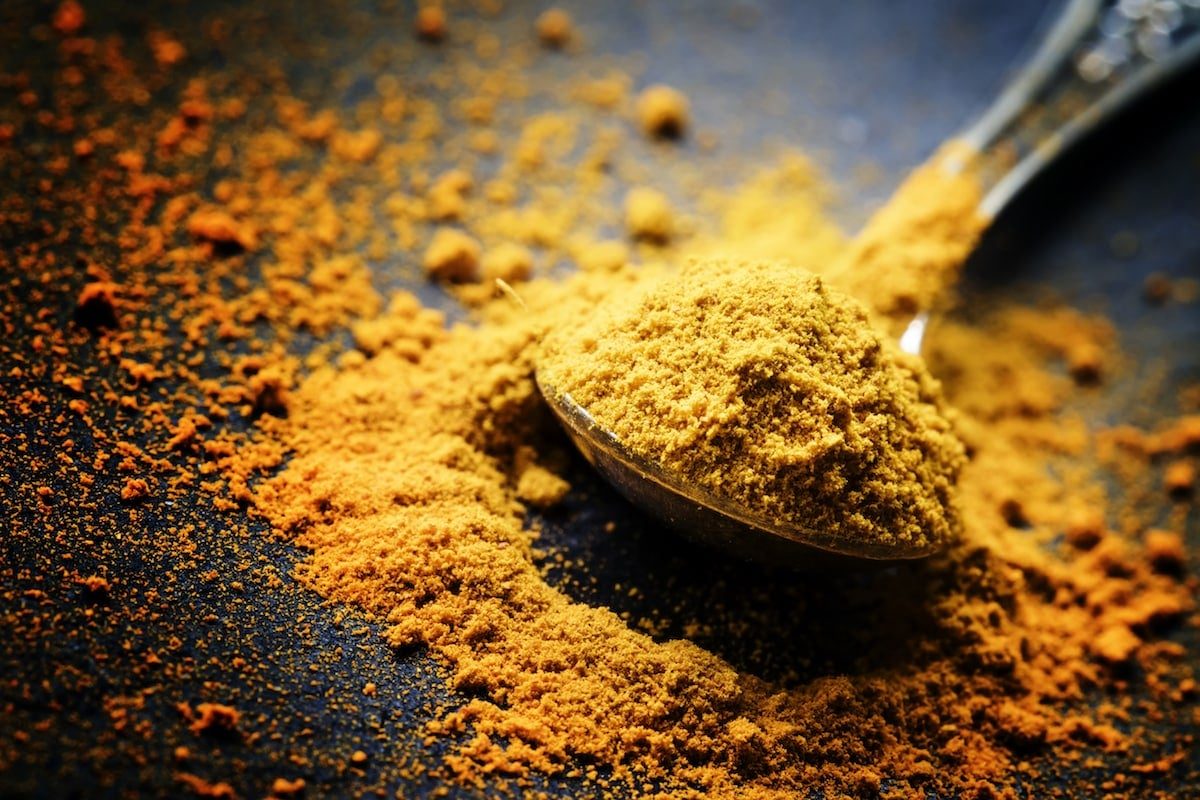
Jamaican curry powder is a ground curry blend led by turmeric and seasoned with allspice, the berry Jamaica is known for. Writer Hank Shaw sums up the difference from Indian-style powders as more allspice and more turmeric.1 It is the seasoning behind curried goat, a dish Jamaica’s African Caribbean Institute credits to the Indians who arrived on the island from 1845.2 This page covers what is in it, where it came from, the compounds behind its flavor, and how to use, buy and store it.
At a glance
| What it is | A ground curry powder blend, sold under several Jamaican brands341 |
| Typical ingredients | Turmeric, coriander, cumin, fenugreek and allspice, plus salt and garlic, on both labels checked34 |
| What sets it apart | Allspice, and a heavy hand with turmeric (Hank Shaw)1 |
| Heat | Varies: one mild label has no chile, another includes cayenne; hot versions are sold341 |
| Roots | Indian immigration to Jamaica, 1845 to 19172 |
| Signature dish | Curried goat2 |
| Official standard | None found for the Jamaican style; the USDA lists only a general curry powder5 |
What is in it
Two widely sold Jamaican brands, as printed on their labels, alongside the minimum list the USDA sets for curry powder in general:
| Blend | Ingredients, in label order | Source |
|---|---|---|
| Grace Jamaican Style Mild Curry Powder | Turmeric, salt, dehydrated garlic and onion, cumin, coriander, black pepper, fenugreek, allspice | 3 |
| Blue Mountain Country Jamaican Curry Powder | Turmeric, salt, coriander, fenugreek, cumin, allspice, cayenne pepper, garlic | 4 |
| USDA curry powder (general, minimum list) | Turmeric, coriander, fenugreek, cinnamon, cumin, black pepper, ginger, cardamom | 5 |
On these two labels, turmeric comes first, salt second, and allspice appears in both. Neither lists the cinnamon, ginger or cardamom that the USDA’s general curry powder list includes.345 Neither lists thyme, though thyme is often said to be part of the blend. Two labels are a small sample, so treat this as a description of those products, not of every Jamaican curry powder.
Allspice is not unique to Jamaican blends. Atlas Obscura quotes an 1870 curry powder recipe from a Mrs. Hill that includes it alongside coriander, turmeric, ginger, pepper, mustard, cumin and cardamom.6 What marks the two Jamaican labels checked is allspice as a regular ingredient and turmeric at the head of the list.34
Hank Shaw calls Blue Mountain the gold standard of Jamaican curry powder and also recommends Betapac; he prefers Blue Mountain’s milder version to its very hot one.1 That is one cook’s preference, not a test.
History
Indians came to Jamaica as indentured laborers. According to a history published by the African Caribbean Institute of Jamaica, the first 261 arrived at Old Harbour Bay on the Blundell on May 10, 1845, and more than 36,000 had arrived by 1917.2 The same history credits them with popularizing curried goat, now a Jamaican specialty, and with the use of curry powder to season meats and other foods.2
How the Jamaican blend took its current form is not documented in the sources checked. A common claim holds that Indian workers, cut off from home, adopted British-made curry powder instead of bringing their own; no evidence for it was found, and it is left out here.
Allspice ties the blend to the island. Pimenta dioica is native from southern Mexico through Central America and the Caribbean, Jamaica included, and Britannica notes it is also called Jamaican pepper.78 PROSEA reports that Jamaican pimento is considered the best quality.9
Flavor and the compounds behind it
Jamaican curry powder tastes earthy and warm, with turmeric’s slight bitterness and an allspice note that reads as clove and cinnamon. That description is ours. The measured compounds belong to the individual spices:
| Spice | What has been measured or described | Source |
|---|---|---|
| Turmeric | Curcumin gives the yellow color | 10 |
| Allspice | Eugenol, 50 to 80% of the berry oil; flavor resembling a mix of cinnamon, cloves and nutmeg | 9 |
| Coriander seed | Linalool and related terpene alcohols, 60 to 80% of the oil | 11 |
| Cumin | Cuminaldehyde, 20 to 72% of the oil | 12 |
| Fenugreek | Strong, sweetish and somewhat bitter, with a characteristic curry aroma | 1314 |
No analysis of a Jamaican curry powder blend as a whole was found.
How Jamaican curry powder is used
Curried goat is the dish most tied to it.2 Hank Shaw notes that curry shrimp turns up across the Caribbean, including Trinidad, Barbados and Belize.1
Cook it in oil first. In his curry shrimp, Shaw cooks the curry powder in hot oil for a couple of minutes, stirring often, before the other ingredients go in.1 He uses several tablespoons and warns that the heat adds up.1
Ackee. Ackee, the fruit of Blighia sapida, is native to West and West Central tropical Africa and was introduced to Jamaica.15 Curried ackee is sometimes mentioned as a vegetarian use; no recipe source for it was checked.
Heat. Whether the blend brings chile heat depends on the brand: Grace’s mild powder lists no chile, while Blue Mountain’s lists cayenne.34 Many cooks add fresh hot peppers to the pot separately; that is kitchen practice, not a sourced finding.
For more, see cooking with curry powder and is curry powder spicy?. If a dish has gone over, see too much curry powder.
Buying and quality
The USDA’s specification for spice blends covers curry powder in general and jerk seasoning, but has no entry for Jamaican curry powder.5 Read the label: turmeric and allspice should be there, salt is common, and the presence or absence of cayenne tells you about heat.34 Because both labels checked list salt second, taste a dish before adding more salt.
Storage
No shelf-life figure for Jamaican curry powder was found. The University of California Cooperative Extension lists air, light, moisture and heat as what speeds flavor and color loss in spices.16 America’s Test Kitchen suggests the smell test: if a spice still smells strong, it is probably still potent.17
Safety
Lead. A New York City health department review of 1,496 spice samples collected from 2008 to 2017 found detectable lead in more than half.18 Turmeric, the first ingredient on both labels, has its own documented problem: a 2026 study in eastern India found 30% of turmeric samples over India’s lead limit of 10 µg/g, linked to lead chromate adulteration.19 That study covered turmeric sold in eastern India, not Jamaican curry powder. See turmeric for more.
Health claims
Claims that the turmeric in curry powder prevents diabetes or cancer go beyond the evidence. NCCIH’s summary of the research on turmeric and curcumin says, for several conditions, that there is not enough evidence to conclude whether they help.10 This page makes no health claims for the blend.
Substitutes and comparisons
- Jamaican curry powder substitutes
- Jamaican curry powder vs. Indian curry powder
- Curry powder and Madras curry powder
- Jamaican spices, Caribbean spices and jerk seasoning
The individual spices: turmeric, allspice, coriander, cumin, fenugreek, black pepper, cayenne pepper, garlic powder and onion powder.
Footnotes
-
Hank Shaw, “Jamaican Curry Shrimp”, Hunter Angler Gardener Cook, 2022. honest-food.net · Publication ↩ ↩2 ↩3 ↩4 ↩5 ↩6 ↩7 ↩8
-
Rochelle Clarke, “A Brief History of East Indian Heritage in Jamaica”, African Caribbean Institute of Jamaica / Institute of Jamaica. acij-ioj.org.jm · Reference work ↩ ↩2 ↩3 ↩4 ↩5 ↩6
-
Grace Jamaican Style Mild Curry Powder, label ingredients via Kroger. kroger.com · Merchant ↩ ↩2 ↩3 ↩4 ↩5 ↩6 ↩7 ↩8
-
Blue Mountain Country Jamaican Curry Powder, label ingredients via H-E-B. heb.com · Merchant ↩ ↩2 ↩3 ↩4 ↩5 ↩6 ↩7 ↩8
-
Commercial Item Description A-A-20001C, Spices and Spice Blends, USDA Agricultural Marketing Service, 2023. ams.usda.gov · Regulator ↩ ↩2 ↩3 ↩4
-
Rohini Chaki, “The Subversive, Surprising History of Curry Powder”, Atlas Obscura, 2019. atlasobscura.com · Publication ↩
-
“Allspice”, Encyclopaedia Britannica. britannica.com · Reference work ↩
-
Pimenta dioica (L.) Merr., Plants of the World Online, Royal Botanic Gardens, Kew. powo.science.kew.org · Reference work ↩
-
D. Sulistiarini, Pimenta dioica, Plant Resources of South-East Asia (PROSEA). uses.plantnet-project.org · Reference work ↩ ↩2
-
“Turmeric: Usefulness and Safety”, National Center for Complementary and Integrative Health, 2025. nccih.nih.gov · Regulator ↩ ↩2
-
Al-Khayri et al., “Essential Oil from Coriandrum sativum: A Review”, Molecules, 2023. mdpi.com · Peer-reviewed ↩
-
P.C.M. Jansen, Cuminum cyminum, Plant Resources of South-East Asia (PROSEA). uses.plantnet-project.org · Reference work ↩
-
“Fenugreek”, Encyclopaedia Britannica. britannica.com · Reference work ↩
-
C.S. Tawan and N. Wulijarni-Soetjipto, Trigonella foenum-graecum, Plant Resources of South-East Asia (PROSEA). uses.plantnet-project.org · Reference work ↩
-
Blighia sapida K.D.Koenig, Plants of the World Online, Royal Botanic Gardens, Kew. powo.science.kew.org · Reference work ↩
-
Add a Little Spice to Your Life! Part II, University of California Cooperative Extension. ucanr.edu · Reference work ↩
-
“Keeping Spices and Dried Herbs Fresher Longer”, America’s Test Kitchen. americastestkitchen.com · Publication ↩
-
Hore et al., “A Spoonful of Lead: A 10-Year Look at Spices as a Potential Source of Lead Exposure”, Journal of Public Health Management and Practice, 2019. scholars.mssm.edu · Peer-reviewed ↩
-
Forsyth et al., “Systemic drivers of toxic food adulteration: lead chromate in turmeric across eastern India”, npj Science of Food, 2026. nature.com · Peer-reviewed ↩