Spice Comparisons · Comparison
Harissa Paste vs. Powder: What Changes Besides the Water
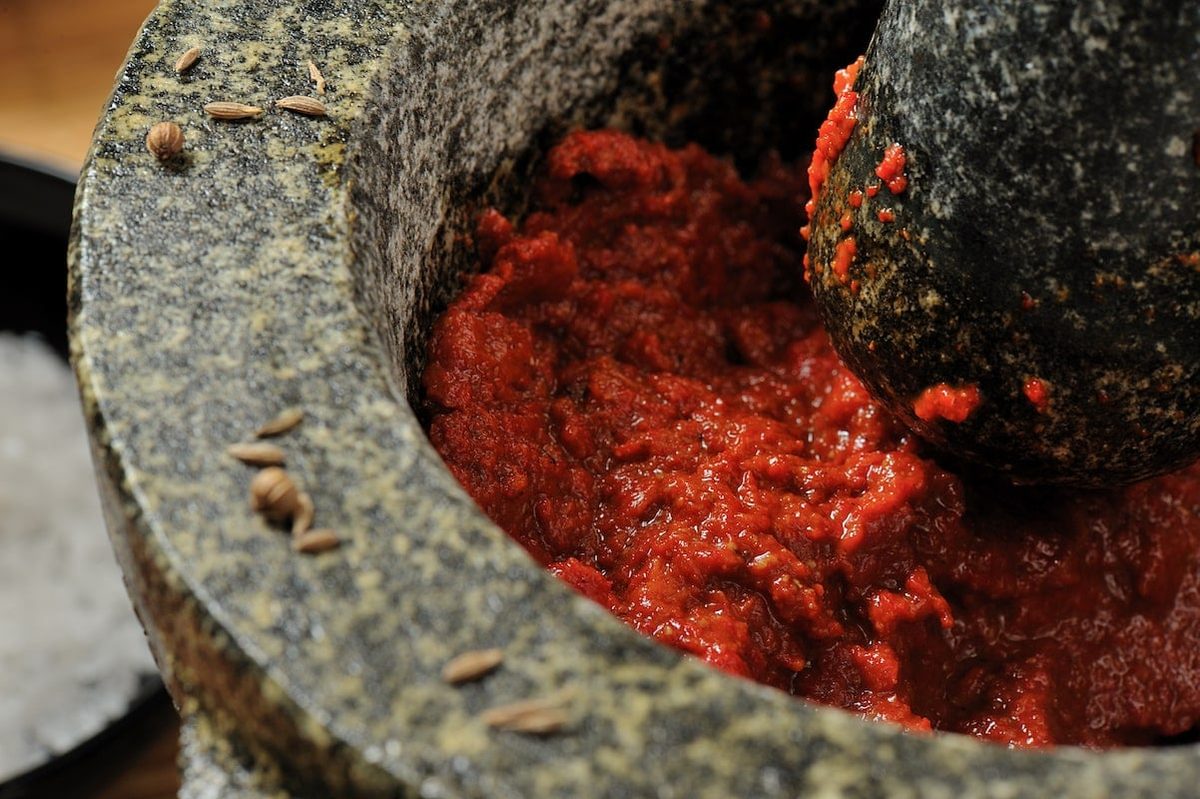
Harissa is a chile paste first. UNESCO, which inscribed Tunisian harissa on its intangible heritage list in 2022, describes sun-dried chilies ground with salt, garlic and coriander,1 and Merriam-Webster defines harissa as a North African paste of dried chilies, salt, oil and other seasonings.2 Harissa powder is a dry blend built on the same idea. The obvious difference is water and oil, but the labels show a second one: the powders checked here add cumin, and the Tunisian pastes checked here do not.
Side by side
| Harissa paste | Harissa powder | |
|---|---|---|
| What it is | The traditional form: a seasoning made with chile pepper paste, part of everyday household provisions in Tunisia1 | A dry blend modeled on the paste34 |
| Base | Sun-dried chilies, seeded and ground1 | Ground dried chile, such as cayenne and paprika34 |
| Liquid | Oil in Merriam-Webster’s definition and in some labels;25 one Tunisian label lists none6 | None; Oregon State suggests mixing it with oil to make a paste3 |
| Cumin | Not in UNESCO’s description or either Tunisian label checked165 | In both powders checked34 |
| Heat | Depends on the chile; one maker calls its paste medium strength5 | Depends on the chile; Oregon State says to pick a ground red pepper with the heat you like3 |
| Storage | One commercial paste: refrigerate at 4 to 6 °C and use within 30 days of opening6 | Oregon State: airtight container3 |
| Typical uses | Soups, stews, main dishes, marinades for meat and fish, dips (one maker’s list)5 | Roasted vegetables, sauces, soups and stews; mixed with oil as a paste for roasting poultry, meat or tofu (Oregon State);3 a dry rub for steaks, chicken or meaty fish (PepperScale)7 |
| Flavor (editorial) | Fresher and rounder, with garlic up front; oil carries the chile | Drier, toastier; more seed-spice warmth when cumin and caraway are in |
| Price | No dated, sourced comparison found | No dated, sourced comparison found |
The flavor row is ours. For the dry blend in depth, see harissa powder.
What goes into each
There is no standard recipe for either form, and no regulator or standards body defining harissa was found. Six named versions, side by side:
| Ingredient | UNESCO, traditional paste1 | Le Phare du Cap Bon paste6 | Les Moulins Mahjoub paste5 | Ottolenghi rose harissa (paste)8 | Oregon State powder3 | The Spice House powder4 |
|---|---|---|---|---|---|---|
| Chile | Sun-dried chilies | Red hot pepper, 87% | Sun-dried peppers | Dried Kashmiri and ancho chilies, chile powder or paprika | Cayenne, smoked paprika | Chiles, paprika |
| Garlic | Yes | Yes | Yes | Yes | Garlic powder | Yes |
| Coriander | Yes | Yes | Yes | Yes | Yes | Yes |
| Caraway | not listed | Yes | Yes | Yes | Yes | Yes |
| Cumin | not listed | not listed | not listed | Yes | Yes | Yes |
| Salt | Yes | Yes | Yes | Yes | Yes | Kosher salt |
| Oil | not listed | not listed | Extra virgin olive oil | Olive oil | none | none |
| Tomato | not listed | not listed | Sun-dried tomatoes | Tomato paste | none | Tomato powder, listed first |
| Other | none | none | none | Rose petals, rose water, lemon juice, cider vinegar, sugar | none | Pepper, fennel, lemon juice powder, onion |
How to read it:
- The shared core is chile, garlic, coriander and salt, the four things UNESCO names.1 Caraway joins them in every version but UNESCO’s; Katzer notes that several Tunisian recipes call for it.9
- Cumin is the dividing line. Neither Tunisian paste label lists it,65 while both powders and the Ottolenghi paste do.348 PepperScale’s dry harissa seasoning fits the same pattern, with cumin seeds and smoked paprika alongside the chiles, coriander, caraway, garlic and salt.7 Seven versions are not a survey, so treat this as a pattern in these products, not a rule.
- Tomato and oil come and go. One Tunisian paste is 87% red pepper with no oil or tomato on the label;6 another adds olive oil and sun-dried tomatoes.5
- Rose harissa is its own variation. The Ottolenghi recipe adds dried rose petals and rose water.8 See rose petals.
- Mint, sometimes said to be a standard addition, is in none of the six.
The differences that change a dish
Water and oil
The paste is wet; the powder is dry. In a marinade, a stew or a sauce, paste blends in easily, and Les Moulins Mahjoub suggests its paste for marinades for meat and fish.5 In a dry rub, a spice crust, or a dish you want to keep thick, the powder adds flavor without loosening anything. That is kitchen judgment.
Salt
Both usually contain salt, in very different forms. The Le Phare du Cap Bon label gives 2.25 g of salt per 100 g of paste.6 The Oregon State powder uses ½ teaspoon of salt in a 2-tablespoon batch.3 Those are different products measured differently, so they cannot be compared directly. Read the label, and taste before salting the dish.
Flavor
With cumin and often tomato powder or smoked paprika, the powders checked here lean warmer and earthier than the Tunisian pastes. The pastes taste more of chile and garlic. That is our reading of the ingredient lists, not a sensory measurement.
Storage and safety
Both commercial pastes checked are sold unrefrigerated. Le Phare du Cap Bon’s label says to store it in a dry place away from light, then refrigerate it at 4 to 6 °C and use it within 30 days of opening.6 Gourmet Food Store describes the Mahjoub spread as non-perishable.5 Traditional Tunisian harissa is stored in glass or pottery,1 but UNESCO gives no keeping time.
Homemade paste is a different case, because raw garlic mixed with oil is a known botulism risk. A 2011 review of home-prepared vegetables and herbs stored in oil records botulism outbreaks from garlic-in-oil preparations in 1985 and 1989, after which the FDA ordered non-acidified products off store shelves.10 Advice on how long a homemade mixture keeps does not agree:
| Source | Product | Advice |
|---|---|---|
| Nummer et al., Food Protection Trends, 201110 | Home-prepared vegetables or herbs in oil, not acidified | Freezing is the safest choice; if not frozen, refrigerate and use within 4 days. The review notes published guidance ranging from 3 days to 3 weeks |
| Ottolenghi Test Kitchen8 | Their rose harissa, which includes lemon juice and cider vinegar | Sealed, sterilized jar in the fridge for up to 2 months, topped with oil |
These answer different questions about different recipes, so they are shown side by side, not reconciled. If your homemade paste uses raw garlic and oil and no acid, the review’s 4-day refrigeration or freezing advice is the cautious one to follow. For the powder, Oregon State says only to store it in an airtight container.3
Can one stand in for the other?
Often, with adjustments for liquid and seasoning. No published ratio exists for either swap, so both are Method.
- Paste in place of powder. Our harissa powder substitutes page rates paste as the best stand-in where the dish is wet: marinades, sauces, soups and stews. Ratio (Method): start with an equal amount, then taste, and cut back a little on other oil and salt. Avoid it in dry rubs and spice crusts, where the oil and moisture get in the way.
- Powder in place of paste. Oregon State suggests mixing its powder with vegetable oil to make a paste for roasting poultry, meat or tofu, but gives no amount of oil.3 Ratio (Method): no published figure. As a starting point, use about half as much powder as the paste called for, stir in oil a little at a time until it is spreadable, add a crushed garlic clove if you want the paste’s fresher garlic, and taste. If your powder contains cumin and the recipe expects a Tunisian-style paste, the result will taste warmer and earthier.
- Make the powder yourself. Oregon State’s formula makes 2 tablespoons from 1½ teaspoons cayenne, 1 teaspoon each smoked paprika, cumin and coriander, and ½ teaspoon each garlic powder, salt and ground caraway.3 Leave out the cumin and smoked paprika for something closer to the Tunisian pastes above; that is our suggestion.
What isn’t known
- No regulator or standards body defines harissa paste or powder, and no heat measurement for either was found.
- Six products and recipes are not a market survey. Whether most Tunisian pastes omit cumin was not established.
- Claims that harissa is traditional in Morocco and Algeria, or in Middle Eastern cooking generally, were not supported by the sources opened; UNESCO’s inscription covers Tunisia, and Merriam-Webster says North African.12
- No published ratio exists for swapping paste and powder.
- No dated, sourced price comparison was found.
Related
- Harissa powder and harissa powder substitutes
- Tunisian spices, Moroccan spices, ras el hanout
- The single spices: caraway seeds, coriander, cumin, garlic, cayenne pepper, smoked paprika
- Another chile-based blend: berbere seasoning
- Too much cumin? How to fix the dish.
Footnotes
-
Harissa, knowledge, skills and culinary and social practices (Tunisia), UNESCO Intangible Cultural Heritage, 2022. ich.unesco.org · Reference work ↩ ↩2 ↩3 ↩4 ↩5 ↩6 ↩7 ↩8
-
harissa, Merriam-Webster Dictionary. merriam-webster.com · Reference work ↩ ↩2 ↩3
-
Harissa Spice Mix, Food Hero, Oregon State University Extension Service. foodhero.org · Reference work ↩ ↩2 ↩3 ↩4 ↩5 ↩6 ↩7 ↩8 ↩9 ↩10 ↩11 ↩12 ↩13
-
Harissa Seasoning, The Spice House. thespicehouse.com · Merchant ↩ ↩2 ↩3 ↩4 ↩5
-
Les Moulins Mahjoub Traditional Harissa Spread, Gourmet Food Store. gourmetfoodstore.com · Merchant ↩ ↩2 ↩3 ↩4 ↩5 ↩6 ↩7 ↩8 ↩9
-
Le Phare du Cap Bon Harissa Paste, 70 g, SuperValu listing. shop.supervalu.ie · Merchant ↩ ↩2 ↩3 ↩4 ↩5 ↩6 ↩7 ↩8
-
Matt Bray, “Harissa Seasoning Recipe”, PepperScale, 2024. pepperscale.com · Publication · PepperScale is also owned by Matt Bray, the editor of this site. ↩ ↩2
-
The Ottolenghi Test Kitchen’s Rose Harissa, from Ottolenghi Test Kitchen: Extra Good Things, via The Happy Foodie. thehappyfoodie.co.uk · Publication ↩ ↩2 ↩3 ↩4
-
Gernot Katzer, Caraway (Carum carvi), Gernot Katzer’s Spice Pages. gernot-katzers-spice-pages.com · Reference work ↩
-
Nummer, Schaffner, Fraser and Andress, Current Food Safety Issues of Home-prepared Vegetables and Herbs Stored in Oil, Food Protection Trends, 2011. foodprotection.org · Peer-reviewed ↩ ↩2