Spice Comparisons · Comparison
Jamaican vs. Indian Curry Powder: Allspice, Turmeric and Heat Compared
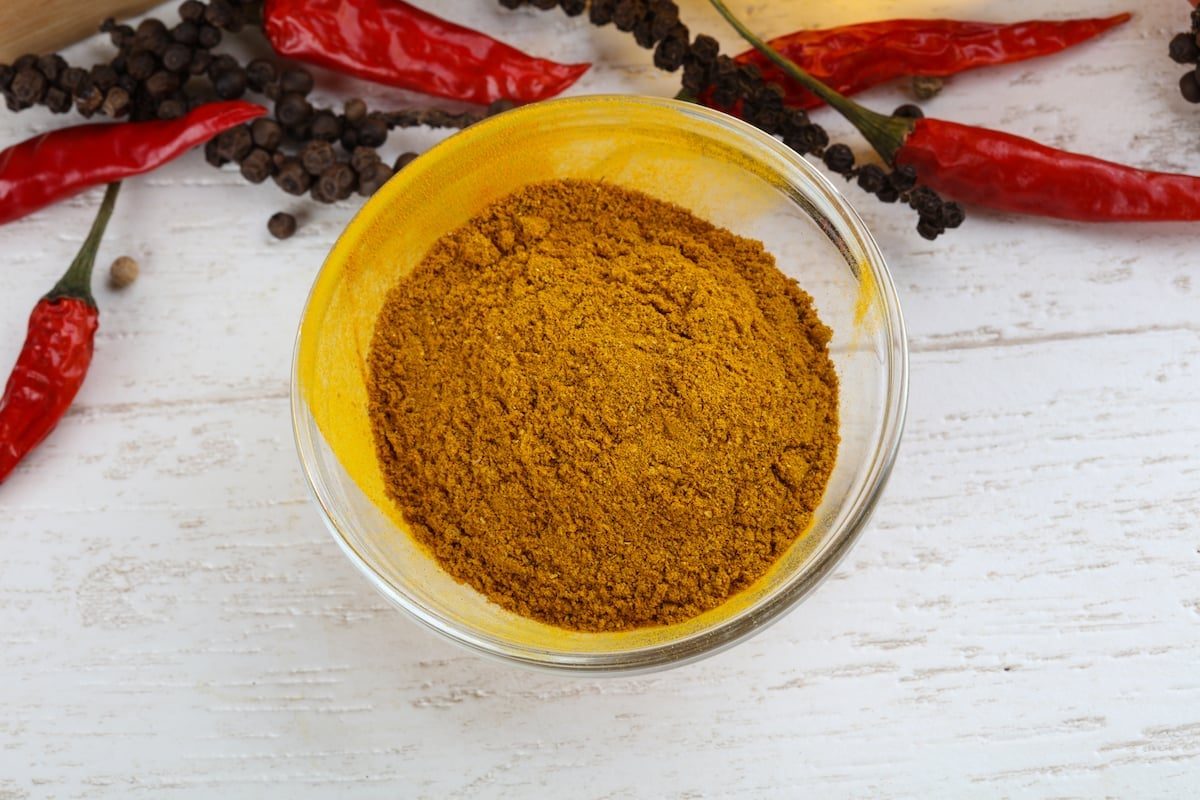
Jamaican and “Indian” curry powders share a core of turmeric, coriander, cumin and fenugreek, and differ in two places: allspice and heat. Both Jamaican labels checked here list allspice, and food writer Hank Shaw says Jamaican powders use more allspice and more turmeric than Indian ones.123 Indian-style blends sold in the West, such as Madras curry powder, have no allspice in the versions checked and are known for chile.45
“Indian curry powder” is itself a loose name. Britannica says curry powder was adapted by British settlers in India, while Indian home cooks call their spice mixtures masala and make them at home.6 Jamaica’s curry tradition came with indentured workers from India: the first 261 arrived at Old Harbour Bay in 1845, more than 36,000 had come by 1917, and the Institute of Jamaica credits them with curried goat and with the use of curry powder to season meats.7
Side by side
| Jamaican curry powder | Indian-style (Madras) curry powder | |
|---|---|---|
| Where it comes from | Jamaica, through Indian indentured workers who arrived from 18457 | Curry powder as adapted by the British in India; Madras was one of the earliest English trading posts65 |
| Example labels | Grace Mild: turmeric, salt, garlic and onion, cumin, coriander, black pepper, fenugreek, allspice;1 Blue Mountain Country: turmeric, salt, coriander, fenugreek, cumin, allspice, cayenne, garlic2 | World Spice Merchants’ Madras: coriander, brown mustard seed, turmeric, cumin, fenugreek, black pepper and red chile flake, among others4 |
| Allspice | On both labels;12 more than in Indian powders, per Shaw3 | Not on the World Spice list4 |
| Turmeric | First on both labels, so the largest ingredient by weight;128 more than in Indian powders, per Shaw3 | Present; Julia Fine describes 19th-century recipes “laden with turmeric, chili, and/or cayenne”5 |
| Chile heat | Varies: Grace Mild lists no chile; Blue Mountain lists cayenne12 | Historically promoted as spicier than Bengal and Bombay styles;5 World Spice rates its blend 2 of 54 |
| Salt | Second on both labels12 | Varies by brand; check the label |
| Key compounds | Allspice berry oil is 50 to 80% eugenol;9 curcumin gives the yellow;10 sotolon gives fenugreek its curry aroma11 | Curcumin and sotolon as well,1011 plus chile where the blend includes it4 |
| Typical uses | Curried goat; curry used to season meats7 | Hotter Anglo-Indian curries (editorial) |
| Price | No dated, sourced comparison found | No dated, sourced comparison found |
These are a few blends, not the whole market. Atlas Obscura notes there has never been a set combination of spices in curry powder,12 and other brands will differ. For each blend on its own, see Jamaican curry powder and Madras curry powder.
The differences that change a dish
Allspice
This is the Jamaican signature. Allspice is native to the Caribbean, southern Mexico and Central America,13 and PROSEA says Jamaican pimento is considered the best quality.9 Its eugenol-rich oil gives a clove-like warmth.9 The same spice is essential in Jamaican jerk, according to the Smithsonian.14 Allspice is not unique to Jamaican curry powder, though: Atlas Obscura quotes an 1870 curry powder recipe that includes it,12 and the USDA’s purchase specification for curry powder in general doesn’t list it.15
Heat
Neither style has a fixed heat level. Among the Jamaican blends, Grace’s mild powder has no chile and Blue Mountain’s has cayenne,12 and Shaw notes that Blue Mountain sells both milder and very hot versions.3 Mike Hultquist’s homemade Jamaican curry powder makes Scotch bonnet powder optional.16 Gernot Katzer notes that the extreme heat of Capsicum chinense peppers matters in Caribbean cooking.17 Madras curry powder was marketed as the spicy option,5 but one merchant rates its own blend only 2 out of 5.4 Read the label: chile, cayenne or red pepper in the ingredients is the only reliable signal.
Color
Turmeric’s curcumin makes curry powder yellow.10 With turmeric listed first on both Jamaican labels,12 and Shaw saying Jamaican powders use more of it,3 a yellow color is expected. It is often said that Madras powders look redder because of their chile; we found no source that measures or describes this.
Salt
Both Jamaican labels list salt second, right after turmeric.12 Other blends may have little or none. If you switch from a salted to an unsalted powder, or the reverse, adjust the salt in the dish.
Can one stand in for the other?
Yes, with adjustments. Both are curry powders built on the same core. No source publishes a ratio for either direction, so these amounts are starting points.
| Swap | Starting amount, per 1 tablespoon | Treatment |
|---|---|---|
| Madras or other Indian-style powder for Jamaican | 1 tablespoon plus 1/4 teaspoon ground allspice, then taste for heat | Method |
| Jamaican powder for Madras | 1 tablespoon plus about 1/8 teaspoon cayenne if the Jamaican powder lists no chile | Method |
- Indian-style powder in place of Jamaican. Add allspice. Our Jamaican curry powder substitutes page works out about 1/4 teaspoon of ground allspice per tablespoon from Hultquist’s recipe, which uses 1 tablespoon of allspice in a batch of about 36 teaspoons.16 Taste for heat before adding any fresh chile, and add salt if your Jamaican recipe counted on a salted powder.
- Jamaican powder in place of Madras. You get the curry base, an allspice note, and possibly no heat. Method: if the label shows no chile, add about 1/8 teaspoon cayenne per tablespoon, as on our Madras curry powder substitutes page, and taste. Cut back on salt if the Jamaican powder lists it.
- Cook it the same way. Shaw fries Jamaican curry powder in hot oil for a couple of minutes, stirring often, before the other ingredients go in.3 That works for either blend.
When to reach for each
- Jamaican curry powder for Jamaican curries: curried goat7 or Shaw’s curry shrimp.3
- Madras or another Indian-style powder for Anglo-Indian dishes. Mulligatawny, for example, is a soup the Christian Science Monitor describes as created for officers of the British Raj, and says it can be made with commercial curry powder.18 Sun Brand’s Madras curry powder was established in 1876 for export to England, according to the retailer ChefShop.19
What isn’t known
- No heat measurement of any Jamaican or Madras curry powder was found.
- Only two Jamaican labels and one Madras blend were compared; brand formulas differ and are not published as proportions.
- Claims that Madras powders are redder, or that Scotch bonnet and scallions are essential to Jamaican curries, could not be traced.
- A common claim says dairy or coconut milk “neutralizes” capsaicin in an over-hot curry. We found no source for that mechanism; adding milder ingredients dilutes the heat, which is common kitchen practice rather than a measured finding.
Related
- Jamaican curry powder substitutes, Jamaican spices, jerk seasoning and allspice
- Madras curry powder vs. curry powder, vindaloo vs. Madras curry powder and vindaloo curry powder
- Curry powder, is curry powder spicy? and too much curry powder?
- Japanese curry powder and Malaysian curry powder
Footnotes
-
Grace Jamaican Style Mild Curry Powder (retailer listing with label ingredients), Kroger. kroger.com · Merchant ↩ ↩2 ↩3 ↩4 ↩5 ↩6 ↩7 ↩8 ↩9
-
Blue Mountain Country Jamaican Curry Powder (retailer listing with label ingredients), H-E-B. heb.com · Merchant ↩ ↩2 ↩3 ↩4 ↩5 ↩6 ↩7 ↩8 ↩9
-
Hank Shaw, “Jamaican Curry Shrimp,” Hunter Angler Gardener Cook, 2022. honest-food.net · Publication ↩ ↩2 ↩3 ↩4 ↩5 ↩6 ↩7
-
“Madras South Indian Curry” (product page), World Spice Merchants. worldspice.com · Merchant ↩ ↩2 ↩3 ↩4 ↩5 ↩6
-
Julia Fine, “From Delhi to Durban: The Many Homes of Madras Curry Powder,” Diaspora Co., 2022. diasporaco.com · Merchant ↩ ↩2 ↩3 ↩4 ↩5
-
“Curry,” Encyclopaedia Britannica. britannica.com · Reference work ↩ ↩2
-
Rochelle Clarke, “A Brief History of East Indian Heritage in Jamaica,” African Caribbean Institute of Jamaica / Institute of Jamaica. acij-ioj.org.jm · Reference work ↩ ↩2 ↩3 ↩4
-
21 CFR 101.4, Food; designation of ingredients, eCFR. ecfr.gov · Regulator ↩
-
D. Sulistiarini, Pimenta dioica, Plant Resources of South-East Asia (PROSEA). uses.plantnet-project.org · Reference work ↩ ↩2 ↩3
-
“Turmeric: Usefulness and Safety,” NCCIH, NIH, 2025. nccih.nih.gov · Regulator ↩ ↩2 ↩3
-
C.S. Tawan and N. Wulijarni-Soetjipto, Trigonella foenum-graecum, Plant Resources of South-East Asia (PROSEA). uses.plantnet-project.org · Reference work ↩ ↩2
-
Rohini Chaki, “The Subversive, Surprising History of Curry Powder,” Atlas Obscura, 2019. atlasobscura.com · Publication ↩ ↩2
-
Pimenta dioica (L.) Merr., Plants of the World Online, Royal Botanic Gardens, Kew. powo.science.kew.org · Reference work ↩
-
Vaughn Stafford Gray, “A Brief History of Jamaican Jerk,” Smithsonian Magazine, 2020. smithsonianmag.com · Publication ↩
-
Commercial Item Description A-A-20001C, Spices and Spice Blends, USDA Agricultural Marketing Service, 2023. ams.usda.gov · Regulator ↩
-
Mike Hultquist, “Jamaican Curry Powder Recipe,” Chili Pepper Madness. chilipeppermadness.com · Publication ↩ ↩2
-
Gernot Katzer, “Chiles (Capsicum),” Gernot Katzer’s Spice Pages. gernot-katzers-spice-pages.com · Reference work ↩
-
Phyllis Hanes, “British, Indian traditions blend in Mulligatawny Soup,” The Christian Science Monitor, 1985. csmonitor.com · Publication ↩
-
“Madras Curry Powder - Sun Brand” (product page), ChefShop. chefshop.com · Merchant ↩