Seasonings · Profile
Japanese Curry Powder: What’s in It, How It Reached Japan, and How It’s Used
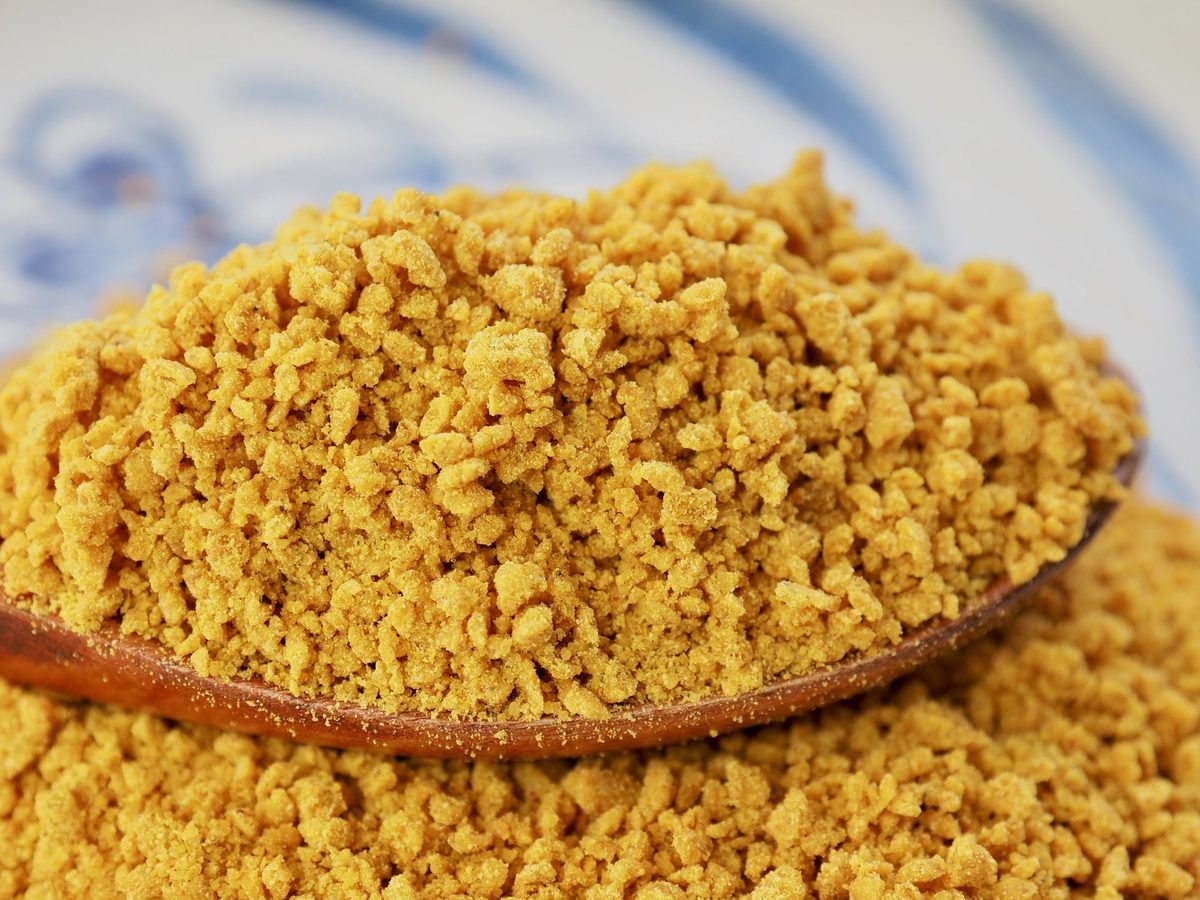
Japanese curry powder is the spice blend behind Japan’s thick, mild, slightly sweet curries. It descends from British curry powder, which reached Japan in the Meiji era, and it is usually made from a long list of spices that are roasted and then aged.12 It is used both as a spice in its own right and as the base of curry roux, the blocks of curry powder set with flour and fat.12 This page covers what goes into it, the history that can be documented, how it is used, and what to know about allergens and safety.
At a glance
| What it is | A commercial spice blend made for Japanese-style curry1 |
| Number of spices | About ten to over thirty, depending on the maker (Nipponica); “twenty-odd” (Daijisen)2 |
| Processing | Mixed, roasted, and aged three months or more to unify the flavor (Nipponica)2 |
| Proportions | Treated as each manufacturer’s secret2 |
| Arrived in Japan | Meiji era (1868–1912), via Britain12 |
| Best-known brand | S&B “Aka Kan” (red tin)1 |
| Related product | Curry roux: curry powder set with flour, fat, salt and seasonings into blocks, flakes or granules2 |
What’s in it
There is no single recipe. Nipponica, the Japanese encyclopedia, says Japanese curry powders combine from about ten to more than thirty ground spices, and that the types and amounts are each maker’s secret.2 It groups the spices by job: pungency, aroma (cumin, fenugreek, cardamom, nutmeg, cinnamon, bay, mace, coriander, dill, celery seed, allspice, caraway, thyme), masking odors (garlic, cloves, fennel) and color (turmeric, paprika).2
Here are two published lists, each as its source gives it, beside the U.S. government’s minimum for curry powder in general:
| Ingredient | S&B Oriental Curry Powder (label)3 | Just One Cookbook homemade blend1 | USDA minimum for curry powder4 |
|---|---|---|---|
| Turmeric | Yes (first listed) | 1 Tbsp | Yes |
| Coriander | Yes | 1 Tbsp | Yes |
| Cumin | Yes | 1 Tbsp | Yes |
| Fenugreek | Yes | 2 tsp seeds | Yes |
| Cardamom | Yes | 1 tsp | Yes |
| Cinnamon | Yes | 1 tsp | Yes |
| Black pepper | Pepper | ½ tsp | Yes |
| Ginger | Yes | ½ tsp | Yes |
| Chile | Chili pepper | Cayenne ½ tsp; optional red chili, gochugaru | |
| Orange peel | Yes | Optional | |
| Cloves | Yes | 1 tsp | |
| Fennel | Yes | ½ tsp | |
| Nutmeg | Yes | ½ tsp | |
| Bay leaf | Yes | 1 leaf | |
| Star anise | Yes | ||
| Thyme | Yes | ||
| Sage | Yes | ||
| Allspice | ½ tsp | ||
| Paprika | 1 tsp | ||
| Garlic powder | ½ tsp | ||
| White pepper | Optional |
The S&B label lists 17 ingredients;3 Just One Cookbook says the main ones in S&B’s red-tin powder are turmeric, coriander, cumin, fenugreek, pepper, chili and orange peel.1 A widely repeated claim says Japanese curry powder is almost entirely turmeric, coriander, cumin and cardamom, making up as much as 90% of the blend. No source supports it, and the makers do not publish their proportions.2
Flavor
Just One Cookbook describes Japanese curry powder as fragrant, golden and mildly sweet, with a rounded, sweet aroma.1 ChefShop, which sells the S&B powder, says it tends to be milder and less complex than Indian curry powders.3 That is a retailer’s opinion; with 17 ingredients on the S&B label, the blend is not short on spices.3 In our judgment, the sweetness and roundness come through most once the powder is cooked into a roux with onions.
History
From India via Britain. Britannica says curry powder was adapted by British settlers in India.5 The Daijisen dictionary says it reached Japan from India by way of Britain in the Meiji era,2 and Just One Cookbook says curry first came to Japan during the Meiji era (1868–1912) via the British navy.1 Nipponica says the first Western spice introduced to the Japanese, during the Westernizing 1880s, was the British C&B (Crosse & Blackwell) curry powder.2
The first Japanese curry powder. According to the Japan Dietetic Association’s profile of S&B Foods, the company’s founder, Minejiro Yamazaki, succeeded in making Japan’s first domestically produced curry powder in 1923 and founded Hidakaya (日賀志屋), the forerunner of S&B.6 The same profile says the red-tin curry powder, launched in 1950, spread curry culture across Japan in one stroke.6
The sources disagree on when the red tin itself appeared:
| Claim | Source |
|---|---|
| Aka Kan “first sold in 1923” | Just One Cookbook1 |
| First domestic curry powder made in 1923; red-tin curry powder launched in 1950 | Japan Dietetic Association, on S&B6 |
This page does not settle the date.
The counterfeit C&B affair. A compiled history of S&B on The Shashi describes an episode in which someone sold curry powder bearing an imitation of the C&B mark; a British trading company protested to the authorities, the Tokyo police seized the fakes from wholesalers, and orders for the domestic maker’s own powder poured in.7 The compilation files the episode under 1935 but gives no date in the text.7 The often-quoted year of 1931, and the claim that the scandal showed Japanese powders to be indistinguishable from British ones, could not be confirmed.
Two other common claims could not be traced: that imported curry was a luxury eaten mainly by the rich, and that roux blocks overtook curry powder in the 1950s.
How it is used
In curry roux. Nipponica describes instant curry made by setting curry powder with wheat flour, fats, salt, sugar and seasonings into blocks, flakes or granules.2 Just One Cookbook notes that the powder itself, unlike commercial roux, contains no wheat flour, and gives a homemade roux method.1
As a spice. Just One Cookbook suggests:1
- Sautéing it with onions, meat or vegetables when making curry from scratch.
- Mixing it with Japanese mayonnaise for a dip or spread.
- Seasoning meat or vegetables before grilling or roasting.
- Adding it to dressings, soups, stews, stir-fries, marinades or fried rice.
- Stirring it into the flour for breading, or into mashed potatoes for croquettes.
The best-known dish is curry rice (kare raisu).1
Technique. America’s Test Kitchen recommends blooming ground spices in fat, which takes anywhere from 30 seconds to several minutes.8
Buying and storage
- Powder or roux? Check whether the package is curry powder (spices only) or curry roux (spices plus flour and fat).12 They are not interchangeable in a recipe.
- Storage. Just One Cookbook advises keeping the powder in a cool, dark place away from moisture and humidity, and gives two months, in a cool dark place or the freezer, for its homemade blend.1 No shelf life from a regulator or standards body was found.
Safety
Wheat in roux. Curry roux contains wheat flour,2 and the FDA lists wheat among the major food allergens.9 The powder alone is flour-free per Just One Cookbook,1 but read the label.
Lead in spices. A ten-year review of spice samples tested by the New York City health department found detectable lead in more than half of them.10 The abstract does not break the results out by curry powder. See turmeric for the lead-chromate problem in that spice.
Health claims
Curry powder’s spices are often credited with benefits for cholesterol and digestion. NCCIH, part of the National Institutes of Health, says there is not enough evidence to conclude that turmeric or curcumin is beneficial for any health purpose.11 For fenugreek, NCCIH says some research suggests it may help lower blood sugar in people with type 2 diabetes, but many of those studies were not of high quality.12 This page makes no health claim for the blend. Claims that it supplies meaningful iron, calcium, vitamin C or fiber could not be supported from any source reviewed.
Substitutes and comparisons
- Curry powder, the general profile, and cooking with curry powder
- Other styles: Madras, Jamaican, Malaysian and vindaloo curry powders
- Curry paste vs. curry powder and garam masala vs. curry powder
- Is curry powder spicy? and too much curry powder
- Japanese spices
- The spices: turmeric, coriander, cumin, fenugreek, cardamom, cinnamon, star anise, fennel seed
Footnotes
-
Namiko Hirasawa Chen, “Japanese Curry Powder”, Just One Cookbook. justonecookbook.com · Publication ↩ ↩2 ↩3 ↩4 ↩5 ↩6 ↩7 ↩8 ↩9 ↩10 ↩11 ↩12 ↩13 ↩14 ↩15 ↩16
-
カレー粉, Kotobank (Nihon Daihyakka Zensho/Nipponica; Digital Daijisen). kotobank.jp · Reference work ↩ ↩2 ↩3 ↩4 ↩5 ↩6 ↩7 ↩8 ↩9 ↩10 ↩11 ↩12 ↩13 ↩14 ↩15
-
S&B Oriental Curry Powder, ChefShop (product page). chefshop.com · Merchant ↩ ↩2 ↩3 ↩4
-
Commercial Item Description A-A-20001C, Spices and Spice Blends, USDA Agricultural Marketing Service, 2023. ams.usda.gov · Regulator ↩
-
“Curry”, Encyclopaedia Britannica, 2026. britannica.com · Reference work ↩
-
いざ、大阪・関西万博へ!, S&B Foods section, Japan Dietetic Association. dietitian.or.jp · Publication ↩ ↩2 ↩3
-
ヱスビー食品 chapter 1 (1923–1949), The社史. the-shashi.com · Publication ↩ ↩2
-
“How to Bloom Spices”, America’s Test Kitchen, 2023. americastestkitchen.com · Publication ↩
-
Food Allergies, U.S. Food and Drug Administration. fda.gov · Regulator ↩
-
Hore et al., “A Spoonful of Lead”, Journal of Public Health Management and Practice, 2019. scholars.mssm.edu · Peer-reviewed ↩
-
“Turmeric: Usefulness and Safety”, National Center for Complementary and Integrative Health, 2025. nccih.nih.gov · Regulator ↩
-
“Fenugreek”, National Center for Complementary and Integrative Health, 2025. nccih.nih.gov · Regulator ↩