Cooking · Dish guide
The Best Spices for Chicken Soup: What Each One Does and When to Add It
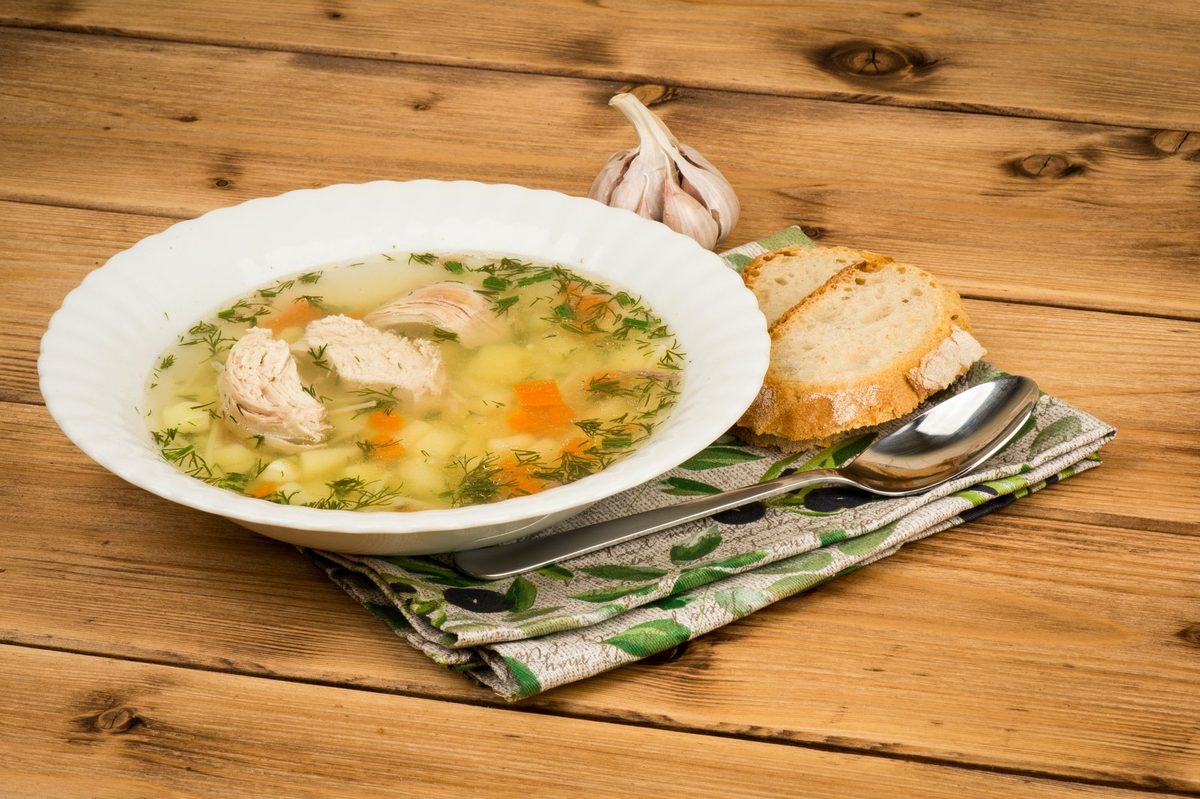
Chicken soup gets most of its flavor from the chicken, the long simmer and a few vegetables, and the seasoning on top is simple. Three recipes, two from university extension services and one from the cookbook author Joan Nathan, agree on the constants: onion, celery, carrots and black pepper.123 Beyond that they differ: Nathan’s Jewish-style soup is heavy on parsley and dill, one extension recipe offers thyme or sage, and only one uses garlic. This page covers what each seasoning does, when it goes in, and where amounts come from.
At a glance
| Seasoning | Job in the pot | Notes |
|---|---|---|
| Onion | Sweet, savory base | In all three recipes123 |
| Celery | Savory, green note and texture | In all three123 |
| Celery seed | Concentrated celery flavor | Much stronger than the stalk; a pinch goes far45 |
| Black pepper or white pepper | Warmth; white keeps a pale broth clean-looking | Black pepper in all three123 |
| Salt | Seasoning | Amount depends on the broth123 |
| MSG | Savory (umami) boost | A main ingredient in bouillon cubes6 |
| Parsley and dill | Fresh, green flavor | 6 Tbsp each in Nathan’s soup3 |
| Thyme, sage, marjoram or oregano | Herbal depth | Optional 1 tsp thyme or sage in the Minnesota recipe2 |
| Garlic | Savory depth | In one of the three recipes1 |
Three recipes side by side
| Iowa State Extension (5 servings)1 | University of Minnesota Extension (6 servings)2 | Joan Nathan, with matzah balls3 | |
|---|---|---|---|
| Chicken and liquid | 1 lb boneless chicken, 4 cups reduced-sodium broth, 2 cups water | 3 lb chicken pieces covered with water, simmered 2 to 3 hours | 1 large whole chicken, simmered about 2 1/2 hours |
| Onion | 1 cup diced | 1 onion | 2 onions, unpeeled |
| Celery | 1 cup sliced | 1 cup chopped | 2 stalks with leaves, plus 1/2 cup chopped leaves |
| Garlic | 1 tsp garlic powder | None | None |
| Black pepper | 1 tsp ground | 1/4 tsp | 1/4 tsp ground |
| Salt | None added | 1/2 tsp | 1 Tbsp |
| Herbs | None | Optional: 1 tsp thyme or sage | 6 Tbsp parsley, 6 Tbsp dill |
| Other vegetables | Carrots | Carrots | Parsnips, carrots and other root vegetables |
These are each cook’s own recipe, not a house standard. Salt tracks the liquid: Iowa adds none because it starts with broth, while Nathan, starting from water and a whole chicken, uses a tablespoon.13
The core seasonings and what each one does
Salt and MSG
Salt seasons the soup. The savory, meaty taste of a good broth is a separate taste, umami, which Britannica attributes to glutamate, guanylate and inosinate found in meat and vegetables.7 A widely repeated claim says salt supplies the umami in chicken soup; it doesn’t.
MSG is the most direct way to add umami. The FDA describes it as the sodium salt of glutamic acid and considers it generally recognized as safe.8 Commercial bouillon leans on it: a Knorr chicken bouillon cube sold in Canada lists salt first and MSG second, followed later by disodium guanylate and disodium inosinate, and carries 720 mg of sodium in a serving of one third of a cube.6 The FDA’s Daily Value for sodium is less than 2,300 mg a day,9 so if you use bouillon or MSG, salt last and taste first. None of the three recipes uses MSG; a small pinch per pot, adjusted by taste, is a reasonable starting point (Method). See cooking with MSG and MSG vs. salt.
Celery and celery seed
Celery is in all three recipes.123 The extension recipes add chopped celery for the last part of cooking: 10 minutes before the noodles go in for Iowa, 15 to 20 minutes before the noodles for Minnesota. Nathan simmers whole stalks with their leaves for the full time.123 Doing both, whole stalks in the long simmer and fresh chopped celery near the end, combines the two approaches; that is a Method suggestion, not a tested rule.
Celery seed has a similar but much stronger aroma than the stalk, Gernot Katzer notes, and holds up well to heat.4 McCormick warns that its pungent, somewhat bitter flavor goes a long way and suggests starting with a pinch.5 Add it early so it can infuse. See celery seed uses and celery leaves.
Onion
Onion is in all three recipes: diced in the two noodle soups and whole and unpeeled in Nathan’s, which simmers for about 2 1/2 hours before the broth is strained.123 A common suggestion is to add onion in batches through the cooking time for more complexity; none of these recipes does that, and no source tests it. See onion powder vs. onion.
Black and white pepper
All three recipes use black pepper, from 1/4 teaspoon to 1 teaspoon.123 White pepper is the choice when you want to keep dark specks out of a pale broth: Katzer notes it is often suggested for cream sauces where black pepper could spoil the color.10 It tastes different, though. America’s Test Kitchen says stripping the skin removes much of the volatile oils and aroma compounds, and its tasters preferred white pepper in hot and sour soup for its floral, earthy flavor.11 Freshly ground pepper is a common preference; no source measured the difference. See white pepper vs. black pepper.
Parsley and dill
Nathan’s soup uses 6 tablespoons each of chopped parsley and snipped dill: parsley and 4 tablespoons of the dill go into the long simmer, and the rest of the dill goes on at serving.3 Only that final dill follows the LSU AgCenter’s advice for delicate herbs such as parsley and dill, which it says lose flavor with prolonged heat and are best added a minute or two before the end.12 PROSEA notes that curly parsley leaves are used for seasoning as well as garnish.13 See dill, cooking with dill and fresh vs. dried parsley.
Thyme, sage, marjoram or oregano
The Minnesota recipe offers 1 teaspoon of thyme or sage as an optional seasoning.2 Marjoram and oregano are close relatives: marjoram is Origanum majorana,14 and oregano is an Origanum in the mint family, Lamiaceae.15 Some cooks avoid using both in one pot on the grounds that they overlap, but that is a matter of taste; Pati Jinich’s chicken tinga, for one, uses 1/2 teaspoon of oregano with 1/4 teaspoon of marjoram.16 See marjoram vs. oregano.
Garlic
Garlic is optional in chicken soup. Only the Iowa recipe uses it, as 1 teaspoon of garlic powder; the Minnesota and Nathan recipes leave it out.123 See garlic powder vs. garlic.
When to add the herbs
Sources disagree on timing for herbs in a long simmer:
| Source | Advice |
|---|---|
| America’s Test Kitchen | Hearty herbs such as thyme go in early17 |
| University of Delaware Extension | In long-simmered recipes, add herbs during the last 45 minutes18 |
| LSU AgCenter | Delicate herbs such as parsley and dill a minute or two before the end12 |
| University of Minnesota recipe | Seasonings go in with the vegetables for the final 15 to 20 minutes, before the noodles2 |
| Joan Nathan’s recipe | Parsley and most of the dill simmer for the full 2 1/2 hours; the rest of the dill at serving3 |
A practical starting point (Method, not a measured rule): simmer thyme sprigs, a bay leaf or a parsley bundle in the broth and fish them out; add dried herbs for the last 45 minutes; finish with fresh parsley or dill. As a general rule, the University of Delaware gives 3/4 to 1 teaspoon of dried crumbled herb as equal to 2 to 3 teaspoons of fresh.18
Food safety
- Chicken: cook to 165°F; FSIS sets that minimum for all poultry, and the Iowa recipe checks the chicken at 165°F before shredding it.191
- Leftovers: FSIS says leftovers keep 3 to 4 days in the refrigerator and that soups should be reheated to a rolling boil.20 The Minnesota recipe is stricter, at 2 days refrigerated.2 Both say to refrigerate within 2 hours of cooking.220
Related
- Good spices for chicken
- Vegetable soup spices
- Potato soup spices
- Tortilla soup spices
- The master list of herbs and spices
Footnotes
-
“Chicken Noodle Soup”, Spend Smart. Eat Smart., Iowa State University Extension and Outreach. spendsmart.extension.iastate.edu · Reference work ↩ ↩2 ↩3 ↩4 ↩5 ↩6 ↩7 ↩8 ↩9 ↩10 ↩11 ↩12 ↩13 ↩14
-
“Chicken noodle soup”, University of Minnesota Extension. reallifegoodfood.umn.edu · Reference work ↩ ↩2 ↩3 ↩4 ↩5 ↩6 ↩7 ↩8 ↩9 ↩10 ↩11 ↩12 ↩13 ↩14 ↩15 ↩16
-
“Joan Nathan’s Chicken Soup with Matzah Balls”, Foodish, ANU Museum of the Jewish People. foodish.anumuseum.org.il · Publication ↩ ↩2 ↩3 ↩4 ↩5 ↩6 ↩7 ↩8 ↩9 ↩10 ↩11 ↩12 ↩13 ↩14 ↩15
-
Gernot Katzer, “Celery (Apium graveolens)”, Gernot Katzer’s Spice Pages. gernot-katzers-spice-pages.com · Reference work ↩ ↩2
-
“McCormick Whole Celery Seed”, McCormick product page. mccormick.com · Merchant ↩ ↩2
-
Knorr Bouillon Cubes Chicken, 69 g, label via Voilà. voila.ca · Merchant ↩ ↩2
-
“Umami”, Encyclopaedia Britannica. britannica.com · Reference work ↩
-
“Questions and Answers on Monosodium glutamate (MSG)”, US FDA. fda.gov · Regulator ↩
-
Gernot Katzer, “Black Pepper (Piper nigrum L.)”, Gernot Katzer’s Spice Pages. gernot-katzers-spice-pages.com · Reference work ↩
-
“Substituting Black Pepper for White Pepper”, America’s Test Kitchen. americastestkitchen.com · Publication ↩
-
“Flavorful Herbs”, LSU AgCenter. lsuagcenter.com · Reference work ↩ ↩2
-
I.B. Ipor and L.P.A. Oyen, “Petroselinum crispum”, PROSEA, via Pl@ntUse. uses.plantnet-project.org · Reference work ↩
-
“Origanum majorana L.”, Plants of the World Online, Royal Botanic Gardens, Kew. powo.science.kew.org · Reference work ↩
-
Anoushka Pant, “Oregano”, Encyclopaedia Britannica. britannica.com · Reference work ↩
-
Pati Jinich, “Chicken Tinga (Tinga de Pollo)”, patijinich.com. patijinich.com · Publication ↩
-
Liz Bomze, “Our Guide to Fresh Herbs”, America’s Test Kitchen, 2019. americastestkitchen.com · Publication ↩
-
“Using Herbs and Spices”, University of Delaware Cooperative Extension, revised 2025. udel.edu · Reference work ↩ ↩2
-
“Safe Minimum Internal Temperature Chart”, USDA Food Safety and Inspection Service, updated 2025. fsis.usda.gov · Regulator ↩
-
“Leftovers and Food Safety”, USDA Food Safety and Inspection Service. fsis.usda.gov · Regulator ↩ ↩2