Spices · Dish guide
Good Spices for Turkey: The Herbs, Aromatics and Blends That Work, and When to Add Them
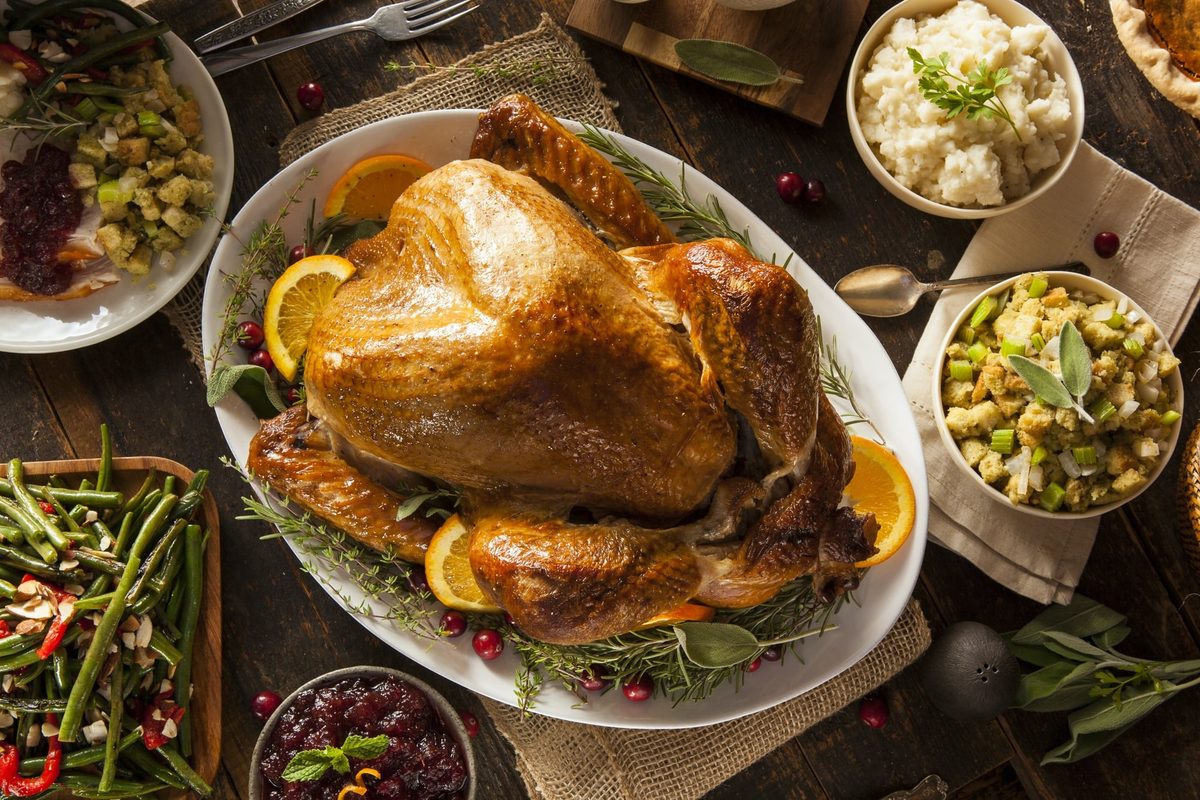
Most roast turkey seasoning comes down to the same few herbs plus garlic, onion, salt and pepper. Two herb-roasted turkey recipes, one from America’s Test Kitchen and one from the University of Florida’s extension service, both build on sage, thyme and rosemary, and both put the herbs on the bird before it goes into the oven.12 This page covers what each seasoning does, how those recipes use them, the less usual choices (allspice, bay), and the USDA’s rules for getting the bird safely done: roast at no lower than 325°F and check that the thigh, wing and breast reach 165°F.3
At a glance
| Seasoning | Job on the bird | Notes |
|---|---|---|
| Sage | The signature turkey and stuffing herb | In both recipes and in poultry seasoning124 |
| Thyme | Savory, sharp herbal base | Thyme leads McCormick Culinary’s poultry seasoning4 |
| Rosemary | Piney, resinous note | Strong; use a light hand5 |
| Parsley | Fresh, green bulk in a herb paste or a finish | 1 1/4 cups in ATK’s paste1 |
| Garlic and onion or shallot | Savory aromatics | Garlic in both recipes12 |
| Black pepper and salt | Seasoning | Both recipes; ATK also brines12 |
| Allspice | Warm, clove-like note | Not in either recipe; a jerk-style option67 |
| Bay leaf | Background note in gravy and broth | Remove before serving89 |
Two herb-roasted turkey recipes
| America’s Test Kitchen, Herbed Roast Turkey1 | UF/IFAS Extension, Herby Turkey2 | |
|---|---|---|
| Herbs | Fresh: 1 1/4 cups parsley, 4 tsp thyme, 2 tsp sage, 1 1/2 tsp rosemary | 1/4 cup minced fresh rosemary, thyme, sage, marjoram and oregano, plus 20 sprigs |
| Aromatics | 1 shallot, 2 garlic cloves, 3/4 tsp lemon zest | Apple, lemon and onion, quartered, with 2 to 3 smashed garlic cloves |
| Salt and pepper | Brined first (2 cups table salt in the brine); 3/4 tsp salt and 1 tsp pepper in the paste | 1 Tbsp kosher salt, 2 tsp black pepper |
| Fat and binder | 1/4 cup olive oil, 1 tsp Dijon mustard | 2 Tbsp avocado oil |
| Where it goes | Under the breast skin, in pockets in the breast, in the cavity, then on the skin | Rubbed all over, including under the skin; aromatics and sprigs in the cavity |
| Oven | 400°F | 475°F, then 350°F |
| Done when | Breast 165°F; thigh 170 to 175°F | Thigh and breast 165°F |
These are the publishers’ own recipes, not a house standard. ATK’s 170 to 175°F for the thigh is above the safety minimum; FSIS notes that cooks may choose higher temperatures for personal preference.10
The core seasonings and what each one does
Sage
Sage is the herb most tied to turkey and stuffing. PROSEA, the Southeast Asian plant reference, lists sausages and stuffings among its main uses and calls the United States its biggest user, at about 4,000 tonnes a year; its strong smell comes from compounds called thujones.11 It is in both recipes above and in McCormick Culinary’s poultry seasoning.124 The University of Delaware’s extension guide warns that sage can taste extremely objectionable if overused,5 and ATK’s paste uses only 2 teaspoons of sage against 1 1/4 cups of parsley.1 A widely repeated claim says sage “cuts through” fatty dark meat; no source for that was found. See cooking with sage and too much sage.
Thyme
Thyme’s sharp, savory character comes from its oil, whose characteristic constituents are thymol and carvacrol.12 America’s Test Kitchen classes it as a hearty herb to add early in cooking,13 and thyme is the first-listed, largest ingredient in McCormick Culinary’s poultry seasoning.4 See cooking with thyme.
Rosemary
Rosemary, now Salvia rosmarinus,14 is a mint-family plant with a pungent, slightly bitter taste,15 and PROSEA ties its warm, piny scent to alpha-pinene.16 The University of Delaware lists it with sage among the strong herbs that turn objectionable when overdone,5 so use it sparingly.
A common claim says rosemary should go in late in cooking. The sources say otherwise: America’s Test Kitchen treats it as a hearty herb to add early,13 and both turkey recipes rub it onto the raw bird before roasting.12 Fresh or dried both work; the University of Delaware’s general rule is that 3/4 to 1 teaspoon of dried crumbled herb equals 2 to 3 teaspoons of fresh.5 See cooking with rosemary and dried vs. fresh rosemary.
Parsley
Flat-leaf parsley is stronger flavored than the curly type, according to PROSEA, which says it is mainly used to flavor sauces, soups and stews.17 It can do two jobs on a turkey. As a finish, it is a delicate herb that the LSU AgCenter says to add a minute or two before the end of cooking.18 As bulk in a herb paste, it goes on before roasting: ATK’s paste uses 1 1/4 cups.1 See flat-leaf vs. Italian parsley.
Garlic and onion
Garlic is in both recipes: minced into ATK’s paste and smashed into the cavity in the Florida recipe. ATK uses a shallot for its onion note; the Florida recipe quarters an onion into the cavity.12 Kew lists onion as Allium cepa, in the amaryllis family, Amaryllidaceae.19 Neither recipe uses onion powder or garlic powder, but both work in a dry rub; that is common practice rather than a sourced rule. See onion powder and garlic powder.
A herb butter or garlic oil for under the skin is another option. If you make garlic oil ahead, keep it cold: UC Agriculture and Natural Resources says not to store garlic in oil at room temperature, and to refrigerate it for no more than 4 days.20
Allspice
Allspice is named for a flavor that resembles a combination of cinnamon, cloves and nutmeg.6 Neither turkey recipe above uses it. It belongs to Jamaican jerk, where pimento (allspice) and fresh thyme are essential ingredients,7 and PROSEA notes that the whole berries go into meat broths and gravies.21 For a jerk-style turkey, a small amount in a dry rub alongside thyme, black pepper and chile is a reasonable starting point (Method, not a tested ratio). See jerk seasoning.
Bay leaf
Bay suits the liquid parts of a turkey dinner rather than the roasting bird. Food Network’s classic turkey gravy simmers the broth with herb sprigs and a bay leaf,9 and J. Kenji López-Alt says bay brings out the meaty flavors of beef and chicken.8 Atlas Obscura describes the flavor as herbal, bitter and slightly piney,22 so a light hand is sensible. Take them out before serving; López-Alt compares eating one to eating a fish bone.8 See turkey gravy spices and too much bay leaf.
Poultry seasoning: the one-jar version
McCormick Culinary’s poultry seasoning combines thyme, sage, marjoram, rosemary, black pepper and nutmeg,4 which covers most of the herbs above in one jar. See poultry seasoning and good stuffing spices.
Roasting safely
- Oven: FSIS says to roast at no lower than 325°F.3
- Doneness: 165°F, checked in the innermost part of the thigh and wing and the thickest part of the breast.3 FSIS sets 165°F for all poultry, including stuffing.10
- Stuffing: FSIS advises cooking stuffing separately for optimal safety and uniform doneness.23
- Rest: let the turkey stand 20 minutes before carving.3
- No rinsing: FSIS does not recommend washing raw poultry before cooking.24
Related
- Turkey gravy spices
- Good stuffing spices
- Good seasonings for turkey burgers
- Good spices for chicken
- The master list of herbs and spices
Footnotes
-
“Herbed Roast Turkey”, America’s Test Kitchen, 2007. americastestkitchen.com · Publication ↩ ↩2 ↩3 ↩4 ↩5 ↩6 ↩7 ↩8 ↩9 ↩10 ↩11
-
“Herby Turkey”, UF/IFAS Extension, University of Florida. sfyl.ifas.ufl.edu · Reference work ↩ ↩2 ↩3 ↩4 ↩5 ↩6 ↩7 ↩8
-
“Let’s Talk Turkey: A Consumer Guide to Safely Roasting a Turkey”, USDA Food Safety and Inspection Service. fsis.usda.gov · Regulator ↩ ↩2 ↩3 ↩4
-
“Poultry Seasoning, 12 oz”, McCormick Culinary. mccormick.com · Merchant ↩ ↩2 ↩3 ↩4 ↩5
-
“Using Herbs and Spices”, University of Delaware Cooperative Extension, revised 2025. udel.edu · Reference work ↩ ↩2 ↩3 ↩4
-
“Allspice”, Encyclopaedia Britannica. britannica.com · Reference work ↩ ↩2
-
Vaughn Stafford Gray, “A Brief History of Jamaican Jerk”, Smithsonian Magazine, 2020. smithsonianmag.com · Publication ↩ ↩2
-
David Leite with J. Kenji López-Alt, “Bay leaves are an optional ingredient”, The Splendid Table. splendidtable.org · Publication ↩ ↩2 ↩3
-
“Classic Turkey Gravy”, Food Network Kitchen. foodnetwork.com · Publication ↩ ↩2
-
“Safe Minimum Internal Temperature Chart”, USDA Food Safety and Inspection Service, updated 2025. fsis.usda.gov · Regulator ↩ ↩2
-
U.A. Dasuki, “Salvia officinalis”, PROSEA, via Pl@ntUse. uses.plantnet-project.org · Reference work ↩
-
S.H. Widodo, “Thymus vulgaris”, PROSEA, via Pl@ntUse. uses.plantnet-project.org · Reference work ↩
-
Liz Bomze, “Our Guide to Fresh Herbs”, America’s Test Kitchen, 2019. americastestkitchen.com · Publication ↩ ↩2
-
“Salvia rosmarinus Spenn.”, Plants of the World Online, Royal Botanic Gardens, Kew. powo.science.kew.org · Reference work ↩
-
Anoushka Pant, “Rosemary”, Encyclopaedia Britannica. britannica.com · Reference work ↩
-
C.C. de Guzman, “Rosmarinus officinalis”, PROSEA, via Pl@ntUse. uses.plantnet-project.org · Reference work ↩
-
I.B. Ipor and L.P.A. Oyen, “Petroselinum crispum”, PROSEA, via Pl@ntUse. uses.plantnet-project.org · Reference work ↩
-
“Flavorful Herbs”, LSU AgCenter. lsuagcenter.com · Reference work ↩
-
“Allium cepa L.”, Plants of the World Online, Royal Botanic Gardens, Kew. powo.science.kew.org · Reference work ↩
-
Linda J. Harris, “Garlic: Safe Methods to Store, Preserve, and Enjoy”, UC ANR Publication 8568, 2016. ccfruitandnuts.ucanr.edu · Reference work ↩
-
D. Sulistiarini, “Pimenta dioica”, PROSEA, via Pl@ntUse. uses.plantnet-project.org · Reference work ↩
-
Andrew Coletti, “What Is a Bay Leaf, Exactly?”, Atlas Obscura, 2023. atlasobscura.com · Publication ↩
-
“Stuffing and Food Safety”, USDA Food Safety and Inspection Service. fsis.usda.gov · Regulator ↩
-
“Washing Food: Does it Promote Food Safety?”, USDA FSIS. fsis.usda.gov · Regulator ↩