Spice Comparisons · Comparison
Tandoori Masala vs. Garam Masala: A Red Marinade Blend and a Warm-Spice Blend
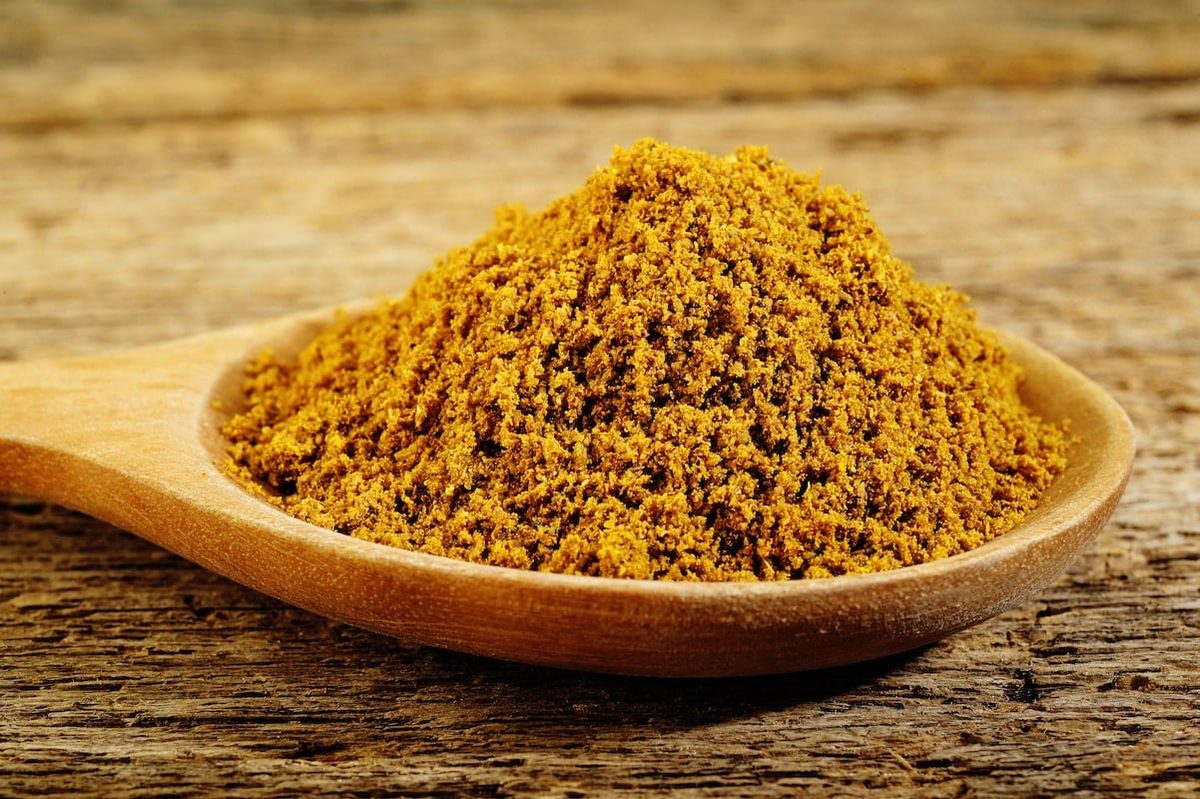
Tandoori masala is a blend for one job: stirred into yogurt, it marinates meat for the tandoor, the clay oven it is named for.1 Most versions are built on coriander and cumin, with chile or paprika and something red.123 Garam masala is a warm-spice blend, at its most basic just cardamom, cinnamon and cloves, used both early in cooking and as a finish.45 The practical differences are color and heat: tandoori masala is red and can be hot, while none of the garam masala recipes compared here contains chile or any red spice.564
Side by side
| Tandoori masala | Garam masala | |
|---|---|---|
| The name | From the tandoor, a clay oven;1 masala is a varying blend of spices used in Indian cooking7 | Literally “hot spices”;8 Saveur says the heat refers to spices thought to warm the body in Ayurvedic medicine, not chile6 |
| Main job | Mixed with yogurt as a marinade1 | In marinades, sauces and the base of a dish, or as a finish at the end of cooking5 |
| Fixed recipe? | No; published versions differ widely123 | No: varies widely by region and personal taste5 |
| Typical spices | Coriander and cumin lead the home recipes; Singla adds Kashmiri chiles, peppercorns, cloves, cardamom, fenugreek, cinnamon, carom, ginger, garlic, turmeric and paprika12 | Cardamom, cinnamon and cloves at the most basic;4 Great British Chefs’ common list adds bay leaf, fennel, cumin, coriander seed, mace and black and white pepper5 |
| Color | Red to orange-red, from chiles, paprika, turmeric or beet powder; some store blends use Red 40 dye23 | Brown (editorial); no red spice in the versions compared564 |
| Chile | Usually: Kashmiri chiles in Singla’s recipe, cayenne on Woodland’s label; The Spice House’s version has paprika only239 | None in the versions compared;564 The Spice House says it is warming but “not hot like chili peppers”10 |
| Salt | Some store blends list salt first; others are salt-free39 | None in the versions compared564 |
| Toasted? | Anjula Devi dry-roasts the whole spices1 | Sometimes: Bong Eats dry-roasts; Jaffrey’s version is untoasted46 |
| Official standard | None found; not in the USDA spice-blend specification11 | None found; not in the USDA spice-blend specification11 |
| Flavor (editorial) | Earthy coriander and cumin, warm spice, a chile edge | Sweet, warm and resinous, cardamom and clove up front |
The differences that change a dish
Color
The red is what most people picture with tandoori chicken, and it is where tandoori blends differ most. Anupy Singla, a cookbook author who also sells spices, writes that the blend was originally made with a leaning toward turmeric and paprika, and that the bright red of some store-bought blends comes from food dyes such as Red 40.2 Woodland Foods colors its blend with beet powder and paprika.3 Paprika’s red comes mainly from capsanthin and capsorubin;12 turmeric’s yellow from curcumin.13 Garam masala adds no red: the versions compared here are built on brown seeds and bark.564 Swap one for the other and the color of the dish changes first.
Heat
Chile heat comes from capsaicinoids,14 and how much a tandoori masala has depends on the chiles. Singla’s recipe uses a whole cup of dried Kashmiri chiles,2 which Dassana Amit describes as less hot,15 so much of that cup is there for color. Woodland’s label lists cayenne,3 and The Spice House’s salt-free version lists paprika and no other chile.9 No published heat measurement exists for any tandoori masala we found. Garam masala’s “hot” is a different idea altogether, and none of the versions compared here contains chile.610
The spice base
The two overlap more than the colors suggest. Singla’s tandoori masala includes peppercorns, cloves, cardamom and cinnamon,2 the core of many garam masalas.54 What tandoori masala adds is a heavy coriander and cumin base (Anjula Devi’s recipe starts with 8 tablespoons of coriander seeds),1 plus fenugreek in some versions.23 The compounds behind those spices are well measured: coriander seed oil is 60 to 80% linalool and related terpene alcohols,16 cumin oil 20 to 72% cuminaldehyde,17 and PROSEA credits fenugreek with a characteristic curry aroma.18 On the garam masala side, clove oil is about 85 to 92% eugenol,19 and cardamom oil is led by α-terpinyl acetate with 1,8-cineole second.20 These figures come from separate studies of each spice; no analysis of either finished blend was found.
When it goes in
Tandoori masala goes in first, into the marinade, and is cooked with the meat.1 Garam masala can go in at either end. Great British Chefs describes both uses,5 and Bong Eats sprinkles a pinch with a little ghee over finished dishes.4 A widely repeated rule says garam masala is only a finishing spice; these sources show cooks use it both ways.
Can one stand in for the other?
Partly. Garam masala can cover tandoori masala’s warm side if you add the red and the heat; tandoori masala is a poor stand-in for garam masala as a finish. We found no published ratio in either direction. See tandoori masala substitutes and garam masala substitutes.
| Swap | Starting amount | Treatment |
|---|---|---|
| Garam masala for tandoori masala | Per tablespoon: 1 1/2 tsp garam masala plus 1 1/2 tsp sweet paprika, then cayenne a pinch at a time | Method |
| Tandoori masala for garam masala, cooked into a dish | Half as much, salt-free if possible, then taste | Method |
- Garam masala in place of tandoori masala. It brings the warm spices but none of the red, coriander-cumin base or chile. The starting amount above is the one our tandoori masala substitutes page uses: half garam masala, half paprika, cayenne to taste. It is a starting point, not a published ratio.
- Tandoori masala in place of garam masala. It will turn the dish red, may add heat, and may add salt if the jar lists it.3 Use it only where the blend is cooked in, start with half the amount, and taste before salting. As a last-minute sprinkle it is a poor match. Both points are our judgment, not a tested result.
When either goes into a hot pan rather than a marinade, America’s Test Kitchen recommends blooming ground spices in fat, since powdered spices added straight to liquid can taste bland and musty; blooming takes from 30 seconds to several minutes.21
When to reach for each
- Tandoori masala for a yogurt marinade,1 as The Spice House also suggests for its blend.9 Chicken, lamb, fish, paneer and vegetables all take it, cooked in the hottest oven, broiler or grill you have; that is common practice rather than a sourced finding. It seasons the chicken in butter chicken, which NPR describes as tandoori-roasted chicken doused in buttery tomato sauce;22 the sauce is a separate step.
- Garam masala for curries, stews and samosas,6 for the base of a dish, or as a finish on a soup, dal or dip.5 See garam masala uses and cooking with garam masala.
What isn’t known
- No published heat measurement exists for any tandoori masala or garam masala.
- No source gives a ratio for swapping one for the other.
- No analysis of either finished blend was found; the compound figures describe the individual spices.
- A claim that most Indian households keep garam masala on hand circulates; no source we found measures it.
Related
- Tandoori masala and tandoori masala substitutes
- Garam masala, garam masala substitutes and too much garam masala?
- Tikka masala and tikka masala vs. garam masala
- Other comparisons: chaat masala vs. garam masala, garam masala vs. curry powder, ras el hanout vs. garam masala
- The spices: paprika, cayenne pepper, coriander, cumin, fenugreek, turmeric, cardamom, cinnamon, cloves
Footnotes
-
Anjula Devi, “Tandoori Masala”, 15-Minute Indian, 2025, via ckbk. app.ckbk.com · Publication ↩ ↩2 ↩3 ↩4 ↩5 ↩6 ↩7 ↩8 ↩9 ↩10
-
Anupy Singla, “Why Your Tandoori Masala Doesn’t Need to be Bright Red”, Indian As Apple Pie, 2013. indianasapplepie.com · Merchant ↩ ↩2 ↩3 ↩4 ↩5 ↩6 ↩7 ↩8 ↩9
-
Woodland Foods, Tandoori Spice Blend, product page. shop.woodlandfoods.com · Merchant ↩ ↩2 ↩3 ↩4 ↩5 ↩6 ↩7 ↩8 ↩9
-
“Bengali Garam Masala”, Bong Eats, 2016. bongeats.com · Publication ↩ ↩2 ↩3 ↩4 ↩5 ↩6 ↩7 ↩8 ↩9 ↩10
-
GBC Kitchen, “How to make garam masala”, Great British Chefs, 2025. greatbritishchefs.com · Publication ↩ ↩2 ↩3 ↩4 ↩5 ↩6 ↩7 ↩8 ↩9 ↩10 ↩11 ↩12
-
“Garam Masala” (Madhur Jaffrey recipe), Saveur, 2014. saveur.com · Publication ↩ ↩2 ↩3 ↩4 ↩5 ↩6 ↩7 ↩8 ↩9
-
“masala”, Merriam-Webster.com Dictionary. merriam-webster.com · Reference work ↩
-
“garam masala”, Merriam-Webster.com Dictionary. merriam-webster.com · Reference work ↩
-
The Spice House, Tandoori Salt-Free Seasoning, product page. thespicehouse.com · Merchant ↩ ↩2 ↩3 ↩4
-
“Garam Masala Substitute”, The Spice House, 2018. thespicehouse.com · Merchant ↩ ↩2
-
Commercial Item Description A-A-20001C, Spices and Spice Blends, USDA Agricultural Marketing Service, 2023. ams.usda.gov · Regulator ↩ ↩2
-
“Paprika extract”, Chemical and Technical Assessment, 77th JECFA, FAO/WHO. fao.org · Regulator ↩
-
“Turmeric: Usefulness and Safety”, National Center for Complementary and Integrative Health, 2025. nccih.nih.gov · Regulator ↩
-
Bosland and Walker, “Measuring Chile Pepper Heat”, New Mexico State University, 2010. pubs.nmsu.edu · Reference work ↩
-
Dassana Amit, “Rasam Powder Recipe”, Dassana’s Veg Recipes. vegrecipesofindia.com · Publication ↩
-
Al-Khayri et al., “Essential Oil from Coriandrum sativum: A Review”, Molecules, 2023. mdpi.com · Peer-reviewed ↩
-
P.C.M. Jansen, Cuminum cyminum, Plant Resources of South-East Asia (PROSEA). uses.plantnet-project.org · Reference work ↩
-
C.S. Tawan and N. Wulijarni-Soetjipto, Trigonella foenum-graecum, Plant Resources of South-East Asia (PROSEA). uses.plantnet-project.org · Reference work ↩
-
Batiha et al., “Syzygium aromaticum L. (Myrtaceae)”, Biomolecules, 2020. mdpi.com · Peer-reviewed ↩
-
Blažeković et al., “Content and Chemical Composition of Essential Oil from Cardamom”, Croatica Chemica Acta, 2025. hrcak.srce.hr · Peer-reviewed ↩
-
“How to Bloom Spices”, America’s Test Kitchen, 2023. americastestkitchen.com · Publication ↩
-
Diaa Hadid and Omkar Khandekar, “Who cooked up butter chicken? A court seeks the answer”, NPR, 2024. kpbs.org · Publication ↩