Spice Comparisons · Comparison
Ras el Hanout vs. Garam Masala: Turmeric, Chile and Rose Set Them Apart
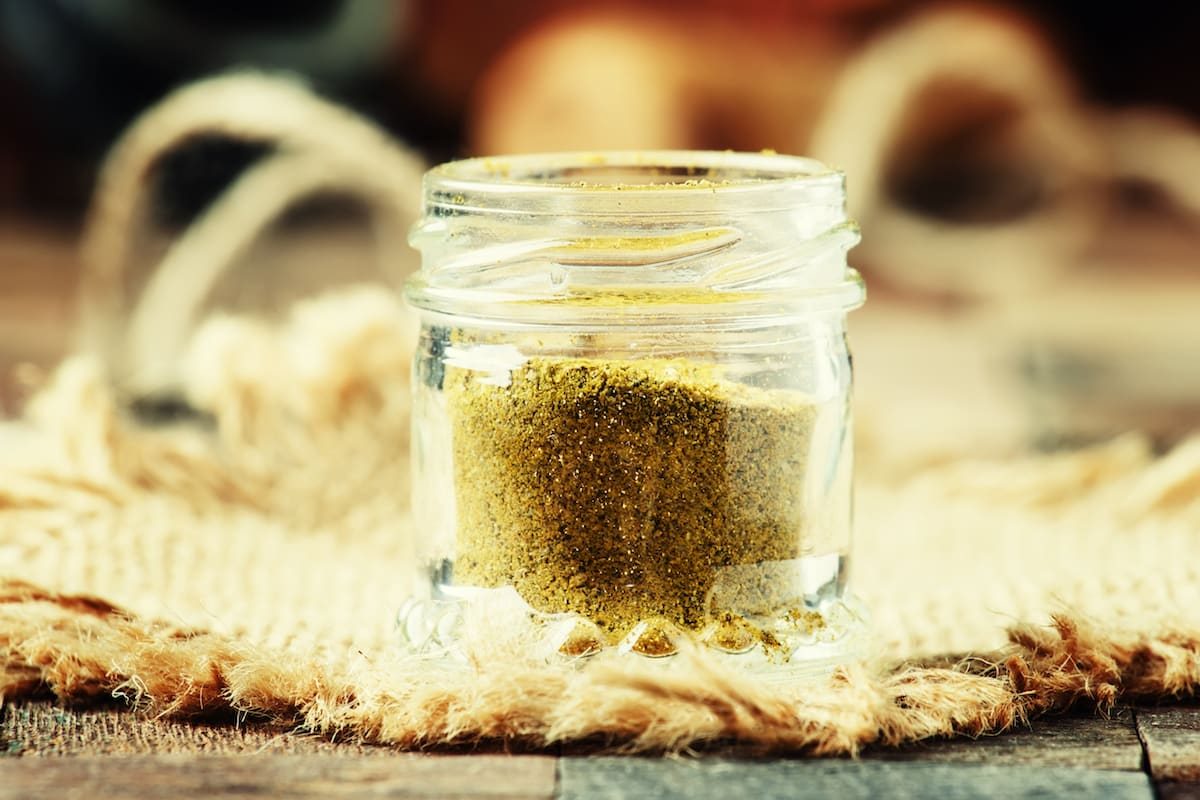
Ras el hanout and garam masala share a warm-spice core of cinnamon, cloves, cardamom, pepper, cumin and coriander, and neither has a fixed recipe.1234 What separates them is what ras el hanout adds. Its standard list includes turmeric and ginger, cayenne is usually in it, and the longer versions bring in rosebud and lavender.13 None of the garam masala recipes compared here uses turmeric, ginger or chile, and none is floral.456 In the pot, that means ras el hanout turns a dish yellow-tinged and can add heat; garam masala does neither.
Side by side
| Ras el hanout | Garam masala | |
|---|---|---|
| Where | Found in varying forms in Morocco, Algeria and Tunisia1 | Used across the Indian subcontinent4 |
| Name | Something like “top of the shop”1 | Literally “hot spices”;7 Saveur says the heat refers to spices thought to warm the body in Ayurvedic medicine, not chile5 |
| Fixed recipe? | No: “one of the most complex such mixtures” (Oxford Companion)1 | No: varies widely by region and personal taste;4 one food writer says it changes with every state and every home8 |
| Core spices | Cumin, coriander seed, turmeric, ginger, cardamom and nutmeg as standard; cinnamon, cayenne, rosebud and oregano usually added1 | Cardamom, cinnamon and cloves at its most basic (Bengali);6 Great British Chefs’ common list adds bay leaf, fennel, cumin, coriander seed, mace and black and white pepper4 |
| Number of spices, in the versions compared | 8 (Saveur), 24 (World Spice Merchants), 27 (a list recorded by Mme Guinaudeau)231 | 3 (Bong Eats), 6 (Madhur Jaffrey via Saveur), about 10 named by Great British Chefs654 |
| Turmeric | On the standard list; also in World Spice’s blend13 | Not in the Bengali, Jaffrey or Great British Chefs versions654 |
| Chile | Cayenne usually included; Saveur’s recipe uses 1 1/2 tablespoons12 | None in the versions compared456 |
| Floral notes | Rosebud on the standard list; roses, lavender and chamomile in World Spice’s blend13 | None in the versions compared |
| Toasted? | Not addressed by the sources compared | Sometimes: Bong Eats dry-roasts; Jaffrey’s version is untoasted65 |
| Official standard | None found; not in the USDA spice-blend specification9 | None found; not in the USDA spice-blend specification9 |
| Flavor (editorial) | Warm and sweet with an earthy, yellow base, often some heat, and in long blends a perfumed lift | Sweet, warm and resinous, cardamom and clove up front, a mild pepper bite |
The counts belong to the specific recipes and products named, not to either blend in general. Counts of 80 or 100 ingredients in ras el hanout circulate widely; no source we found supports them.
The differences that change a dish
Color and earthiness: turmeric and ginger
Turmeric’s yellow comes from curcumin.10 It is on the Oxford Companion’s standard list for ras el hanout and absent from all three garam masala versions above,1456 so ras el hanout tints a braise where garam masala leaves it brown. Ginger is the other standard ras el hanout spice missing from the garam masala versions above;1456 its pungency comes from non-volatile gingerols.11
Heat
Cayenne is usually in ras el hanout,1 and Saveur’s eight-spice version carries a tablespoon and a half of it.2 Chile heat comes from capsaicinoids.12 Garam masala’s “hot” is not chile heat,5 and none of the versions above contains any.456 Ras el hanout varies too: a floral, cardamom-led jar can be mild, and a Saveur-style blend will not be. Check the label.
Perfume
The longer ras el hanout blends carry flowers. The Oxford Companion lists rosebud of the damask rose among the usual additions, and World Spice’s 24-ingredient blend includes roses, lavender and chamomile.13 Garam masala’s perfume comes from cardamom instead: Jaffrey’s recipe starts from a quarter cup of cardamom seeds.5
What they share
Both draw on the same aroma compounds for their warm side. Clove oil is about 85 to 92% eugenol,13 cardamom oil is led by α-terpinyl acetate with 1,8-cineole second,14 true cinnamon bark oil is about 49.9 to 62.8% cinnamaldehyde,15 coriander seed oil is 60 to 80% linalool and related terpene alcohols,16 and cumin oil is 20 to 72% cuminaldehyde.17 Those figures describe each spice’s own oil, from separate studies; no analysis of either finished blend was found. Which of these spices dominates depends on the recipe, so a cumin-heavy garam masala and a clove-heavy ras el hanout can sit closer together than two jars with the same name.
Can one stand in for the other?
Yes, with adjustments, and the two directions are not symmetrical. Our ras el hanout substitutes and garam masala substitutes pages carry the full treatment.
| Swap | Starting amount | Treatment |
|---|---|---|
| Garam masala for ras el hanout | 1:1, plus a pinch of paprika and a pinch of cayenne (Mike Hultquist) | Attributed |
| Ras el hanout for garam masala | Half as much, then taste | Method |
- Garam masala in place of ras el hanout. The Spice House and Hultquist both name garam masala as a substitute.1819 Hultquist says to use it 1 for 1 and add a pinch of paprika and a pinch of cayenne to bring it closer.19 He does not say how he arrived at that, and we found no second figure to compare it with. What it can’t supply is turmeric’s color, ginger, or the floral notes of a long blend. A pinch of turmeric helps with color; that is our suggestion, not his.
- Ras el hanout in place of garam masala. Frontier Co-op suggests ras el hanout in place of garam masala in dishes like tagines, but gives no amount.20 We found no published ratio. Start with half the amount, since ras el hanout can bring chile and turmeric that garam masala doesn’t, and taste. It is a poor choice as a last-minute finish on an Indian dish, where garam masala’s job is aroma: the yellow color and any cayenne will show. That is our judgment.
When to reach for each
- Ras el hanout for North African cooking. Saveur’s headnote says it is used in virtually every dish of the region,2 and World Spice lists tagines, couscous, stews and roasted vegetables, and even fruit pies.3 See Moroccan spices.
- Garam masala for Indian cooking, early or late. Great British Chefs describes it going into marinades, sauces and the base of a dish, and also finishing a dish at the end of cooking.4 Bong Eats sprinkles a pinch, with a sliver of ghee, over finished vegetarian dishes such as ghonto, dalna and khichuri.6 Saveur mentions stews, curries and fried snacks such as samosas.5 See garam masala uses and cooking with garam masala.
When either goes in early, America’s Test Kitchen’s advice on ground spices applies: bloom them in fat, since powdered spices added straight to liquid can taste bland and musty, and watch them, because they burn fairly quickly.21
A note on Spanish fly
The Oxford Companion records that some Moroccan formulas for ras el hanout have included supposed aphrodisiacs such as cantharides, the beetles called Spanish fly, and says these seem irrelevant for flavor.1 Its active substance blisters skin on contact, and Britannica describes eating it as extremely hazardous.22 None of the published versions compared here contains it.23
What isn’t known
- No analysis of either finished blend was found; the compound figures describe the individual spices.
- Whether ras el hanout spices are traditionally toasted before grinding is not addressed by the sources compared.
- Hultquist’s 1:1 ratio is the only published figure for either swap, and he does not say how he arrived at it.
- Counts of 80 or more ingredients in ras el hanout could not be traced.
Related
- Ras el hanout and ras el hanout substitutes
- Garam masala, garam masala substitutes and too much garam masala?
- Other garam masala comparisons: garam masala vs. curry powder, tandoori masala vs. garam masala, tikka masala vs. garam masala, chaat masala vs. garam masala
- Related blends: baharat and berbere
- The spices: turmeric, ginger, cardamom, cinnamon, cloves, cumin, coriander, cayenne pepper
Footnotes
-
Alan Davidson, “Ras-el-hanout”, The Oxford Companion to Food, 2014. app.ckbk.com · Reference work ↩ ↩2 ↩3 ↩4 ↩5 ↩6 ↩7 ↩8 ↩9 ↩10 ↩11 ↩12 ↩13 ↩14 ↩15
-
“Ras el Hanout (North African Spice Mix)”, Saveur, 2012. saveur.com · Publication ↩ ↩2 ↩3 ↩4 ↩5 ↩6
-
World Spice Merchants, Ras El Hanout, product page. worldspice.com · Merchant ↩ ↩2 ↩3 ↩4 ↩5 ↩6 ↩7 ↩8
-
GBC Kitchen, “How to make garam masala”, Great British Chefs, 2025. greatbritishchefs.com · Publication ↩ ↩2 ↩3 ↩4 ↩5 ↩6 ↩7 ↩8 ↩9 ↩10 ↩11 ↩12
-
“Garam Masala” (Madhur Jaffrey recipe), Saveur, 2014. saveur.com · Publication ↩ ↩2 ↩3 ↩4 ↩5 ↩6 ↩7 ↩8 ↩9 ↩10 ↩11 ↩12
-
“Bengali Garam Masala”, Bong Eats, 2016. bongeats.com · Publication ↩ ↩2 ↩3 ↩4 ↩5 ↩6 ↩7 ↩8 ↩9 ↩10
-
“garam masala”, Merriam-Webster.com Dictionary. merriam-webster.com · Reference work ↩
-
Karishma H. Nandkeolyar, “How Hyderabadi biryani taught me not all of India’s garam masalas are the same”, Gulf News. gulfnews.com · Publication ↩
-
Commercial Item Description A-A-20001C, Spices and Spice Blends, USDA Agricultural Marketing Service, 2023. ams.usda.gov · Regulator ↩ ↩2
-
“Turmeric: Usefulness and Safety”, National Center for Complementary and Integrative Health, 2025. nccih.nih.gov · Regulator ↩
-
Sutarno, Hadad and Brink, Zingiber officinale, Plant Resources of South-East Asia (PROSEA). uses.plantnet-project.org · Reference work ↩
-
Bosland and Walker, “Measuring Chile Pepper Heat”, New Mexico State University, 2010. pubs.nmsu.edu · Reference work ↩
-
Batiha et al., “Syzygium aromaticum L. (Myrtaceae)”, Biomolecules, 2020. mdpi.com · Peer-reviewed ↩
-
Blažeković et al., “Content and Chemical Composition of Essential Oil from Cardamom”, Croatica Chemica Acta, 2025. hrcak.srce.hr · Peer-reviewed ↩
-
Ranasinghe et al., “Medicinal properties of ‘true’ cinnamon: a systematic review”, BMC Complementary and Alternative Medicine, 2013. link.springer.com · Peer-reviewed ↩
-
Al-Khayri et al., “Essential Oil from Coriandrum sativum: A Review”, Molecules, 2023. mdpi.com · Peer-reviewed ↩
-
P.C.M. Jansen, Cuminum cyminum, Plant Resources of South-East Asia (PROSEA). uses.plantnet-project.org · Reference work ↩
-
“Ras El Hanout Substitute”, The Spice House, 2020. thespicehouse.com · Merchant ↩
-
Mike Hultquist, “Ras El Hanout Recipe (Moroccan Spice Blend + Substitutes)”, Chili Pepper Madness, 2026. chilipeppermadness.com · Publication ↩ ↩2
-
“Our Guide to the Best Garam Masala Substitutes”, Frontier Co-op. frontiercoop.com · Merchant ↩
-
“How to Bloom Spices”, America’s Test Kitchen, 2023. americastestkitchen.com · Publication ↩
-
“Spanish fly”, Encyclopaedia Britannica. britannica.com · Reference work ↩