Spice Substitutes · Substitutes
Garam Masala Substitutes, Ranked by the Job It’s Doing
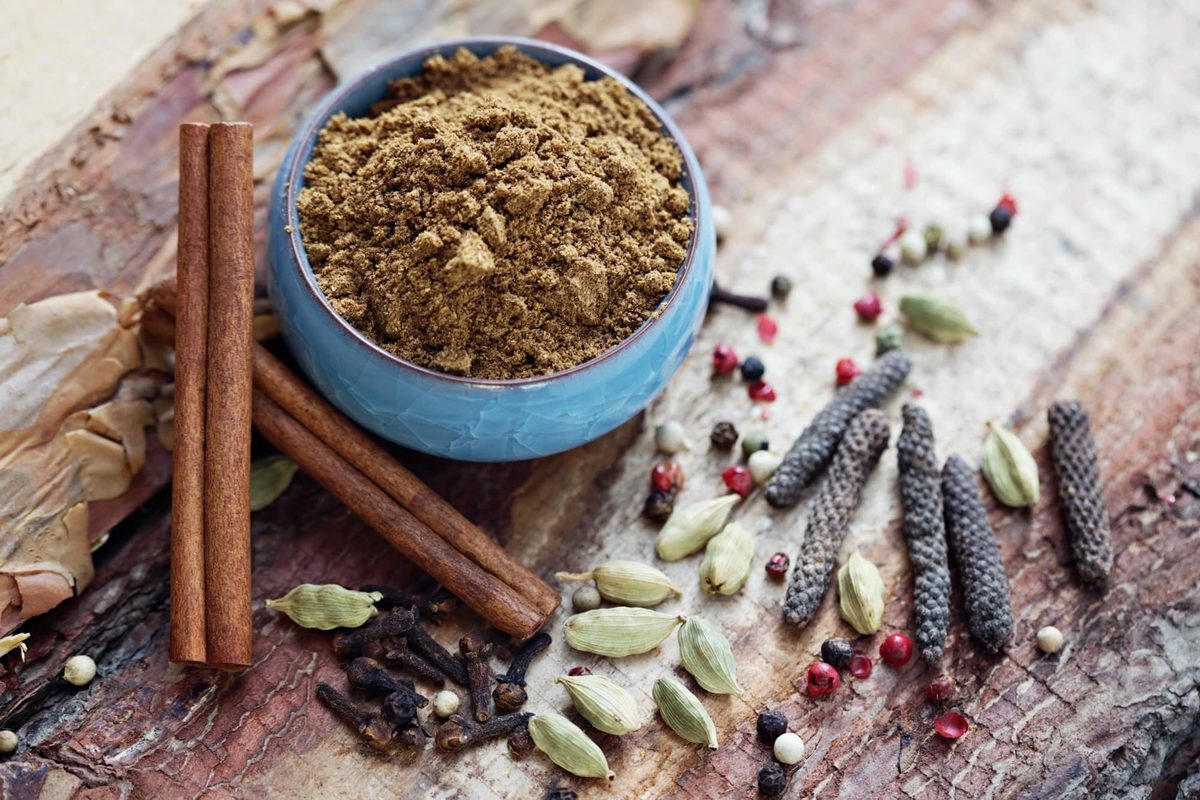
Garam masala is a ground blend of warm spices used across the Indian subcontinent,1 with no single recipe. Great British Chefs lists cloves, bay leaf, fennel, cinnamon, cardamom, cumin, coriander seeds, mace and black and white pepper as the spices most often used,1 while a Bengali garam masala, in its most basic form, is just cardamom, cinnamon and cloves.2 The “garam” (hot) refers to spices thought to warm the body in Ayurvedic medicine, Saveur explains, not to chile heat.3 The Spice House makes the same point: the blend is warming but not hot like chili peppers.4
That range is good news when you run out: almost any kitchen has some of these spices. The best stand-in depends on what the garam masala is doing in your recipe.
Quick answer
| What garam masala is doing | Best substitute | Starting amount, per 1 part garam masala | Treatment |
|---|---|---|---|
| Fragrant finish, sprinkled at the end | Quick mix of cardamom, cinnamon and cloves | Bong Eats’ proportions, 7 : 2 : 2 by weight | Attributed |
| Warm background in a curry or marinade | 4 parts cumin to 1 part allspice | 1 part of the mix | Attributed (mix), Method (amount) |
| The same, with only cumin on hand | Ground cumin | 1 part, up to 2 | Attributed |
| One spice among many in a dish | Curry powder | 1/2 part, then taste | Method |
| A savory dish, nothing else on hand | Baharat or ras el hanout | 1/2 part, then taste | Method |
| A sweet dish | Pumpkin pie spice | 1/2 part, then taste | Method |
How the ratios on this page are labeled
Every ratio carries one of four labels.
- Computed: based on a measurable physical relationship, with the source named.
- Attributed: a named source publishes this ratio. We quote it as theirs.
- Disputed: named sources give different answers to the same swap. We show each one and do not average them.
- Method: we found no published ratio. We give a direction and a cautious starting point, and say so.
None of the ratios below comes from a measurement of flavor strength. They are merchants’ and cooks’ rules of thumb, and garam masala itself varies so much from region to region and cook to cook1 that no substitute can match “garam masala” exactly.
What’s in it, and why that matters for a swap
The spices that turn up most often each bring a different aroma compound:
| Spice | What has been measured | Source |
|---|---|---|
| Cloves | Eugenol, about 85 to 92% of the oil | 5 |
| Cardamom | 1,8-cineole, 0.24 to 30.62% of the oil across samples | 6 |
| Cinnamon (true) | Cinnamaldehyde, about 49.9 to 62.8% of the bark oil | 7 |
| Cumin | Cuminaldehyde, 20 to 72% of the oil | 8 |
| Coriander seed | Linalool and related terpene alcohols, 60 to 80% of the oil | 9 |
No published analysis of garam masala as a blend was found, so the table describes the parts, not the whole. In practice, a substitute that keeps the clove, cardamom and cinnamon notes will taste closest to a northern-style or Bengali blend; one built on cumin will taste earthier and less perfumed.
If garam masala is a fragrant finish
Great British Chefs notes that garam masala can be used to finish dishes at the end of cooking,1 and Bong Eats suggests a pinch, with a sliver of ghee, over finished Bengali dishes.2 Here aroma is the whole point, so the closest substitute is a small batch of the real thing.
1. A quick three-spice garam masala
Formula (Attributed): Bong Eats’ Bengali garam masala is 7 g cardamom, 2 g cloves and 2 g cinnamon, dry-roasted for about 5 minutes and ground.2 If you have the three spices ground rather than whole, mix them in the same proportions and skip the roasting.
Formula (Attributed): For a fuller blend, The Spice House’s recipe uses a 3-inch cinnamon stick, 2 tablespoons each black peppercorns, green cardamom seeds and cumin seeds, 3 tablespoons coriander seeds, 1 teaspoon ground mace and a bay leaf, with the whole spices toasted and ground.4 Madhur Jaffrey’s recipe in Saveur leans much harder on cardamom, a quarter cup of seeds, and is not toasted at all.3
Use homemade blend 1:1 for garam masala. Because these are recipes for garam masala itself, not stand-ins, no conversion is needed.
2. Cumin, coriander and cardamom, equal parts
Formula (Attributed): Frontier Co-op suggests starting with equal parts of cumin, coriander and cardamom and adjusting to taste, adding a pinch of cinnamon or cloves for more warmth if you like.10 This keeps cardamom’s aroma while leaning on two spices most kitchens have.
If garam masala is warm background in a curry or marinade
Saveur describes garam masala lending potency to stews, curries and fried snacks such as samosas.3 Cooked in, its top notes fade into a general warmth, so a simpler mix can do the job.
1. Cumin and allspice
Formula (Attributed): The Spice House says to combine 4 parts ground cumin with 1 part allspice.4 The logic shows in the chemistry. Allspice berry oil is 50 to 80 percent eugenol,11 the same compound that dominates clove oil,5 so allspice stands in for the clove note while cumin supplies earthiness.
Amount (Method): The Spice House does not say how much of the mix to use. Start with the same amount as the garam masala called for, and taste before adding more. Expect a less perfumed result, since there is no cardamom or cinnamon.
2. Cumin alone
Ratio (Attributed): The Spice House says to start with 1 part cumin to 1 part garam masala, adjusting to taste, and notes you may need up to 2 parts cumin.4 It also says cumin is not a perfect match. You lose the clove, cardamom and cinnamon notes entirely.
If garam masala is one spice among many
In a dish that already has several spices, garam masala’s job is depth. A ready-made blend with overlapping spices can fill in.
1. Curry powder
The Spice House calls curry a suitable substitute when you have no garam masala,4 and Frontier Co-op suggests combining curry powder with cinnamon and cloves.10 The overlap is real: the USDA’s purchasing specification lists turmeric, coriander, fenugreek, cinnamon, cumin, black pepper, ginger and cardamom for curry powder.12 The differences matter too. Turmeric’s curcumin gives it a yellow color,13 so the dish will turn yellow, and fenugreek and ginger are not usual garam masala spices in the lists above.12
Ratio (Method): Neither merchant gives a ratio. Start with half the amount of garam masala called for, add a pinch of ground cinnamon or cloves if you have them, and taste before adding more.
2. Baharat
Ottolenghi calls baharat the Middle East’s equivalent of India’s garam masala.14 Its label lists pepper, cumin, coriander, clove, cardamom, nutmeg, cinnamon and allspice, which covers most of garam masala’s usual spices, along with paprika, chilli and cayenne.14 Frontier Co-op suggests baharat for savory dishes.10 Check the label: a blend with chile will add heat that garam masala does not.
Ratio (Method): No published ratio. Start with half the amount and taste.
3. Ras el hanout
The Oxford Companion to Food gives ras el hanout’s standard ingredients as cumin, coriander, turmeric, ginger, cardamom and nutmeg.15 Frontier Co-op suggests it in place of garam masala in dishes like tagines.10 Expect turmeric’s color, and note that cloves are not on that standard list.
Ratio (Method): No published ratio. Start with half the amount and taste.
4. Pumpkin pie spice, for sweet dishes only
Frontier Co-op suggests pumpkin pie spice in sweet dishes and warns you may need less of it.10 McCormick’s version is cinnamon, ginger, nutmeg and allspice.16 It has no cumin, coriander or cardamom, so keep it out of savory food.
Ratio (Method): No published ratio. Start with half the amount, as Frontier’s warning suggests.
5. Chaat masala, with care
The Spice House lists chaat masala as an option without saying how to use it.4 It is a very different blend. Tarla Dalal credits dried mango powder (amchur) with chaat masala’s tang and black salt with its distinctive aroma,17 and one Gulf News recipe uses a full tablespoon of black salt.18 So it adds sourness and salt that garam masala lacks.
Ratio (Method): No published ratio. Use a pinch, taste, and reduce the salt elsewhere in the dish.
What isn’t known
- No published measurement compares the flavor strength of garam masala with any substitute. The Attributed ratios above are merchants’ rules of thumb.
- No published analysis of garam masala as a whole blend was found; the chemistry table describes its separate spices.
- It is often said that garam masala contains 30 or more spices. No source we found supports this; the published recipes above use three to seven.324
- Chaat masala is sometimes called a “cooling” blend, as the opposite of garam masala. We found no source for that.
Related
- Garam masala, garam masala uses, cooking with garam masala and too much garam masala
- Garam masala vs. curry powder, garam masala vs. allspice, chaat masala vs. garam masala, ras el hanout vs. garam masala, tandoori masala vs. garam masala
- Cumin, allspice, cardamom, cloves, coriander
- Curry powder, baharat, ras el hanout, pumpkin pie spice, chaat masala
Footnotes
-
“How to make garam masala”, Great British Chefs, 2025. greatbritishchefs.com · Publication ↩ ↩2 ↩3 ↩4 ↩5
-
“Bengali Garam Masala”, Bong Eats, 2016. bongeats.com · Publication ↩ ↩2 ↩3 ↩4 ↩5
-
Madhur Jaffrey, “Garam Masala”, Saveur, 2014. saveur.com · Publication ↩ ↩2 ↩3 ↩4
-
“Garam Masala Substitute”, The Spice House, 2018. thespicehouse.com · Merchant ↩ ↩2 ↩3 ↩4 ↩5 ↩6 ↩7
-
Batiha et al., “Syzygium aromaticum L. (Myrtaceae)”, Biomolecules, 2020. mdpi.com · Peer-reviewed ↩ ↩2
-
Blažeković et al., “Content and Chemical Composition of Essential Oil from Cardamom”, Croatica Chemica Acta, 2025. hrcak.srce.hr · Peer-reviewed ↩
-
Ranasinghe et al., “Medicinal properties of ‘true’ cinnamon”, BMC Complementary and Alternative Medicine, 2013. link.springer.com · Peer-reviewed ↩
-
P.C.M. Jansen, Cuminum cyminum, Plant Resources of South-East Asia (PROSEA). uses.plantnet-project.org · Reference work ↩
-
Al-Khayri et al., “Essential Oil from Coriandrum sativum: A Review”, Molecules, 2023. mdpi.com · Peer-reviewed ↩
-
“Our Guide to the Best Garam Masala Substitutes”, Frontier Co-op. frontiercoop.com · Merchant ↩ ↩2 ↩3 ↩4 ↩5
-
D. Sulistiarini, Pimenta dioica, Plant Resources of South-East Asia (PROSEA). uses.plantnet-project.org · Reference work ↩
-
Commercial Item Description A-A-20001C, Spices and Spice Blends, USDA Agricultural Marketing Service, 2023. ams.usda.gov · Regulator ↩
-
“Turmeric: Usefulness and Safety”, National Center for Complementary and Integrative Health, 2025. nccih.nih.gov · Regulator ↩
-
“Baharat”, Ottolenghi (product page). ottolenghi.co.uk · Merchant ↩ ↩2
-
Alan Davidson, “Ras-el-hanout”, The Oxford Companion to Food, 2014. app.ckbk.com · Reference work ↩
-
McCormick Pumpkin Pie Spice, product page, McCormick. mccormick.com · Merchant ↩
-
Tarla Dalal, “Chaat Masala”, TarlaDalal.com. cdn.tarladalal.com · Publication ↩
-
Anupa Kurian, “Homemade Indian chaat masala”, Gulf News, 2022. gulfnews.com · Publication ↩