Spice Substitutes · Substitutes
Tandoori Masala Substitutes, Ranked by the Job the Blend Is Doing
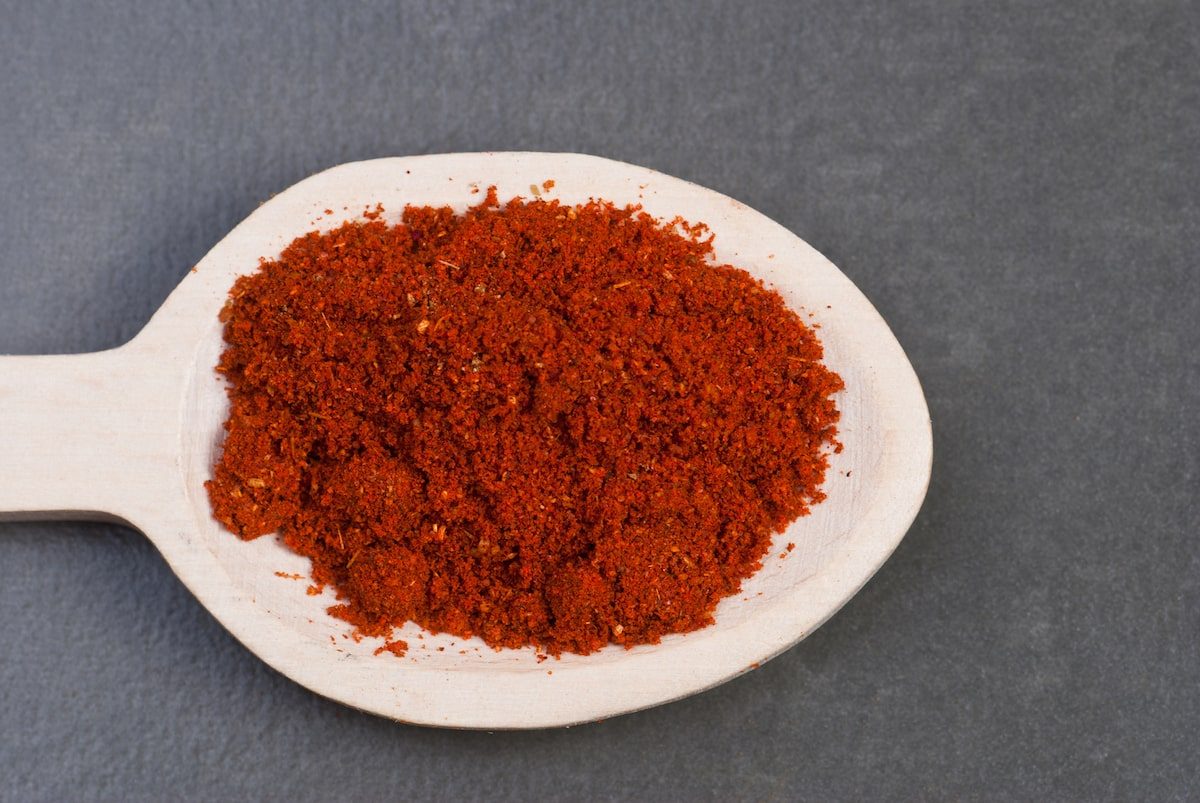
Tandoori masala is a ground spice blend made to be stirred into yogurt as a marinade for meat cooked in a tandoor, a clay oven.1 There is no fixed recipe. Most versions build on coriander and cumin with chile, warm spices and something red, and the red is where they differ most. Cookbook author Anupy Singla writes that the blend originally leaned on turmeric and paprika, and that the bright red of some store-bought blends comes from food dyes such as Red 40.2 Woodland Foods colors its blend with beet powder and paprika instead.3 A good substitute needs three things: the coriander-cumin base, some warm spice, and a red chile or paprika for color.
Quick answer
| What tandoori masala is doing | Best substitute | Starting amount, per 1 part tandoori masala | Treatment |
|---|---|---|---|
| The whole marinade seasoning | A quick mix of paprika, coriander, cumin, garlic, ginger and cardamom | 1 part of the mix | Method |
| Warm spice plus red color | Garam masala plus paprika, with cayenne to taste | 1/2 part garam masala plus 1/2 part paprika | Method |
| A red, ready-made marinade blend | Tikka masala blend | 1 part, less if salted | Method |
| Curry base with heat | Madras curry powder | 2/3 part, then taste | Method |
| Mostly heat | Vindaloo curry powder | 1/2 part, then taste | Method |
The rest of the page explains each choice.
How the ratios on this page are labeled
Every ratio carries one of four labels.
- Computed: based on a measurable physical relationship, with the source named.
- Attributed: a named source publishes this ratio. We quote it as theirs.
- Disputed: named sources give different answers to the same swap. We show each one and do not average them.
- Method: we found no published ratio. We give a direction and a cautious starting point, and say so.
We found no credible published ratio for replacing tandoori masala with any other blend. Every amount here is a Method starting point, and the ingredient lists of the blends involved give no proportions.
Two things to check before you swap. First, salt: Woodland Foods lists salt first on its tandoori blend,3 while The Spice House sells a salt-free one,4 so a recipe written for one may be under- or over-salted with the other. Second, heat: chile heat comes from capsaicinoids,5 and how hot a blend is depends on which chiles go in. Singla’s recipe uses a whole cup of dried Kashmiri chiles,2 and Dassana Amit notes that Kashmiri chiles are less hot,6 so much of that cup is there for color.
If tandoori masala is the whole marinade seasoning
1. A quick mix from jars
The Spice House’s salt-free tandoori blend lists just paprika, coriander, cumin, garlic, ginger, cardamom and saffron, and the company suggests rubbing it on meat or mixing it with plain yogurt for a marinade.4 All but the saffron are pantry spices.
Formula and amount (Method): The Spice House gives no proportions. Start with 2 parts sweet paprika, 1 part each ground coriander and cumin, 1/2 part each garlic powder and ground ginger, and a pinch of ground cardamom. Use it in the amount your recipe gives for tandoori masala, add salt separately, and taste the marinade. These proportions are our starting point, not a published recipe.
Why it works: coriander seed oil is 60 to 80 percent linalool and related terpene alcohols,7 cuminaldehyde makes up 20 to 72 percent of cumin oil,8 and paprika’s red comes from the carotenoids capsanthin and capsorubin.9 Where it falls short: it has none of the cloves, cinnamon or fenugreek in fuller recipes such as Singla’s, which also lists peppercorns, cardamom and carom seeds.2
2. Make the real thing
If you have whole spices, both published recipes compared on our tandoori masala page are worth the time. Anjula Devi’s starts with 8 tablespoons of coriander seeds and dry-roasts the whole spices,1 and Singla’s builds on Kashmiri chiles.2 Use the result in the same amount as the store-bought blend your recipe names (Method).
If you need warm spice plus red color
Garam masala, plus paprika and cayenne
Garam masala covers the warm side of tandoori masala. Bong Eats gives the most basic Bengali garam masala as cardamom, cinnamon and cloves,10 and Great British Chefs lists cloves, bay leaf, fennel, cinnamon and cardamom among commonly used spices.11 Singla’s tandoori recipe includes several of the same: peppercorns, cloves, cardamom and cinnamon.2
Where it falls short: The Spice House notes that garam masala means warming spices but is not hot like chili peppers,12 and a basic version has no paprika, coriander or cumin. It supplies none of the red. Recipes also vary widely; Saveur says there are as many versions as there are home cooks.13
Ratio (Method): No published ratio was found. For each tablespoon of tandoori masala, start with 1 1/2 teaspoons garam masala and 1 1/2 teaspoons sweet paprika, then add cayenne a pinch at a time.
If you want a red, ready-made marinade blend
Tikka masala blend
A tikka masala blend often shares tandoori masala’s red, chile-led profile. Spices, Inc. lists paprika, turmeric, guajillo, garlic, cayenne, black pepper, fenugreek, ginger, cumin and bay leaves, among others, and sells it salt-free.14 Seasoning-mix packets are a different product: McCormick’s chicken tikka masala mix contains salt, sugar and milk.15
Where it falls short: turmeric makes it more yellow-orange, since curcumin gives turmeric its color.16 Mixes built for the sauce, not the marinade, may contain starch or dairy you do not want in a yogurt marinade.15
Ratio (Method): No published ratio was found. Use a salt-free blend 1:1 and taste. With a salted mix, start with about half and salt the marinade last.
If you need a curry base with heat
Madras curry powder
Dan Toombs describes Madras curry powder as a blend like any curry powder that also has dried chiles in it.17 World Spice Merchants’ Madras blend leads with coriander, brown mustard seed, turmeric, cumin, fenugreek and black pepper,18 so it brings tandoori masala’s coriander-cumin base and the fenugreek of some recipes. Historically it was often promoted as spicier than the Bengal and Bombay styles,19 though World Spice rates its own blend only 2 on a 5-point heat scale.18 Britannica says curry powder was adapted by British settlers in India; Indian cooks call their spice mixtures masala.20
Where it falls short: turmeric and mustard. The turmeric turns the marinade yellow rather than red,16 so add paprika if color matters.
Ratio (Method): No published ratio was found. Start with about two-thirds as much Madras curry powder as tandoori masala, add a teaspoon of paprika per tablespoon for color, and taste.
If the job is mostly heat
Vindaloo curry powder
Savory Spice says the dish comes from Goa and was influenced by Portuguese cuisine;21 Lizzy Collingham writes that the name is a garbled pronunciation of a Portuguese dish.22 Savory Spice’s blend lists turmeric, cinnamon, garlic, fenugreek, salt, mustard, coriander, cumin and ginger, with a touch of cayenne,21 so it shares several tandoori ingredients and adds salt and turmeric. It suggests about a teaspoon per pound of beef, pork, poultry or fish.21
Where it falls short: heat varies a lot. America’s Test Kitchen describes fiery, complex heat in its recipe,23 while Savory Spice says its own is closer to medium and not as hot as typical vindaloo.21
Ratio (Method): No published ratio was found. Start with half the tandoori masala amount, taste the marinade, and add paprika for color.
What isn’t known
- No credible published ratio for replacing tandoori masala with any blend was found.
- No published heat measurement for any tandoori masala was found. How hot a blend is depends on its chiles.5
- Ingredient lists give no proportions, so how much paprika, chile or salt a given jar contains is not known from the label alone.
- A widely repeated claim calls tandoori masala a blend from northern India. What is documented is the restaurant most tied to tandoori chicken: Moti Mahal in New Delhi, opened after the 1947 Partition by two cooks from Peshawar, now in northwest Pakistan.24 No source we read traces the blend itself.
- Another says tandoori masala is known for its spiciness. No source we read measures that; Singla’s version leans on mild Kashmiri chiles for color.26
Related
- Tandoori masala and tandoori masala vs. garam masala
- Garam masala and garam masala substitutes
- Tikka masala and tikka masala substitutes
- Madras curry powder, vindaloo curry powder and vindaloo vs. Madras curry powder
- Paprika, cayenne pepper, coriander, cumin, garlic powder, ginger, cardamom, fenugreek and turmeric
- Indian spices
Footnotes
-
Anjula Devi, “Tandoori Masala”, 15-Minute Indian, via ckbk, 2025. app.ckbk.com · Publication ↩ ↩2
-
Anupy Singla, “Why Your Tandoori Masala Doesn’t Need to be Bright Red”, Indian As Apple Pie, 2013. indianasapplepie.com · Merchant ↩ ↩2 ↩3 ↩4 ↩5 ↩6
-
“Tandoori Spice Blend”, Woodland Foods (product page). shop.woodlandfoods.com · Merchant ↩ ↩2
-
“Tandoori Salt-Free Seasoning”, The Spice House (product page). thespicehouse.com · Merchant ↩ ↩2
-
Bosland and Walker, “Measuring Chile Pepper Heat”, New Mexico State University, 2010. pubs.nmsu.edu · Reference work ↩ ↩2
-
Dassana Amit, “Rasam Powder Recipe”, Dassana’s Veg Recipes. vegrecipesofindia.com · Publication ↩ ↩2
-
Al-Khayri et al., “Essential Oil from Coriandrum sativum: A Review”, Molecules, 2023. mdpi.com · Peer-reviewed ↩
-
P.C.M. Jansen, Cuminum cyminum, Plant Resources of South-East Asia (PROSEA). uses.plantnet-project.org · Reference work ↩
-
“Paprika extract”, Chemical and Technical Assessment for the 77th JECFA, FAO/WHO. fao.org · Regulator ↩
-
“Bengali Garam Masala”, Bong Eats, 2016. bongeats.com · Publication ↩
-
“How to make garam masala”, Great British Chefs, 2025. greatbritishchefs.com · Publication ↩
-
“Garam Masala Substitute”, The Spice House, 2018. thespicehouse.com · Merchant ↩
-
“Garam Masala” (Madhur Jaffrey’s recipe), Saveur, 2014. saveur.com · Publication ↩
-
“Tikka Masala”, Spices, Inc. (product page). spicesinc.com · Merchant ↩
-
“McCormick Chicken Tikka Masala Seasoning Mix”, McCormick (product page). mccormick.com · Merchant ↩ ↩2
-
“Turmeric: Usefulness and Safety”, National Center for Complementary and Integrative Health, 2025. nccih.nih.gov · Regulator ↩ ↩2
-
Dan Toombs, “Take your curries to the next level with homemade hot Madras curry powder”, Great Curry Recipes, 2015. greatcurryrecipes.net · Publication ↩
-
“Madras South Indian Curry”, World Spice Merchants (product page). worldspice.com · Merchant ↩ ↩2
-
Julia Fine, “From Delhi to Durban: The Many Homes of Madras Curry Powder”, Diaspora Co., 2022. diasporaco.com · Merchant ↩
-
“Curry”, Encyclopaedia Britannica, 2026. britannica.com · Reference work ↩
-
“Vindaloo”, Savory Spice (product page). savoryspiceshop.com · Merchant ↩ ↩2 ↩3 ↩4
-
Lizzy Collingham, “Fired Up: The History of Vindaloo”, Saveur, 2014. saveur.com · Publication ↩
-
Leah Colins, “Vindaloo Curry Powder”, America’s Test Kitchen, 2020. americastestkitchen.com · Publication ↩
-
Diaa Hadid and Omkar Khandekar, “Who cooked up butter chicken? A court seeks the answer”, NPR, 2024. kpbs.org · Publication ↩