Spice Substitutes · Substitutes
Sambar Powder Substitutes, Ranked by the Job the Blend Is Doing
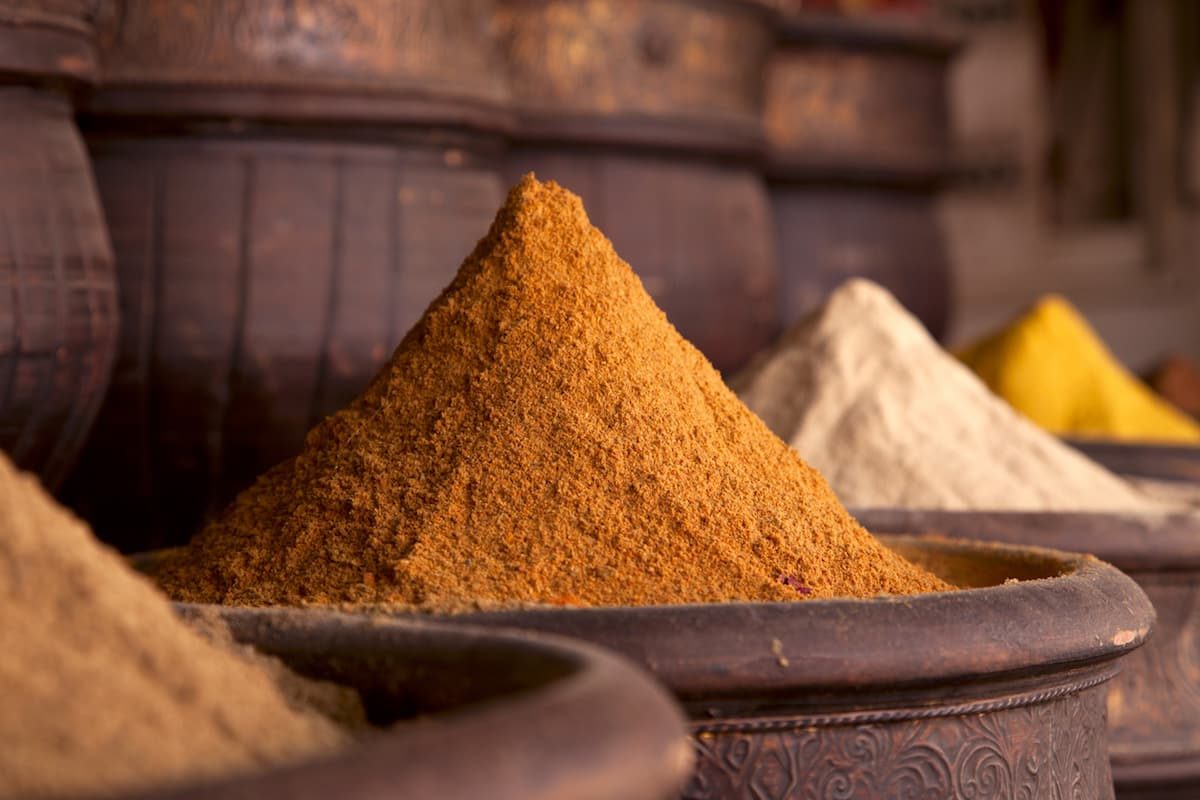
Sambar powder (sambar masala, sambar podi) is the roasted, ground blend that seasons sambar, which Saveur calls the ubiquitous split-pea stew of South India.1 Most recipes roast and grind dried split pulses (dals) along with coriander seed, dried red chiles, fenugreek, curry leaves and asafoetida, and that is what makes it hard to replace: of the store-bought blends below, only rasam powder is built on roasted dal.2 Even in Tamil Nadu, the podi differs across regions, communities and households.3 Below are the stand-ins, ranked by how much of the blend’s job each one can do.
Quick answer
| What sambar powder is doing | Best substitute | Starting amount, per 1 part sambar powder | Treatment |
|---|---|---|---|
| Seasoning a pot of sambar | Homemade sambar powder, or a quick mix of ground spices | 1 part | Method (recipes Attributed) |
| South Indian lentil flavor from a related blend | Rasam powder | 3/4 part, then taste | Method |
| Coriander, chile and fenugreek, with no South Indian blend on hand | Madras curry powder, plus a pinch of asafoetida | 2/3 part, then taste | Method |
| The same, with plain curry powder | Curry powder, plus cayenne and a pinch of asafoetida | 2/3 part, then taste | Method |
The rest of the page explains each choice.
How the ratios on this page are labeled
Every ratio carries one of four labels.
- Computed: based on a measurable physical relationship, with the source named.
- Attributed: a named source publishes this ratio. We quote it as theirs.
- Disputed: named sources give different answers to the same swap. We show each one and do not average them.
- Method: we found no published ratio. We give a direction and a cautious starting point, and say so.
We found no credible published ratio for replacing sambar powder with any other blend. Every amount on this page is a Method starting point.
There is a further reason to start low and taste. Sambar powders differ in strength, and two published recipes show it. Dassana Amit uses about 2 to 3 teaspoons of her sambar powder for four servings,4 while Swasthi Shreekanth uses 1 1/2 to 2 tablespoons of hers for a four-serving sambar.5 That is roughly two to three times as much. Saveur’s version is salted, with 3 tablespoons of kosher salt in the batch.1 So “the same amount” depends on which sambar powder your recipe was written for.
If sambar powder is seasoning a pot of sambar
1. Make your own
This is the only route that brings back the roasted dals and curry leaves. Three published recipes, from Saveur, Tarla Dalal and Dassana Amit, are compared side by side on our sambar powder page. All three roast the ingredients before grinding.164 Dassana Amit’s list is typical:4
| Ingredient | Amount |
|---|---|
| Coriander seeds | 1/2 cup (40 g) |
| Cumin seeds | 2 tablespoons |
| Dried red chiles | 16 to 18, halved and seeded |
| Fenugreek seeds | 1 1/2 teaspoons |
| Black pepper | 1 tablespoon |
| Chana dal | 2 tablespoons |
| Urad dal | 1 tablespoon |
| Curry leaves | 1/3 cup |
| Mustard seeds | 1/2 tablespoon |
| Asafoetida | 1/2 tablespoon |
| Turmeric powder | 1/2 tablespoon |
She says you can skip the urad dal and the powder will still turn out well,4 and, answering a reader, that ground coriander can be used in the same quantity as the seeds.4
Amount (Method): Use your homemade powder in the amount your recipe gives, then taste. Dassana Amit’s own guide is 2 to 3 teaspoons for four servings.4
2. A quick mix of ground spices
If you have no dals or curry leaves, you can still build the spice side of the blend from jars.
Formula (Method, proportions scaled from Dassana Amit’s recipe): about 4 teaspoons ground coriander, 1 teaspoon ground cumin, 1/2 teaspoon ground black pepper, and 1/4 teaspoon each of ground fenugreek, asafoetida, turmeric and ground mustard, with chile powder to taste. Those are one sixth of her amounts for the same spices.4 Her recipe uses whole seeds and whole chiles, so this is our adaptation, not her recipe, and it leaves out the dals and curry leaves. Toast the mix briefly in a dry pan if you can. Use it in the amount your recipe gives for sambar powder, then taste.
Why it works: coriander is the largest ingredient in all three sambar recipes,164 and its seed oil is 60 to 80 percent linalool and related terpene alcohols.7 PROSEA credits sotolon with fenugreek’s characteristic curry aroma.8 Asafoetida’s essential oil contains a wealth of sulfur compounds, and Katzer compares its fried aroma to (not altogether fresh) garlic.9 What it lacks is the nutty depth of the roasted dals.
If you want South Indian lentil flavor from a related blend
Rasam powder
Rasam powder is the closest relative on the shelf. It too is a roasted South Indian blend of coriander, chiles and dal: Dassana Amit’s version roasts coriander, chana dal, toor dal, black pepper, cumin and dried red chiles, with optional turmeric.2 Swasthi Shreekanth describes rasam powder as a traditional South Indian spice mix made with roasted lentils.10 It is made for rasam, a thin South Indian soup; TASTE’s recipe sours it with tomatoes and tamarind pulp.11
Swasthi Shreekanth’s note on her sambar powder shows how close the two are. She says it can also be used to make rasam if you add some pepper powder toward the end.5 That suggests running the swap the other way with a lighter hand, since rasam leans on black pepper, whose flavor comes mainly from piperine.12
Where it falls short: Dassana Amit’s rasam powder has no fenugreek, curry leaves or asafoetida,2 all of which appear in every sambar recipe compared on our sambar powder page. Add a pinch of asafoetida and ground fenugreek if you have them.
Ratio (Method): No published ratio was found. Start with about three quarters of the sambar powder amount, taste, and add more.
If you need coriander, chile and fenugreek and have no South Indian blend
1. Madras curry powder
Madras curry powder is curry powder with chile added. Dan Toombs puts it this way: it is a blend like any curry powder that also has dried chiles in it.13 World Spice Merchants’ Madras blend leads with coriander, brown mustard seed, turmeric, cumin, fenugreek and black pepper,14 which covers most of the spices in Dassana Amit’s sambar powder.4 Historically, Madras curry powder was often promoted as spicier than the Bengal and Bombay styles.15 Britannica says curry powder itself was adapted by British settlers in India, while Indian cooks call their spice mixtures masala and prepare them at home.16
Where it falls short: no dals, no curry leaves and no asafoetida. Turmeric will color the dish yellow, as curcumin does.17
Ratio (Method): No published ratio was found. Start with about two-thirds of the sambar powder amount, add a pinch of asafoetida, taste, and add more.
2. Plain curry powder, plus heat
The USDA’s purchasing specification says curry powder should include turmeric, coriander, fenugreek, cinnamon, cumin, black pepper, ginger and cardamom.18 That gives you coriander and fenugreek, but no chile, and cinnamon and cardamom add a sweet warmth that sambar recipes do not call for.164
Ratio (Method): No published ratio was found. Start with about two-thirds of the sambar powder amount, add a pinch of cayenne and a pinch of asafoetida, then taste.
3. Vindaloo curry powder, only if you want heat
Vindaloo blends share chiles, cumin and black pepper with sambar powder, and Savory Spice’s blend also lists coriander and fenugreek.19 The dish takes its name from a Portuguese one, and Lizzy Collingham writes that in England it became another hot curry.20 Blends vary: America’s Test Kitchen describes fiery, complex heat in its recipe,21 while Savory Spice says its own is closer to medium and not as hot as typical vindaloo.19
Ratio (Method): No published ratio was found. Start with half the sambar powder amount and taste for heat before adding more.
A swap we don’t recommend: chaat masala
Chaat masala is a finishing blend, not a cooking base. Tarla Dalal says amchur (dried mango powder) gives it its tangy taste and black salt its classic aroma,22 and Gulf News’s recipe uses a tablespoon each of amchur and black salt.23 Neither of those two recipes contains coriander, the largest ingredient in sambar powder,2223 and the black salt adds salt. Tamarind is the souring agent in sambar’s best-known origin story,3 and none of the three sambar powder recipes compared on our sambar powder page contains it,164 so a sambar’s sourness comes from tamarind added to the pot. If your sambar tastes flat, add more tamarind before reaching for chaat masala.
Safety: asafoetida and gluten
If you add asafoetida to any substitute, check the label. India’s food regulator allows compounded asafoetida to contain gum arabic, edible starches or edible cereal flour,24 and Katzer describes the common compounded powder as more than 50 percent rice flour and gum arabic.9 Anyone avoiding wheat or gluten should look for a powder that names its flour.
What isn’t known
- No credible published ratio for replacing sambar powder with rasam powder, curry powder or any other blend was found. Every amount above is a starting point for tasting.
- How much a given sambar powder should be used varies by recipe; the two published usage figures we found differ two to threefold.45
- No published analysis compares the flavor of sambar powder with any substitute.
Related
- Sambar powder and rasam powder
- Madras curry powder, Madras curry powder substitutes and curry powder
- Vindaloo curry powder and vindaloo vs. Madras curry powder
- Chaat masala and too much tamarind
- Coriander, cumin, fenugreek, asafoetida, curry leaves, black pepper, turmeric and black mustard seeds
- Indian spices and the master list of herbs and spices
Footnotes
-
“Sambar Masala”, Saveur, 2014. saveur.com · Publication ↩ ↩2 ↩3 ↩4 ↩5 ↩6
-
Dassana Amit, “Rasam Powder Recipe”, Dassana’s Veg Recipes. vegrecipesofindia.com · Publication ↩ ↩2 ↩3
-
Roshni Nair, “The sambar saga: On the provenance and many variations of a south Indian staple”, DNA India, 2017. dnaindia.com · Publication ↩ ↩2
-
Dassana Amit, “Sambar Powder Recipe (Homemade Sambar Masala)”, Dassana’s Veg Recipes, 2026. vegrecipesofindia.com · Publication ↩ ↩2 ↩3 ↩4 ↩5 ↩6 ↩7 ↩8 ↩9 ↩10 ↩11 ↩12
-
Swasthi Shreekanth, “Sambar Powder Recipe (Sambar Masala)”, Swasthi’s Recipes, 2023. indianhealthyrecipes.com · Publication ↩ ↩2 ↩3
-
Tarla Dalal, “Sambhar Masala Powder”, TarlaDalal.com. tarladalal.com · Publication ↩ ↩2 ↩3 ↩4
-
Al-Khayri et al., “Essential Oil from Coriandrum sativum: A Review”, Molecules, 2023. mdpi.com · Peer-reviewed ↩
-
C.S. Tawan and N. Wulijarni-Soetjipto, Trigonella foenum-graecum, Plant Resources of South-East Asia (PROSEA). uses.plantnet-project.org · Reference work ↩
-
Gernot Katzer, “Asafetida (Ferula assa-foetida)”, Gernot Katzer’s Spice Pages. gernot-katzers-spice-pages.com · Reference work ↩ ↩2
-
Swasthi Shreekanth, “Rasam Powder | Rasam Podi Recipe”, Swasthi’s Recipes, 2022. indianhealthyrecipes.com · Publication ↩
-
Nikhita Venugopal, “Rasam Is Southern India’s Peppery Comfort Food”, TASTE, 2017. tastecooking.com · Publication ↩
-
“Black pepper”, Encyclopaedia Britannica, 2026. britannica.com · Reference work ↩
-
Dan Toombs, “Take your curries to the next level with homemade hot Madras curry powder”, Great Curry Recipes, 2015. greatcurryrecipes.net · Publication ↩
-
“Madras South Indian Curry”, World Spice Merchants (product page). worldspice.com · Merchant ↩
-
Julia Fine, “From Delhi to Durban: The Many Homes of Madras Curry Powder”, Diaspora Co., 2022. diasporaco.com · Merchant ↩
-
“Curry”, Encyclopaedia Britannica, 2026. britannica.com · Reference work ↩
-
“Turmeric: Usefulness and Safety”, National Center for Complementary and Integrative Health, 2025. nccih.nih.gov · Regulator ↩
-
Commercial Item Description A-A-20001C, Spices and Spice Blends, USDA Agricultural Marketing Service, 2023. ams.usda.gov · Regulator ↩
-
“Vindaloo”, Savory Spice (product page). savoryspiceshop.com · Merchant ↩ ↩2
-
Lizzy Collingham, “Fired Up: The History of Vindaloo”, Saveur, 2014. saveur.com · Publication ↩
-
Leah Colins, “Vindaloo Curry Powder”, America’s Test Kitchen, 2020. americastestkitchen.com · Publication ↩
-
Tarla Dalal, “Chaat Masala”, TarlaDalal.com. cdn.tarladalal.com · Publication ↩ ↩2
-
Anupa Kurian, “Homemade Indian chaat masala”, Gulf News, 2022. gulfnews.com · Publication ↩ ↩2
-
“FAQ: standards for asafoetida and compounded asafoetida”, Food Safety and Standards Authority of India. fssai.gov.in · Regulator ↩