Blog · Dish guide
Christmas Spices: The Eight That Define Holiday Baking and Mulled Drinks
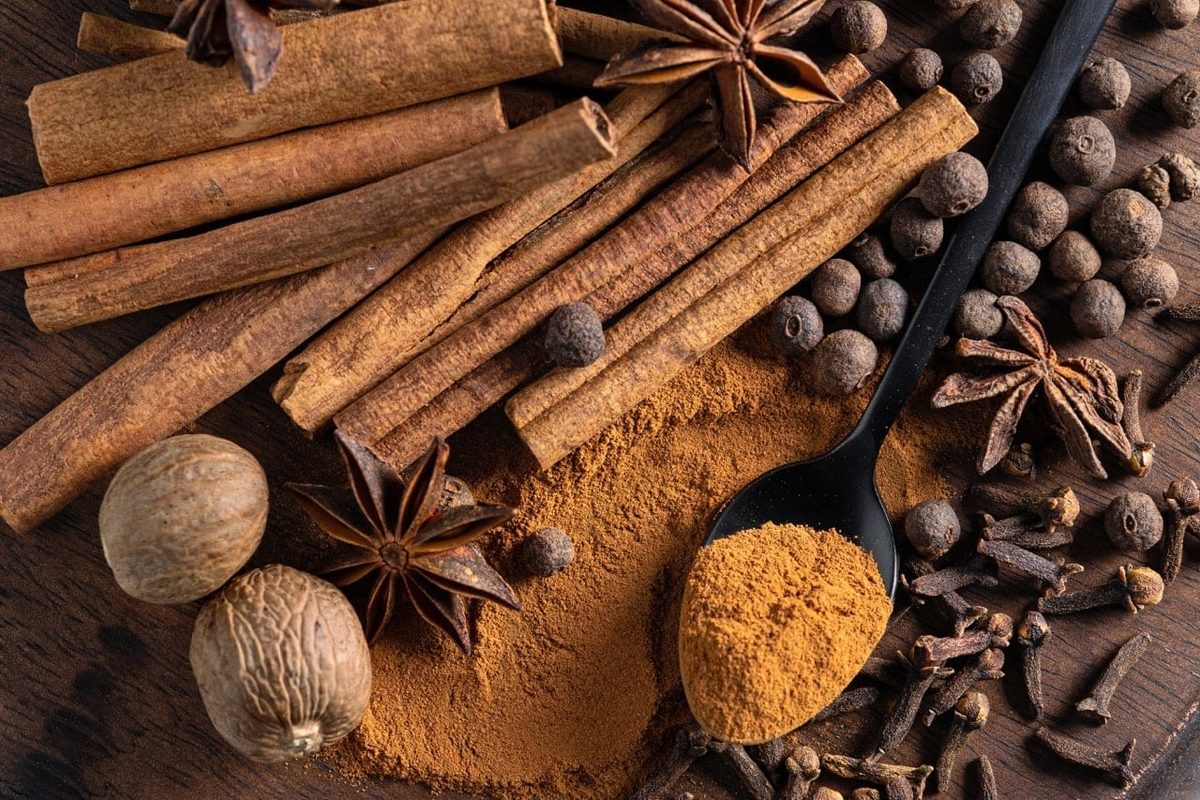
The spices people mean by “Christmas spices” are a small, consistent group: cinnamon, cloves, nutmeg, ginger, allspice, cardamom and star anise. They turn up across the season’s drinks and baking, and the evidence for that is better than tradition alone. European Union law defines Glühwein and Nordic vinglögg as wine drinks flavored mainly with cinnamon and/or cloves,1 and an American cookbook printed in 1796 already spices its gingerbread with ginger, cinnamon, nutmeg, coriander and allspice.2 This page sets out what each spice does, where it shows up, and the three safety points worth knowing before a season of heavy baking.
At a glance
| Spice | Where it shows up at Christmas | Main aroma compound |
|---|---|---|
| Cinnamon | Mulled wine, gingerbread12 | Cinnamaldehyde, about 50 to 63% of bark oil3 |
| Cloves | Mulled wine, baking, ham14 | Eugenol, 70 to 90% of bud oil5 |
| Nutmeg | Eggnog, gingerbread62 | Warm, slightly sweet taste7 |
| Ginger | Gingerbread2 | Pungency from gingerols8 |
| Allspice | Baking, gingerbread92 | Eugenol, 50 to 80% of berry oil10 |
| Cardamom | Scandinavian Christmas breads11 | See the cardamom profile |
| Star anise | Mulled drinks (common practice) | Trans-anethole, 70 to 93% of the oil12 |
| Coriander seed | 18th-century Christmas cookies2 | See the coriander profile |
The core spices and what each one does
Cinnamon: the backbone of mulled wine
Cinnamon is one of the two spices EU law names for mulled wine. Its definition of Glühwein is a drink made only from red or white wine, “flavoured mainly with cinnamon and/or cloves”, with at least 7% alcohol and no added water; the Nordic vinglögg carries the same spice wording.1 In baking, Amelia Simmons’s 1796 American Cookery puts a tablespoon of cinnamon in her molasses gingerbread.2
The warm, sweet smell comes mainly from cinnamaldehyde, which a systematic review puts at roughly 49.9 to 62.8% of the bark oil.3 Most cinnamon sold in North America is cassia rather than Ceylon cinnamon, according to NCCIH,13 and that matters for holiday baking (see Safety below). Sticks are the usual choice for steeping in wine or cider, ground cinnamon for doughs; see cinnamon sticks vs. ground cinnamon and Ceylon vs. cassia.
Health claims about cinnamon get ahead of the evidence. NCCIH’s summary is that research doesn’t clearly support cinnamon for any health condition.13
Cloves: mulled wine’s other half, and the ham
Cloves share the EU mulled-wine definition with cinnamon,1 and a separate EU category of fortified spiced wine, väkevä viiniglögi/starkvinsglögg, takes its characteristic taste from “cloves and/or cinnamon.”1 Britannica describes cloves as strong in aroma and hot and pungent in taste, used particularly for meats and baked goods.4 Studding a holiday ham with whole cloves is common practice rather than something these sources document.
Most of the aroma is eugenol, 70 to 90% of clove bud oil according to PROSEA.5 Cloves are strong: use whole ones in liquids so they can be fished out. See ground vs. whole cloves, cloves vs. star anise and too much clove.
Nutmeg: eggnog and gingerbread
The FAO’s handbook on nutmeg lists eggnog first among its dairy uses.6 Britannica describes the spice as having a distinctive pungent fragrance and a warm, slightly sweet taste.7 Simmons grates a whole nutmeg into her butter-and-sugar gingerbread cakes.2 Grating it fresh is common advice; see fresh vs. ground nutmeg and allspice vs. nutmeg.
Ginger: the reason gingerbread is called gingerbread
Simmons’s 1796 gingerbreads measure ginger by the ounce: two ounces in one, four in another, a quarter pound in a third.2 Its bite comes from non-volatile phenolic compounds, the gingerols.8 Ground dried ginger is the baking form; see fresh vs. ground ginger.
On health: NCCIH says ginger may help with nausea and vomiting in pregnancy, but most studies for motion sickness have not shown it to help.14 No source here supports broad “anti-inflammatory and digestive” claims for ginger eaten in holiday food.
Allspice: one berry, several flavors
Allspice is a single spice, the dried berry of Pimenta dioica, not a blend. Britannica says it was named because its flavor resembles a combination of cinnamon, nutmeg and cloves, and that it is widely used in baking.9 The resemblance to cloves has a chemical basis: eugenol makes up 50 to 80% of allspice berry oil.10 Simmons offers “coriander or allspice” in her molasses gingerbread.2 See allspice vs. cloves.
Cardamom: the Scandinavian Christmas spice
Britannica notes cardamom’s popularity in Scandinavian pastries.15 K-State Research and Extension names three holiday breads built on it: the Scandinavian Yule bread julekake, the Swedish cardamom bun kardemummabullar, and Finnish pulla.11 America’s Test Kitchen reports, citing UN data, that Sweden consumes 18 times more cardamom per capita than the median country.16
How cardamom got to Scandinavia is disputed:
| Account | Source |
|---|---|
| Vikings found it in Constantinople and brought it north | Repeated by K-State’s writer;11 ATK notes many Swedes believe it16 |
| Little evidence of imported spices in the Viking Age; the Moors are a likelier route, and a 13th-century cookbook is the first mention | Culinary archaeologist Daniel Serra, quoted by ATK16 |
On health, a 2024 meta-analysis of randomized trials found cardamom intake was associated with lower total cholesterol and some inflammation markers in blood tests.17 That is a finding about blood markers in trials, not evidence that cardamom in holiday baking boosts immunity or aids digestion. See cooking with cardamom.
Star anise: the licorice note
Star anise oil is mostly trans-anethole, the compound behind its anise-like smell and sweet flavor.12 It is a common addition to mulled wine and cider, though the EU definitions name only cinnamon and cloves.1 The whole pods look good in a punch bowl, and they are easy to remove. See star anise uses.
Coriander seed: the forgotten Christmas cookie spice
The one Christmas recipe in Simmons’s 1796 book, “Another Christmas Cookey”, is flavored with a teacup of finely powdered coriander seed.2 Coriander is rarely called a Christmas spice today, but it was there first in this American record. See coriander.
Gingerbread spice: no single recipe
There is no fixed formula for gingerbread spice. The four gingerbreads in American Cookery show the range even within one book:2
| Simmons recipe (1796) | Spices named |
|---|---|
| Molasses Gingerbread | Cinnamon, coriander or allspice |
| Gingerbread Cakes (No. 1) | A grated nutmeg, two ounces ginger |
| Soft Gingerbread (No. 2) | 4 ounces ginger |
| Gingerbread (No. 4) | A quarter pound of ginger, rose water |
Modern blends sold as pumpkin pie spice cover similar ground; see pumpkin pie spice and apple pie spice.
Safety: three things worth knowing
Cassia and coumarin. Cassia cinnamon contains coumarin. Germany’s BfR estimates that a 60 kg adult reaches the tolerable daily intake by eating about 2 g of cassia with average coumarin content a day.18 The EU caps coumarin in traditional and seasonal bakery products labeled with cinnamon at 50 mg/kg.19 Occasional holiday baking is not the concern; daily heavy use of cassia is. See Ceylon vs. cassia cinnamon and too much cinnamon.
Nutmeg in large amounts. The National Capital Poison Center notes that nutmeg tastes great in cookies and eggnog but too much can cause hallucinations, while kitchen spices are not dangerous used as recommended.20 The Tennessee Poison Center puts reported effects at 15 to 20 grams, about two to three tablespoons of ground nutmeg, far above any recipe amount.21 See too much nutmeg.
Japanese star anise. A related plant, Japanese star anise, is toxic, according to the FDA.22 In 2003 the agency linked teas made with star anise to illnesses in about 40 people.22 Buy star anise from a food supplier, not as a decorative item.
Related
- Thanksgiving herbs and spices
- Cranberry sauce spices
- Cloves vs. star anise
- Too much cinnamon
- The master list of herbs and spices
Footnotes
-
Regulation (EU) No 251/2014, Annex II, EUR-Lex. eur-lex.europa.eu · Regulator ↩ ↩2 ↩3 ↩4 ↩5 ↩6 ↩7
-
Amelia Simmons, American Cookery, 1796, Project Gutenberg. gutenberg.org · Reference work ↩ ↩2 ↩3 ↩4 ↩5 ↩6 ↩7 ↩8 ↩9 ↩10 ↩11 ↩12
-
Ranasinghe et al., “Medicinal properties of ‘true’ cinnamon”, BMC Complementary and Alternative Medicine, 2013. link.springer.com · Peer-reviewed ↩ ↩2
-
“Clove”, Encyclopaedia Britannica. britannica.com · Reference work ↩ ↩2
-
Verheij and Snijders, “Syzygium aromaticum”, PROSEA. uses.plantnet-project.org · Reference work ↩ ↩2
-
G.B. Marcelle, Production, handling and processing of nutmeg and mace, Section VII, FAO, 1995. fao.org · Regulator ↩ ↩2
-
“Nutmeg”, Encyclopaedia Britannica. britannica.com · Reference work ↩ ↩2
-
Sutarno, Hadad and Brink, “Zingiber officinale”, PROSEA. uses.plantnet-project.org · Reference work ↩ ↩2
-
“Allspice”, Encyclopaedia Britannica. britannica.com · Reference work ↩ ↩2
-
D. Sulistiarini, “Pimenta dioica”, PROSEA. uses.plantnet-project.org · Reference work ↩ ↩2
-
Nancy Honig, “Cardamom at Christmas”, K-State Research and Extension, 2021. k-state.edu · Reference work ↩ ↩2 ↩3
-
Vu Ngoc Lô, “Illicium verum”, PROSEA. uses.plantnet-project.org · Reference work ↩ ↩2
-
“Cinnamon: Usefulness and Safety”, NCCIH, 2024. nccih.nih.gov · Regulator ↩ ↩2
-
“Ginger: Usefulness and Safety”, NCCIH, 2025. nccih.nih.gov · Regulator ↩
-
Gregory Lewis McNamee, “Cardamom”, Encyclopaedia Britannica. britannica.com · Reference work ↩
-
Steve Dunn, “Cardamom: How Did It Become Scandinavia’s Favorite Spice?”, America’s Test Kitchen, 2021. americastestkitchen.com · Publication ↩ ↩2 ↩3
-
Zhang et al., Nutrition Research, 2024 (systematic review and meta-analysis). busqueda.bvsalud.org · Peer-reviewed ↩
-
“Cassia cinnamon with high coumarin contents to be consumed in moderation”, BfR. bfr.bund.de · Regulator ↩
-
Regulation (EC) No 1334/2008, Annex III Part B, EUR-Lex. eur-lex.europa.eu · Regulator ↩
-
Rose Ann Gould Soloway, “Kitchen surprises and cautions”, National Capital Poison Center. poison.org · Reference work ↩
-
Nena Bowman, “Nutmeg, a Potentially Uninvited Holiday Guest?”, Tennessee Poison Center, 2020. vumc.org · Reference work ↩
-
“Teas Made from Star Anise Were Associated With Illnesses Including Seizures”, FDA, 2003. fda.gov · Regulator ↩ ↩2