Cooking · Dish guide
Good Spices for Taco Meat: Chili Powder, Cumin, Oregano and How Much to Use
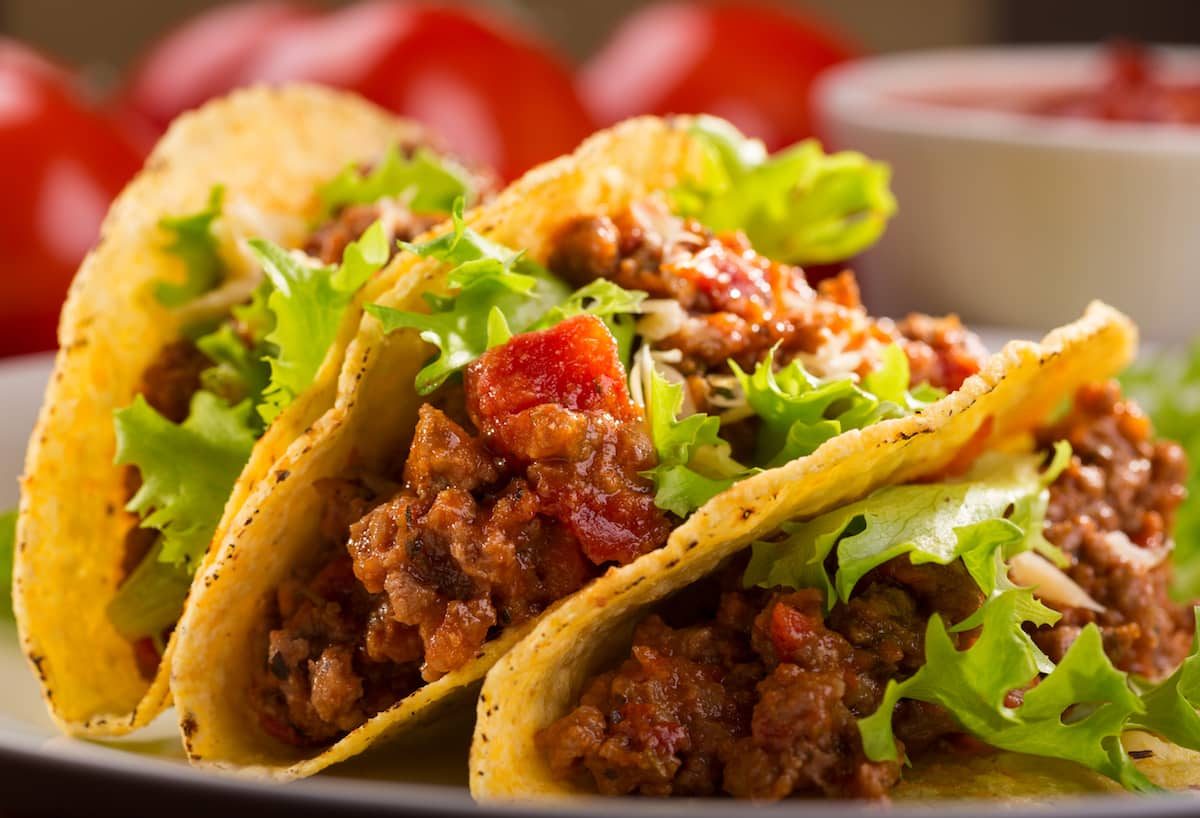
American-style taco meat is ground beef seasoned with chili powder, cumin, oregano, garlic, onion and salt. That is what Cook’s Country’s homemade blend contains, and chili powder itself, by the USDA’s purchasing definition, already carries chili pepper, cumin, oregano, salt and garlic powder.12 A Mexican-style picadillo filling uses much the same spices with tomato and pickled jalapeño.3 This page sets out the amounts, what each spice does, and how much salt the packets carry.
At a glance
| Spice | Job | Amount in Cook’s Country’s blend1 |
|---|---|---|
| Chili powder | The base: chile flavor, color, some heat | 2 Tbsp |
| Cumin | Earthy, warm note | 2 tsp |
| Paprika | Red color, mild pepper flavor | 1 tsp |
| Salt | Seasoning | 1 tsp table salt |
| Granulated garlic | Savory depth | 1/2 tsp |
| Onion powder | Savory, sweet onion note | 1/2 tsp |
| Dried oregano | Herbal note | 1/2 tsp |
| Cornstarch | Body for the pan juices (not a spice) | 2 tsp |
The blend makes about 1/4 cup.1 Cook’s Country’s page doesn’t say how much meat it seasons; the 1-ounce store packets it resembles are meant for 1 pound.45
Chili powder: the base
Cook’s Country found that making chili powder the primary ingredient gave its blend a full, robust chile profile.1 The USDA’s purchasing specification for chili powder lists ground chili pepper, cumin, oregano, salt and garlic powder as minimum ingredients,2 so a spoonful already contains much of the list. PepperScale’s account of taco seasoning gives the same core: chili powder, cumin, paprika, garlic, oregano and onion.6 Saveur describes American chili powder as dried chiles, usually ancho, with oregano, cumin, garlic and sometimes salt.7 Brands differ, so taste yours before adding more salt or cumin. See chili powder substitutes and paprika vs. chili powder.
Cumin
Cook’s Country says cumin added its familiar earthiness.1 The most important compound in cumin oil is cuminaldehyde, at 20 to 72 percent depending on the study.8 Many cooks say taco meat doesn’t taste like taco meat without cumin; that is a matter of taste, and the two best-known packets don’t name cumin on their labels, listing only “spices” or “spice.”45 Cook’s Country uses 2 teaspoons in its blend and Bayless 1 teaspoon in a 1 1/2-pound batch of picadillo.13 See cumin uses, cumin seeds vs. ground cumin and too much cumin.
Garlic and onion: fresh or powder
Both work. Cook’s Country uses granulated garlic and onion powder in its dry blend.1 Bayless’s picadillo uses fresh: he browns the beef, then adds a finely diced white onion, and stirs in 4 chopped garlic cloves later with the potatoes.3 His recipe stresses that browning is the key to developing rich picadillo flavor.3
Adding fresh garlic after the meat and onion fits America’s Test Kitchen’s warning that garlic added to a hot pan too early can quickly burn and turn acrid and bitter.9 A common piece of advice says to add white onion at the end of cooking and green onions at the start; no recipe we opened does this, and Bayless cooks white onion with the browned beef.3 See garlic powder vs. garlic and onion powder vs. onion.
Oregano: Mexican or Mediterranean
Mexican oregano (Lippia graveolens) belongs to the verbena family, Verbenaceae, the same family as lemon verbena (Aloysia citrodora).1011 Mediterranean oregano is in the mint family, Lamiaceae.12 America’s Test Kitchen found the Mexican type stronger, with a hint of menthol, but noticed minimal differences between the two in tomato sauce and mojo-marinated skirt steak.13 Bayless calls for 2 teaspoons of Mexican oregano in his picadillo;3 Cook’s Country uses 1/2 teaspoon of dried oregano without specifying the type.1 Use Mexican if you have it, and don’t worry if you don’t. See Mexican oregano, Mexican oregano vs. oregano and lemon verbena vs. lemongrass.
Heat: cayenne, jalapeño or a hotter chili powder
Chile heat comes from capsaicinoids.14 Neither Cook’s Country nor the McCormick label lists cayenne by name; McCormick’s names chili pepper among its spices.14 Bayless gets his heat from 3 to 4 pickled jalapeños, chopped.3 If you add cayenne, go carefully: Dave DeWitt’s heat scale and PepperScale’s pepper list both put cayenne at 30,000 to 50,000 Scoville heat units, a conventional range not tied to any published measurement we could find.1516 No source gives an amount for taco meat; start with 1/8 teaspoon per pound and taste (Method). See paprika vs. cayenne.
Paprika and color
Paprika’s red color comes mainly from capsanthin and capsorubin.17 Not all paprika is mild, though. A common claim says Spanish and Hungarian paprikas are high in capsaicin while “plain” paprika is not. Hungary’s food codex in fact grades its paprika into heat classes from non-pungent to very hot,18 so the label, not the country, tells you the heat. See smoked paprika.
Tomato adds color and acidity too. Bayless uses a 15-ounce can of diced tomatoes, preferably fire-roasted, cooked until the liquid reduces.3 Tomato powder gives tomato flavor without the liquid; we found no named taco recipe that uses it, so treat it as an option, not a standard.
Packets, water and salt
Both packet labels call for 1 pound of ground meat and 3/4 cup of water.45 Cook’s Country adds cornstarch to its homemade version because it gives the pan juices a saucy body, keeping the meat from being too soupy or too dry.1 Packet mixes contain starch too: corn starch is on both labels, and first on Old El Paso’s.45
Watch the salt. By the labels’ own figures, one McCormick packet carries about 2,280 mg of sodium (6 servings of 380 mg) and one Old El Paso packet about 1,400 mg (5 servings of 280 mg).45 FDA’s Daily Value for sodium is less than 2,300 mg a day.19 A homemade blend lets you set the salt yourself. See taco seasoning and taco seasoning substitutes.
Doneness
Cook ground beef to 160°F; ground turkey or chicken needs 165°F.20 FSIS says color and texture are not reliable signs of doneness, so check with a thermometer.21 With crumbled meat in a skillet, check a few of the thickest clumps.
Related
- Fajita vs. taco seasoning
- Best spices for chili
- Good Mexican spices for chicken
- Spices for hamburgers
- Too much garlic
Footnotes
-
Matthew Fairman, “Homemade Taco Seasoning”, Cook’s Country, America’s Test Kitchen, 2023. americastestkitchen.com · Publication ↩ ↩2 ↩3 ↩4 ↩5 ↩6 ↩7 ↩8 ↩9 ↩10
-
Commercial Item Description A-A-20001C, Spices and Spice Blends, USDA Agricultural Marketing Service, 2023. ams.usda.gov · Regulator ↩ ↩2
-
Rick Bayless, “Beef Picadillo”, rickbayless.com. rickbayless.com · Publication ↩ ↩2 ↩3 ↩4 ↩5 ↩6 ↩7 ↩8
-
McCormick Original Taco Seasoning Mix, ingredients, nutrition label and directions, via Giant Food Stores product listing. giantfoodstores.com · Merchant ↩ ↩2 ↩3 ↩4 ↩5 ↩6
-
Old El Paso Gluten Free Original Taco Seasoning Mix, ingredients, nutrition label and directions, via Giant Food Stores product listing. giantfoodstores.com · Merchant ↩ ↩2 ↩3 ↩4 ↩5
-
Matt Bray, “Taco Seasoning Ingredients: What’s In That Packet?”, PepperScale, 2019. pepperscale.com · Publication · PepperScale is also owned by Matt Bray, the editor of this site. ↩
-
“Chili Powder”, Saveur, 2009. saveur.com · Publication ↩
-
P.C.M. Jansen, “Cuminum cyminum”, PROSEA. uses.plantnet-project.org · Reference work ↩
-
Liz Bomze, “Why You Should Wait to Add Garlic”, America’s Test Kitchen, 2023. americastestkitchen.com · Publication ↩
-
“Lippia graveolens Kunth”, Plants of the World Online, Royal Botanic Gardens, Kew. powo.science.kew.org · Reference work ↩
-
“Aloysia citrodora Paláu”, Plants of the World Online, Royal Botanic Gardens, Kew. powo.science.kew.org · Reference work ↩
-
Anoushka Pant, “Oregano”, Encyclopaedia Britannica. britannica.com · Reference work ↩
-
“Oregano: Mediterranean and Mexican”, America’s Test Kitchen. americastestkitchen.com · Publication ↩
-
Bosland and Walker, “Measuring Chile Pepper Heat”, New Mexico State University, 2010. pubs.nmsu.edu · Reference work ↩
-
Dave DeWitt, “Heat Scale Updated”, Fiery Foods & Barbecue Central, 2008. fieryfoodscentral.com · Publication ↩
-
“The Hot Pepper List: 170+ Chilies Profiled”, PepperScale. pepperscale.com · Publication · PepperScale is also owned by Matt Bray, the editor of this site. ↩
-
“Paprika extract”, Chemical and Technical Assessment, FAO/WHO JECFA, 2008 (rev. 2013). fao.org · Regulator ↩
-
MÉ 2-108, Hungarian Food Codex directive on paprika, 2013. elelmiszerlanc.kormany.hu · Standard ↩
-
“Sodium in Your Diet”, U.S. Food and Drug Administration. fda.gov · Regulator ↩
-
“Cook to a Safe Minimum Internal Temperature”, FoodSafety.gov, U.S. Department of Health and Human Services. foodsafety.gov · Regulator ↩
-
“Color of Cooked Ground Beef as It Relates to Doneness”, USDA Food Safety and Inspection Service. fsis.usda.gov · Regulator ↩