Blog · Dish guide
The Best Spices for Beef Stew: What Each One Does and When to Add It
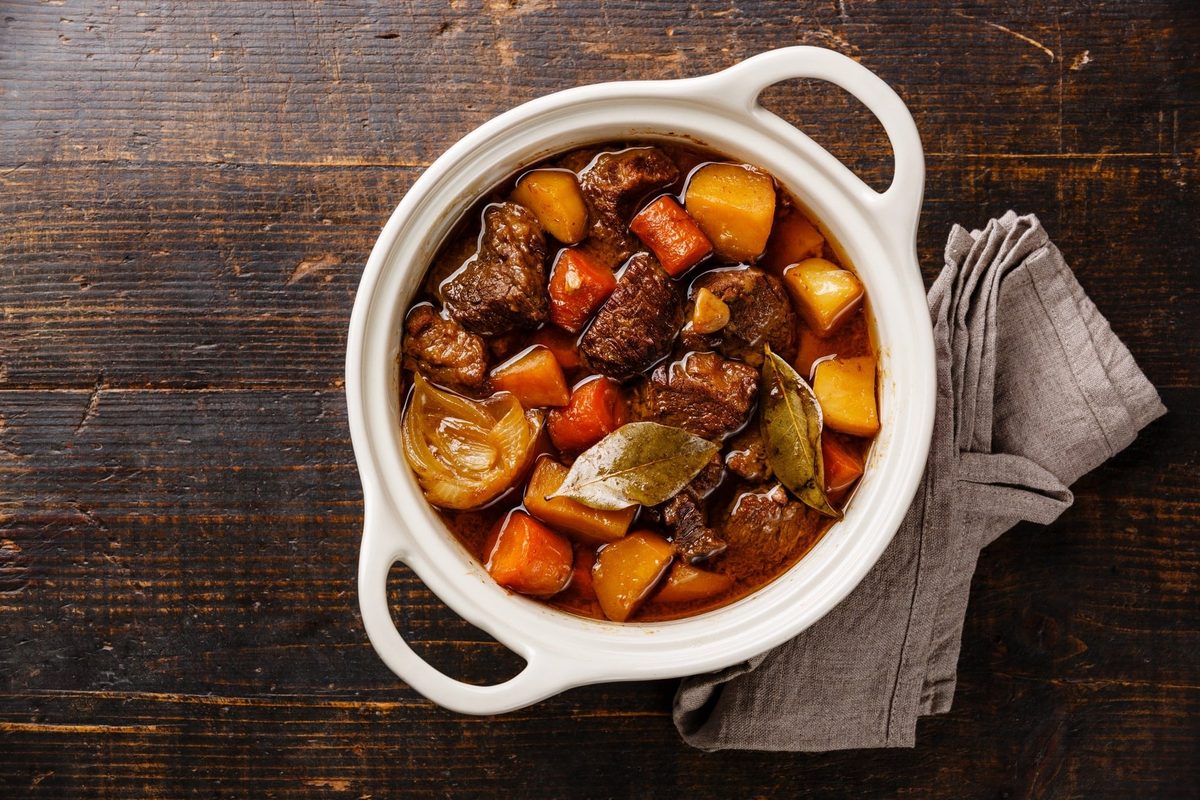
A beef stew gets most of its flavor from browned beef, aromatic vegetables and a long simmer. The seasonings layered on top are few, and two university extension recipes show the usual core: salt, black pepper, onion, garlic and celery, plus one herb or spice such as rosemary, bay leaf or paprika.12 This page covers what each seasoning does in the pot, when to add it, how regional stews differ, and why the bay leaf has to come out. Quantities appear only where a named recipe gives them.
At a glance
| Seasoning | Job in the pot | Notes |
|---|---|---|
| Onion | Sweet, savory base | In both extension recipes12 |
| Garlic or garlic powder | Savory depth | Fresh or powder both used12 |
| Celery | Savory, green note | Stalks (and tops) in both recipes12 |
| Thyme | Woodsy, sharp herbal note | A hearty herb that holds up to long cooking3 |
| Bay leaf | Subtle background; brings out meaty flavor | Remove before serving45 |
| Rosemary or oregano | Herbal top note | Rosemary in the Iowa recipe; basil or oregano offered as swaps1 |
| Paprika | Color, mild pepper flavor; defining in goulash | In the Illinois recipe26 |
| Black pepper and salt | Seasoning | Both recipes12 |
| Parsley | Fresh finish | Add at the end7 |
Two baseline recipes
| Iowa State Extension (5 servings)1 | Illinois Extension, slow cooker (6 servings)2 | |
|---|---|---|
| Beef | 1 1/2 lb stew meat (chuck) | 2 lb stew meat |
| Onion | 1 cup chopped | 3 onions, quartered |
| Garlic | 1 tsp garlic powder (or 2 cloves fresh) | 1 clove |
| Celery | 1 cup chopped | 1 stalk with tops |
| Herb or spice | 1 tsp dried rosemary (or 2 tsp fresh; basil or oregano as swaps) | 1 bay leaf, 1 tsp paprika, 1 tsp Worcestershire sauce |
| Salt and pepper | 1/4 tsp each | 1/2 tsp each |
These are the extension services’ own recipes, not a house standard. Both keep the seasoning light and let the beef and vegetables carry the pot.
The core seasonings and what each one does
Onion, garlic and celery: the savory base
All three appear in both recipes.12 In the Iowa recipe the onion and garlic powder go in early, stirred with the browned beef for 2 minutes before the broth, and the celery goes in with the broth.1 In the Illinois slow-cooker version everything goes in together at the start.2 So the advice to add onions near the end of cooking does not match these recipes; both cook them for the full time.
For fresh garlic, America’s Test Kitchen’s advice is to add it after the other vegetables have softened, because garlic that goes into a hot pan too soon can scorch and turn harsh and bitter.8 Garlic powder works too: the Iowa recipe uses 1 teaspoon and offers 2 fresh cloves as the swap.1 See garlic powder vs. garlic and onion powder.
Celery’s flavor can also come from the seed or from celery salt; that is a kitchen option, not something these recipes use. Escoffier’s brown stock ties a stick of celery into the herb bundle with thyme and bay.9 See celery seeds, celery leaves and celery salt.
Thyme: the classic stew herb
Thyme (Thymus vulgaris) is in the mint family, Lamiaceae.10 Its sharp, savory character comes from its oil, whose characteristic constituents are thymol and carvacrol.11 America’s Test Kitchen classes thyme as a hearty herb to add early in cooking, noting that the flavor compounds in hearty herbs are somewhat more heat-stable.3 Thyme is also one of the three herbs in the classic bouquet garni, with parsley and bay.12 See cooking with thyme and fresh vs. dried thyme.
Bay leaf: a background note, then out it comes
Bay leaves come from Laurus nobilis, a Mediterranean tree.13 Their flavor is subtle: Atlas Obscura describes it as herbal, bitter and slightly piney,14 and J. Kenji López-Alt, speaking to The Splendid Table, says bay leaves bring out the meaty flavors of beef and chicken. He calls them optional, but says things are better with them.4 Turkish bay is milder and sweeter; California bay has a much stronger menthol flavor, and he suggests starting with a quarter to half as much.4
Remove it before serving. Dried bay leaves stay tough; López-Alt compares eating one to eating a fish bone.4 Medical case reports describe whole bay leaves lodging in the esophagus and one perforating the bowel, noting that the leaves are rigid, can have sharp points and margins, and stay intact.515 Count the leaves in and count them out. See cooking with bay leaves and too much bay leaf.
Oregano and rosemary: alternatives to thyme
Oregano is a perennial herb of the mint family, and Britannica describes its flavor as warm and pungent.16 Like thyme and rosemary, America’s Test Kitchen treats it as a hearty herb to add early.3 The Iowa recipe uses rosemary and offers basil or oregano as swaps.1
A widely repeated claim says dried oregano is milder than fresh. The University of Delaware’s extension guide says the opposite as a general rule: dried herbs are stronger than fresh, and 3/4 to 1 teaspoon of dried crumbled herb equals 2 to 3 teaspoons of fresh.17 See fresh vs. dried oregano and too much oregano.
Paprika: color and, in goulash, the main event
Paprika is ground from dried peppers of the nightshade family.18 In an American-style stew it adds color and a mild pepper flavor; the Illinois recipe uses 1 teaspoon.2 In Hungarian goulash it is the defining spice: the Michelin Guide calls paprika a key ingredient in traditional Hungarian fare such as goulash and paprikash.6
Which paprika you use matters. Hungary’s food codex grades paprika by heat, from non-pungent to very hot,19 and Spain’s Pimentón de la Vera is smoke-dried, with a smoky, intense flavor and aroma.20 Smoked paprika takes a beef stew in a different direction; that is a matter of taste. See smoked paprika.
Parsley: the finish
Parsley is a delicate herb. The LSU AgCenter advises adding delicate herbs such as parsley, chives and basil a minute or two before the end of cooking, since prolonged heat costs them flavor.7
When to add each seasoning
Sources disagree on herb timing in long-simmered dishes:
| Source | Advice |
|---|---|
| America’s Test Kitchen | Hearty herbs (thyme, oregano, rosemary) go in early; their flavor compounds are somewhat more heat-stable3 |
| University of Delaware Extension | For recipes that call for long simmering, add herbs during the last 45 minutes17 |
| Iowa State Extension recipe | Dried rosemary goes in with the broth and simmers 45 to 60 minutes1 |
| Illinois Extension recipe | Bay leaf, paprika and everything else go in at the start of a slow cook lasting about 4 to 12 hours2 |
Both approaches work, and we have not tested which tastes better. A practical starting point (Method, not a measured rule): put whole sprigs of thyme and a bay leaf in early, where they can infuse and be fished out; add dried ground herbs within the last 45 minutes if the stew cooks for hours; finish with fresh parsley.
Other timing points from the sources:
- Salt and pepper: the Iowa recipe seasons the meat as it browns.1 Taste again at the end; that is common practice.
- Garlic: after the onions soften, so it doesn’t burn.8
- Bay leaf: in early, out before serving.45
Regional and stylistic variants
- American beef stew: onion, garlic, celery, thyme or rosemary, bay, salt and pepper, as in the extension recipes above.12
- French-style braises: a bouquet garni of parsley, thyme and bay, tied together if fresh or wrapped in cheesecloth if dried, and removed before serving.12 See bouquet garni and herbes de Provence.
- Hungarian goulash: paprika is the defining spice.6 See Hungarian spices.
Related
- Corned beef and cabbage spices
- French onion soup spices and spices for chicken soup
- Potato soup spices
- Bay leaf substitutes and thyme substitutes
- The master list of herbs and spices
Footnotes
-
“Beef Stew”, Spend Smart. Eat Smart., Iowa State University Extension and Outreach. spendsmart.extension.iastate.edu · Reference work ↩ ↩2 ↩3 ↩4 ↩5 ↩6 ↩7 ↩8 ↩9 ↩10 ↩11 ↩12 ↩13 ↩14
-
“Beef Stew”, Eat. Move. Save., University of Illinois Extension. eat-move-save.extension.illinois.edu · Reference work ↩ ↩2 ↩3 ↩4 ↩5 ↩6 ↩7 ↩8 ↩9 ↩10 ↩11 ↩12
-
Liz Bomze, “Our Guide to Fresh Herbs”, America’s Test Kitchen, 2019. americastestkitchen.com · Publication ↩ ↩2 ↩3 ↩4
-
David Leite with J. Kenji López-Alt, “Bay leaves are an optional ingredient, ‘but things are definitely better with them’”, The Splendid Table. splendidtable.org · Publication ↩ ↩2 ↩3 ↩4 ↩5
-
Ahmed and McCormick, “Bay-leaf: an unusual oesophageal foreign body”, Journal of Laryngology and Otology, 1993. cambridge.org · Peer-reviewed ↩ ↩2 ↩3
-
“Paprika: why this smoky spice plays a crucial role in Hungarian cuisine”, Michelin Guide, 2023. guide.michelin.com · Publication ↩ ↩2 ↩3
-
“Flavorful Herbs”, LSU AgCenter. lsuagcenter.com · Reference work ↩ ↩2
-
Liz Bomze, “Why You Should Wait to Add Garlic”, America’s Test Kitchen, 2023. americastestkitchen.com · Publication ↩ ↩2
-
A. Escoffier, A Guide to Modern Cookery, English translation, Project Gutenberg. gutenberg.org · Reference work ↩
-
“Thymus vulgaris L.”, Plants of the World Online, Royal Botanic Gardens, Kew. powo.science.kew.org · Reference work ↩
-
S.H. Widodo, “Thymus vulgaris”, PROSEA. uses.plantnet-project.org · Reference work ↩
-
“Bouquet garni”, Encyclopaedia Britannica. britannica.com · Reference work ↩ ↩2
-
“Laurus nobilis L.”, Plants of the World Online, Royal Botanic Gardens, Kew. powo.science.kew.org · Reference work ↩
-
Andrew Coletti, “What Is a Bay Leaf, Exactly?”, Atlas Obscura, 2023. atlasobscura.com · Publication ↩
-
Bell and Mustard, “Bay leaf perforation of Meckel’s diverticulum”, Canadian Journal of Surgery, 1997. canjsurg.ca · Peer-reviewed ↩
-
Anoushka Pant, “Oregano”, Encyclopaedia Britannica. britannica.com · Reference work ↩
-
“Using Herbs and Spices”, University of Delaware Cooperative Extension, revised 2025. udel.edu · Reference work ↩ ↩2
-
“Paprika”, McCormick Science Institute. mccormickscienceinstitute.com · Merchant ↩
-
MÉ 2-108, Hungarian Food Codex directive on paprika. elelmiszerlanc.kormany.hu · Standard ↩
-
Pimentón de la Vera PDO product specification. assets.publishing.service.gov.uk · Regulator ↩