Spice Substitutes · Substitutes
Pickling Spice Substitutes: What to Use in the Jar and in the Pot
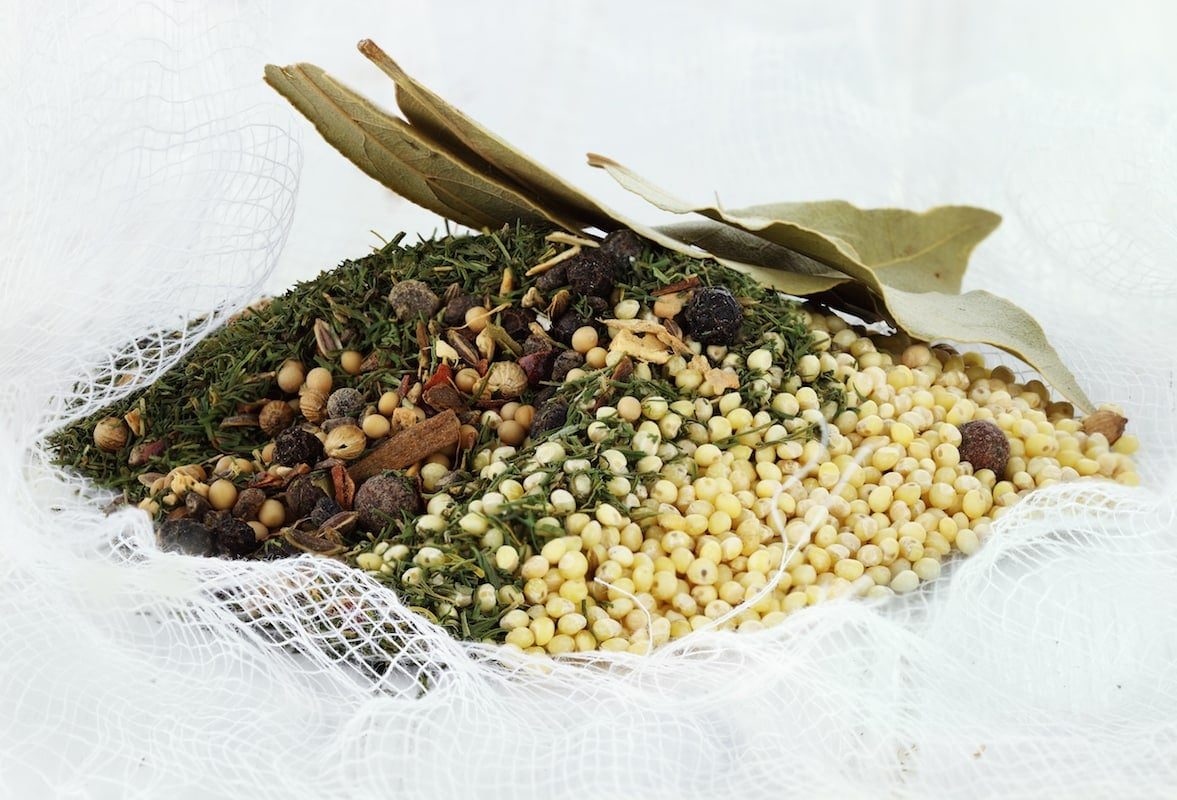
Pickling spice is a mix of whole spices used to flavor pickling brines, and also corned beef and other brined foods. There is no standard recipe: USDA’s purchasing specification for spice blends does not include it,1 and three commercial blends we compared differ by as many as five ingredients.234 What they share is a core of mustard seed, allspice, coriander, cloves, bay leaf, pepper, mace and chile.234 Because the blend is just whole spices, the best substitute is almost always a mix you put together yourself. The bigger question is whether the spices are going into a jar of pickles, where form matters, or into a pot, where it matters much less.
Quick answer
| What pickling spice is doing | Best substitute | Starting amount, per 1 part pickling spice | Treatment |
|---|---|---|---|
| Flavoring a pickle brine or jar | Your own mix of whole spices | 1 part | Attributed (recipe proportions) |
| Same job, with only a few of the spices | Whole mustard seed, coriander, allspice and bay, plus whatever else you have | 1 part | Method |
| Flavoring a corned beef brine or braise | A homemade whole-spice mix, or ground spices if that is all you have | 1 part whole; see the ground conversions below | Method; Computed for whole to ground |
| A warm spice note in a stew or braise | Baharat or garam masala | 1/2 part, then taste | Method |
The rest of the page explains each choice.
How the ratios on this page are labeled
Every ratio carries one of four labels.
- Computed: based on a measurable physical relationship, with the source named.
- Attributed: a named source publishes this ratio. We quote it as theirs.
- Disputed: named sources give different answers to the same swap. We show each one and do not average them.
- Method: we found no published ratio. We give a direction and a cautious starting point, and say so.
The only published proportions on this page are for making the blend itself. We found no published ratio for replacing pickling spice with another blend.
Why whole spices matter in a jar
The National Center for Home Food Preservation (NCHFP) lists ground spices as one cause of dark or discolored pickles, and recommends whole spices.5 It lists leaving spices in the jars as another cause, and says to put spices loosely in a cheesecloth bag so they can be taken out before canning.5 Its quick dill pickle recipe uses 2 tablespoons of whole mixed pickling spice tied in a clean white cloth.6 Cooking spices too long in the vinegar, or using too many, can give a strong, bitter taste.5
So for pickles, any substitute should be whole spices in a bag, not a ground seasoning. Substituting spices changes flavor; we found no NCHFP guidance on whether it affects safety, so in a tested canning recipe change only the spices and keep the vinegar, water and salt as written. That last point is our judgment.
If pickling spice is flavoring a pickle
1. Make your own
A homemade blend from The Art of Preserving, published by Williams Sonoma, combines one cinnamon stick broken into pieces, 2 crushed dried bay leaves, 2 whole cloves, 2 tablespoons each of mustard seeds and whole coriander seeds, 1 tablespoon of mixed peppercorns, 2 teaspoons each of whole allspice and dill seeds, and 1 teaspoon of red pepper flakes, stored airtight for up to a year.7 Without the cinnamon, bay and cloves, that adds up to about 6 2/3 tablespoons of seeds and flakes.
Ratio (Attributed recipe proportions): The proportions above are the book’s. Use the finished mix one for one in place of store-bought pickling spice.
What each spice brings:
| Spice | Main aroma or pungent compound | Source |
|---|---|---|
| Allspice | Eugenol, 50 to 80% of the berry oil | PROSEA8 |
| Cloves | Eugenol, 70 to 90% of the bud oil | PROSEA9 |
| Coriander seed | Linalool, always the main component of the oil | PROSEA10 |
| Bay leaf | 1,8-cineole (31.9% in one Italian leaf oil sample) | Caputo et al.11 |
| Dill seed | Carvone, the principal component | Britannica12 |
| Black pepper | Piperine, the source of its characteristic flavor | Britannica13 |
| Mustard seed | Allyl isothiocyanate, formed only after the seed is crushed and wet | Popular Science;14 Britannica15 |
Allspice and cloves share eugenol, so one can partly cover for the other; that inference is ours, from the PROSEA figures. Whole white (yellow) mustard seeds have no smell,15 and their heat comes from a reaction that needs crushing and water,14 so whole seeds in a brine add more texture and mild flavor than heat.
2. A short version with what you have
Ratio (Method): No source gives a reduced recipe. Build the mix from whatever whole spices you have, keeping mustard seed and coriander as the largest parts, as they are in the recipe above,7 then allspice, peppercorns and a bay leaf. Use the total one for one in place of pickling spice. If you have dill seed, add it; McCormick’s blend has none,2 but The Spice House and World Spice include it,34 and NCHFP’s dill pickle recipe adds dill to the jars separately.6
The Spice House describes its own blend’s logic: cassia, cloves, allspice and star anise for warm sweetness, and pepper, mustard seed, dill seed and juniper for a savory tang.3 Keeping something from each side is a reasonable guide when you are short of spices.
If pickling spice is flavoring corned beef
The Spice House calls its blend ideal for corned beef and suggests five parts pickling spice to one part coriander seed.3 For a braise rather than a jar, the discoloration NCHFP describes does not apply, and ground spices can stand in for whole if that is all you have. Strain or skim as you like.
Ratio (Computed, whole to ground): McCormick’s conversions are 5 whole allspice berries (about 1 teaspoon) to 1 teaspoon of ground allspice, and 1 teaspoon of coriander seed to 1 1/4 teaspoons of ground coriander.16 These are volume figures, not potency figures. For the other spices, we found no conversion we could use here; start with the same volume, ground, and taste.
If pickling spice is a warm note in a stew or braise
McCormick suggests its pickling spice for brines, marinades and stews.2 In a stew, a ground spice blend with an overlapping set of spices can stand in, as long as you accept a different flavor. None of these belongs in a jar of pickles.
| Blend | What overlaps with pickling spice | What differs | Source |
|---|---|---|---|
| Baharat | Black pepper and allspice, the main spices in Katzer’s simpler eastern Mediterranean version | Varies from region to region and family to family | Katzer;17 RecipeTin Eats18 |
| Garam masala | Cloves, bay leaf, cinnamon, cardamom | Fennel | Great British Chefs19 |
| Ras el hanout | Coriander, ginger, cardamom, cinnamon | Cumin, turmeric, nutmeg; sold ground | Oxford Companion to Food20 |
| Jerk seasoning | Allspice (pimento) | Scotch bonnet heat, thyme; dry blends add salt and sugar | Smithsonian;21 McCormick22 |
Ratio (Method): No published ratio. Start with half the pickling spice amount, because these are ground and release flavor quickly, and taste before adding more. Check the label for salt and sugar, especially in jerk seasoning, whose McCormick version lists sea salt and sugar.22
Crab boil seasoning: not for pickles
Old Bay was created in Baltimore as a crab seasoning,23 and its label lists celery salt (salt and celery seed), spices including red and black pepper, and paprika.24 It is ground and salted, so by NCHFP’s guidance it is a poor choice for a jar,5 and its salt will throw off a brine. It shares pepper and chile with pickling spice and little else that its label names.
What isn’t known
- No published ratio exists for replacing pickling spice with any other blend.
- No standard defines pickling spice, so “one part” of a commercial blend is not a fixed mix.1
- We could not confirm the ingredient list of a whole-spice crab boil product from a label, so those products are not ranked here.
- It is sometimes said that pickling spices are chosen because they hold up to heat and fermentation. We found no source that states this.
Related
- Pickling spice and pickling salt
- Corned beef and cabbage spices
- The component spices: allspice, cloves, coriander, bay leaves, dill, mustard seed uses, black pepper, cinnamon, mace, juniper berries
- Swaps for the components: allspice substitutes, coriander substitutes, bay leaf substitutes, dill substitutes
- Other blends: baharat, garam masala, ras el hanout, jerk seasoning, Old Bay seasoning
Footnotes
-
Commercial Item Description A-A-20001C, Spices and Spice Blends, USDA Agricultural Marketing Service, 2023. ams.usda.gov · Regulator ↩ ↩2
-
McCormick Pickling Spice, label text via Hannaford product listing. hannaford.com · Merchant ↩ ↩2 ↩3 ↩4
-
Pickling Spices Blend, product page, The Spice House. thespicehouse.com · Merchant ↩ ↩2 ↩3 ↩4 ↩5
-
Pickling Spice, product page, World Spice Merchants. worldspice.com · Merchant ↩ ↩2 ↩3
-
Causes and Possible Solutions for Problems with Pickled Foods, National Center for Home Food Preservation. nchfp.uga.edu · Reference work ↩ ↩2 ↩3 ↩4
-
Quick Fresh-Pack Dill Pickles, National Center for Home Food Preservation. nchfp.uga.edu · Reference work ↩ ↩2
-
Homemade Pickling Spice, adapted from The Art of Preserving (Atwood, Courchesne and Field, 2010), Williams Sonoma. williams-sonoma.com · Publication ↩ ↩2
-
D. Sulistiarini, Pimenta dioica, Plant Resources of South-East Asia (PROSEA). uses.plantnet-project.org · Reference work ↩
-
E.W.M. Verheij and C.H.A. Snijders, Syzygium aromaticum, PROSEA. uses.plantnet-project.org · Reference work ↩
-
Coriandrum sativum, PROSEA. uses.plantnet-project.org · Reference work ↩
-
Caputo et al., “Laurus nobilis: Composition of Essential Oil and Its Biological Activities”, Molecules, 2017. mdpi.com · Peer-reviewed ↩
-
“Dill”, Encyclopaedia Britannica. britannica.com · Reference work ↩
-
“Black pepper”, Encyclopaedia Britannica. britannica.com · Reference work ↩
-
Sandra Gutierrez G., “When the mustard shortage hits, make your own”, Popular Science, 2022. popsci.com · Publication ↩ ↩2
-
“White mustard”, Encyclopaedia Britannica. britannica.com · Reference work ↩ ↩2
-
How to Grind Your Own Spices, McCormick. mccormick.com · Merchant ↩
-
Gernot Katzer, Paprika and Mexican chiles (Capsicum annuum), Gernot Katzer’s Spice Pages. gernot-katzers-spice-pages.com · Reference work ↩
-
Nagi Maehashi, “Baharat”, RecipeTin Eats, 2026. recipetineats.com · Publication ↩
-
“How to make garam masala”, Great British Chefs. greatbritishchefs.com · Publication ↩
-
Alan Davidson, “Ras-el-hanout”, The Oxford Companion to Food, 2014. app.ckbk.com · Reference work ↩
-
Vaughn Stafford Gray, “A Brief History of Jamaican Jerk”, Smithsonian Magazine, 2020. smithsonianmag.com · Publication ↩
-
McCormick Gourmet Jamaican Jerk Seasoning, Club House (McCormick Canada). clubhouse.ca · Merchant ↩ ↩2
-
Francesca Cohen, “Gustav Brunn’s Baltimore Spice Company”, Explore Baltimore Heritage. explore.baltimoreheritage.org · Publication ↩
-
OLD BAY Classic Seafood Seasoning, product page, McCormick. mccormick.com · Merchant ↩