Cooking · Dish guide
The Best Spices for Split Pea Soup, from American Ham-and-Pea to Swedish Ärtsoppa
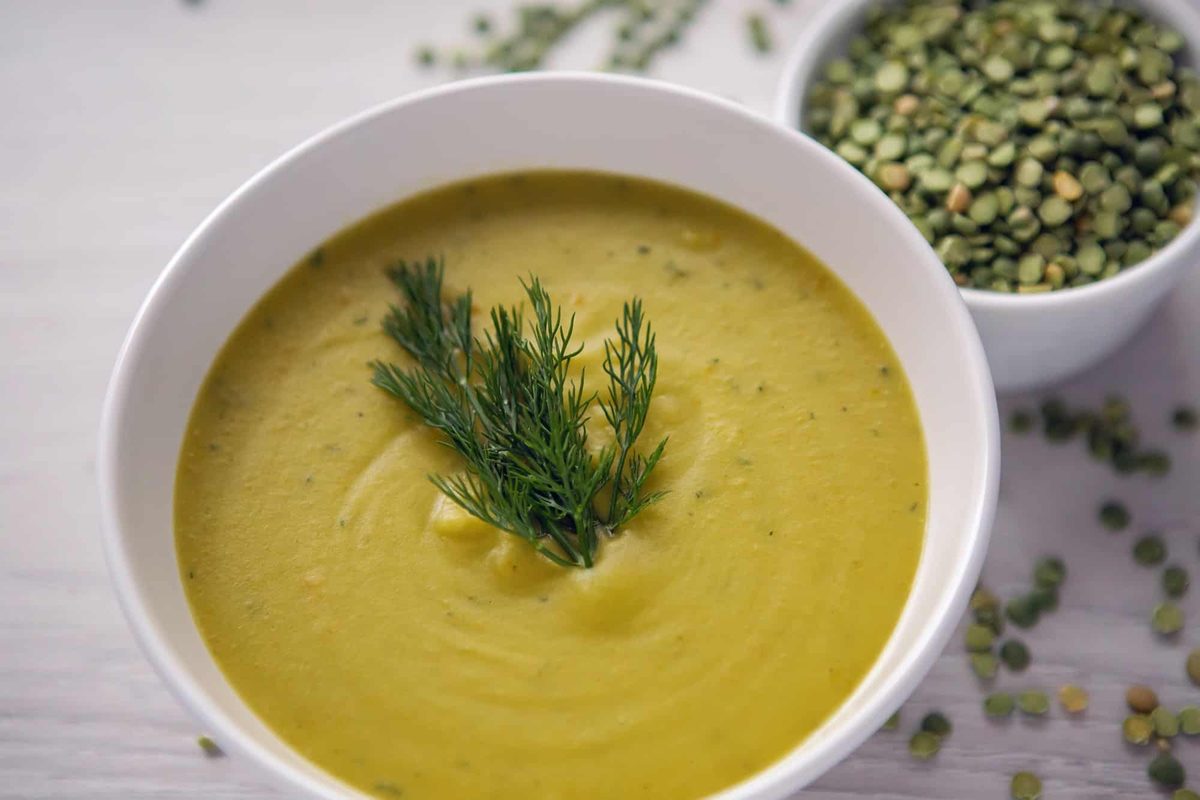
Split pea soup is a lightly seasoned dish. Three extension recipes show how little seasoning the American version needs: onion and black pepper in all three, celery and carrot in two, garlic in one, and ham in one as standard and in another as an option.123 Sweden’s traditional Thursday pea soup goes further, with marjoram, thyme and ginger, and mustard on the side.4 This page covers what each seasoning does and how the styles differ. Quantities appear only where a named recipe gives them.
At a glance
| Seasoning | Job in the pot | Notes |
|---|---|---|
| Onion | Savory base | In all three US recipes123 |
| Celery and carrot | Aromatic base | Iowa and Maine recipes12 |
| Ham, ham bone or ham hock | Smoke, salt, meaty depth | Standard in Iowa, optional in Maine12 |
| Black pepper | Gentle bite | All three US recipes123 |
| Garlic | Savory depth | Maine recipe2 |
| Thyme and marjoram | Herbal note | Swedish ärtsoppa4 |
| Ginger | Warmth | Swedish ärtsoppa4 |
| Curry powder, cumin, turmeric | Warm-spiced variation | Optional in the Maine recipe2 |
| Mustard | Sharp condiment at the table | Served with Swedish ärtsoppa4 |
Three American baseline recipes
| Iowa State (8 servings)1 | University of Maine EFNEP (8 one-cup servings)2 | Illinois Extension (4 servings)3 | |
|---|---|---|---|
| Split peas | 1 lb | 2 cups, green or yellow | 1 1/2 cups |
| Aromatics | 1 cup each onion, celery, carrot | 1 onion, 2 celery stalks, 4 carrots, 2 tsp garlic | 1 large onion |
| Fat | none | 2 tbsp canola, olive or vegetable oil | 3 tbsp butter or margarine |
| Pork | 1 cup ham, cubed | Optional: 1 cup ham, a ham bone or smoked ham hock | none |
| Seasoning | 1/2 tsp black pepper | 1/4 tsp each salt and pepper; optional 1 tbsp curry powder, 1/2 tsp cumin, 1/2 tsp turmeric | 1 1/2 tsp salt, 1/4 tsp black pepper |
| Liquid | 4 cups low-sodium chicken broth, 6 cups water | 7 cups low-sodium broth | 6 cups water |
| Extra | 1/2 cup brown rice | Optional potato | none |
These are the extension services’ own recipes, not a house standard. On the botany: Kew now treats the pea, Pisum sativum, as a synonym of Lathyrus oleraceus, in the legume family, Fabaceae.5
The core seasonings and what each one does
Onion and celery: the base
Onion (Allium cepa) is in the amaryllis family, Amaryllidaceae.6 All three US recipes use it.123 The Iowa and Maine recipes add celery and carrot.12 Green onions or chives work as a garnish; chives have a mild onion flavor and are usually sprinkled on just before serving.7 See onion powder, celery seeds and chives.
Ham and other cured pork
Iowa’s recipe uses a cup of cubed ham, and Maine’s lists ham, a ham bone or a smoked ham hock as an option.12 Illinois’s version has no meat at all.3 In Sweden, the traditional soup is made from yellow split peas and salted pork.4 With ham in the pot, taste before salting; that is common practice.
Black pepper
Every US recipe here uses black pepper: 1/2 teaspoon in Iowa’s, 1/4 teaspoon in Maine’s and Illinois’s.123 Iowa stirs it in at the start with the broth, water, peas and rice.1 Its characteristic flavor comes mainly from piperine.8 Fresh grinding is a matter of preference; we found no measurement comparing fresh and pre-ground pepper in soup. See black pepper.
Garlic
Only the Maine recipe uses garlic, 2 teaspoons minced.2 When garlic is sautéed with the vegetables, America’s Test Kitchen advises adding it after the others have softened, because garlic added too early can burn and turn acrid and bitter.9 A widely repeated idea says garlic is what makes meatless versions taste full; we found no source for it. See garlic and garlic powder.
Thyme and marjoram: the herbs
None of the three US recipes uses an herb.123 The Swedish living-traditions inventory lists onion, marjoram, thyme and ginger as other common ingredients of Swedish pea soup.4 Thyme (Thymus vulgaris) is in the mint family, Lamiaceae,10 and its sharp, savory character comes from an oil whose characteristic constituents are thymol and carvacrol.11
Herb timing in a long simmer is disputed:
| Source | Advice |
|---|---|
| America’s Test Kitchen | Hearty herbs such as thyme go in early; their flavor compounds are somewhat more heat-stable12 |
| University of Delaware Extension | For long-simmered recipes, add herbs during the last 45 minutes13 |
The Delaware guide also suggests using thyme in moderate amounts, 1 to 2 teaspoons for 6 servings.13 A practical starting point (Method): a sprig or two of fresh thyme early, or dried thyme and marjoram crumbled in for the last 45 minutes. See cooking with thyme, cooking with marjoram and too much thyme.
Curry, cumin and turmeric: a warm-spiced version
The Maine recipe offers 1 tablespoon curry powder, 1/2 teaspoon cumin and 1/2 teaspoon turmeric as optional additions.2 Curry powder is a blend with no fixed recipe; the USDA’s purchasing specification lists turmeric, coriander, fenugreek, cinnamon, cumin, black pepper, ginger and cardamom without proportions.14 See curry powder, cumin and turmeric.
Oil or butter
Maine’s recipe starts with 2 tablespoons of canola, olive or vegetable oil; Illinois’s with 3 tablespoons of butter or margarine; Iowa’s uses no added fat.123 A drizzle of extra virgin olive oil at serving is a matter of taste.
Regional variants
- American ham and pea: onion, celery, carrot, black pepper and ham, as in the Iowa recipe.1
- Swedish ärtsoppa: yellow split peas and salted pork with onion, marjoram, thyme and ginger, served with mustard.4 Serving pea soup on Thursdays has a long history in Sweden, and pancakes were first served alongside it in the 18th century.4
- Warm-spiced: curry powder, cumin and turmeric, as in the Maine recipe’s options.2
Related
- Spices for ham
- Vegetable soup spices, minestrone soup spices and potato soup spices
- Marjoram substitutes and thyme substitutes
- The master list of herbs and spices
Footnotes
-
“Split Pea Soup”, Spend Smart. Eat Smart., Iowa State University Extension and Outreach. spendsmart.extension.iastate.edu · Reference work ↩ ↩2 ↩3 ↩4 ↩5 ↩6 ↩7 ↩8 ↩9 ↩10 ↩11 ↩12 ↩13 ↩14
-
“Split Pea Soup”, EFNEP, University of Maine Cooperative Extension. extension.umaine.edu · Reference work ↩ ↩2 ↩3 ↩4 ↩5 ↩6 ↩7 ↩8 ↩9 ↩10 ↩11 ↩12 ↩13 ↩14 ↩15 ↩16 ↩17
-
“Split Pea Soup”, Eat. Move. Save., University of Illinois Extension. eat-move-save.extension.illinois.edu · Reference work ↩ ↩2 ↩3 ↩4 ↩5 ↩6 ↩7 ↩8 ↩9
-
“Pea soup and pancakes on Thursdays”, Levande kulturarv. levandekulturarv.se · Reference work ↩ ↩2 ↩3 ↩4 ↩5 ↩6 ↩7 ↩8
-
Pisum sativum and Lathyrus oleraceus, Plants of the World Online, Royal Botanic Gardens, Kew. powo.science.kew.org · Reference work ↩
-
“Allium cepa L.”, Plants of the World Online, Royal Botanic Gardens, Kew. powo.science.kew.org · Reference work ↩
-
Susan Mahr, “Chives, Allium schoenoprasum”, University of Wisconsin-Madison Division of Extension. hort.extension.wisc.edu · Reference work ↩
-
“Black pepper”, Encyclopaedia Britannica. britannica.com · Reference work ↩
-
Liz Bomze, “Why You Should Wait to Add Garlic”, America’s Test Kitchen, 2023. americastestkitchen.com · Publication ↩
-
“Thymus vulgaris L.”, Plants of the World Online, Royal Botanic Gardens, Kew. powo.science.kew.org · Reference work ↩
-
S.H. Widodo, “Thymus vulgaris”, PROSEA. uses.plantnet-project.org · Reference work ↩
-
Liz Bomze, “Our Guide to Fresh Herbs”, America’s Test Kitchen, 2019. americastestkitchen.com · Publication ↩
-
“Using Herbs and Spices”, University of Delaware Cooperative Extension, revised 2025. udel.edu · Reference work ↩ ↩2
-
USDA Agricultural Marketing Service, Commercial Item Description A-A-20001C, Spices and Spice Blends, 2023. ams.usda.gov · Regulator ↩