Cooking · Dish guide
The Best Spices for Potato Soup: Aromatics, Herbs and Toppings That Do the Work
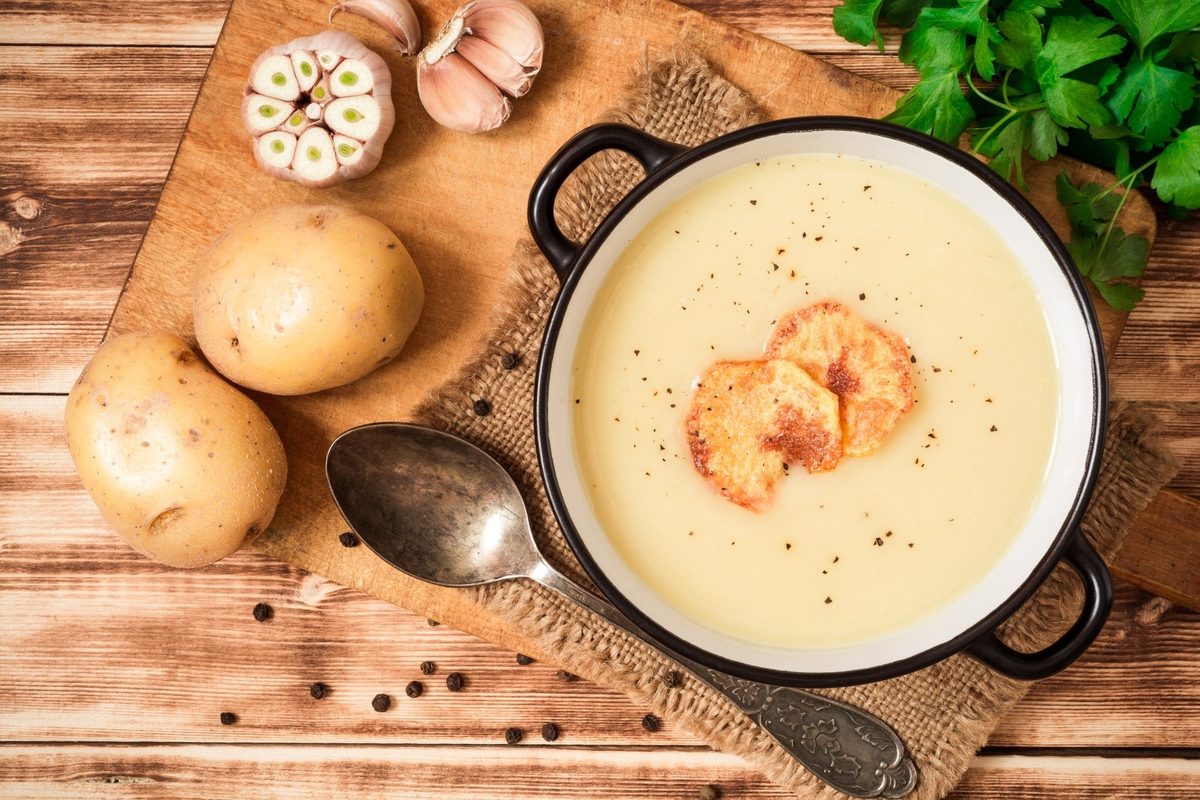
Potato soup is mild by design, so its seasoning comes mostly from aromatic vegetables and a few herbs. Two extension recipes show the range. Iowa State’s loaded potato soup uses onion, garlic powder and black pepper, finished with cheddar and optional toppings such as green onions and bacon.1 Illinois Extension’s herb potato soup builds on onion, celery and carrot sautéed in olive oil, with toasted dried rosemary and thyme, lemon juice and fresh parsley.2 This page covers what each seasoning does and when to add it. Quantities appear only where a named recipe gives them.
At a glance
| Seasoning | Job in the pot | Notes |
|---|---|---|
| Onion | Savory base | In both recipes12 |
| Leek | Milder, sweeter onion flavor | A classic partner for potatoes3 |
| Celery | Green, savory note | Rib and leaves, sautéed at the start2 |
| Garlic powder or garlic | Savory depth | Simmered in the broth in the Iowa recipe1 |
| Thyme and rosemary | Herbal backbone | Dried, toasted, added near the end2 |
| Black pepper | Gentle bite | In both recipes12 |
| Parsley | Fresh, slightly bitter finish | Stirred in at the end2 |
| Chives or green onions | Mild onion garnish | At serving14 |
| Cheddar, bacon | Richness, salt, smoke | Cheese stirred in; bacon as a topping1 |
Two baseline recipes
| Iowa State, loaded potato soup (4 servings)1 | Illinois Extension, herb potato soup2 | |
|---|---|---|
| Potato | 4 medium, peeled and cubed | 2 1/2 cups leftover mashed potatoes |
| Aromatics | 1 onion, chopped | 1/2 cup minced onion, 1 small celery rib with leaves, 1 carrot |
| Garlic | 1 tsp garlic powder | none |
| Herbs | none | 1/2 tsp dried rosemary, 1 tsp dried thyme, 1/3 cup fresh parsley |
| Pepper and salt | 1/2 tsp ground black pepper | salt and black pepper to taste |
| Liquid and dairy | 2 cups low-sodium broth, 1 cup nonfat milk, 3/4 cup cheddar | 2 cups unsalted chicken broth, 1 tbsp lemon juice |
| Toppings | Optional: green onions, cheese, bacon, ham, croutons, crackers | none |
These are the extension services’ own recipes, not a house standard.
The core seasonings and what each one does
Onion and leek: the base
Onion (Allium cepa) is in the amaryllis family, Amaryllidaceae.5 Both recipes cook the onion from the start: Iowa simmers it with the potatoes, garlic powder, pepper and broth,1 and Illinois sautés it with celery and carrot in olive oil before the broth goes in.2 Adding onion in stages to layer its flavor is a technique some cooks use; neither recipe does it, and we found no test of it.
Leek (Allium porrum) is in the same family and has a mild, sweet, onionlike flavor.3 Britannica notes its wide use in European soups and stews, especially as a complement to potatoes.3 Leeks can be cooked whole as a vegetable;3 in soup they are usually sliced and softened with the other aromatics, which is common practice.
Celery: the second aromatic
The Illinois recipe uses one small rib of celery including the leaves, minced and sautéed with the onion.2 Celery’s job here is a green, savory note; that is a flavor description, not a measured property. Celery leaves, seed and salt carry the same flavor in other forms. See celery leaves, celery seeds and celery salt.
Garlic: hydrate the powder
Iowa’s recipe uses a teaspoon of garlic powder simmered in the broth.1 That suits the powder: America’s Test Kitchen found that garlic powder stirred dry into mashed potatoes tasted harsh and garlicky but not particularly complex,6 and recommends hydrating it, because powder straight from the jar has not developed its full flavor.7 In a soup, adding the powder to the broth early is a simple way to do that; the application is our suggestion, based on ATK’s finding. See garlic powder vs. garlic and too much garlic powder.
Thyme and rosemary: toasted, then stirred in
The Illinois recipe toasts 1/2 teaspoon dried rosemary and 1 teaspoon dried thyme in a dry skillet until fragrant, then adds them near the end with the lemon juice and parsley.2 Thyme’s sharp, savory note comes from an oil whose characteristic constituents are thymol and carvacrol.8 America’s Test Kitchen treats thyme and rosemary as hearty herbs that hold up to cooking,9 so either timing works. Dried herbs are stronger than fresh; the University of Delaware’s conversion is 3/4 to 1 teaspoon dried for 2 to 3 teaspoons fresh.10 See cooking with thyme and cooking with rosemary.
Black pepper
Both recipes use black pepper: Iowa simmers 1/2 teaspoon in the broth, and Illinois leaves it to taste at the end.12 Its flavor comes mainly from piperine.11 Fresh grinding is a matter of preference. See black pepper.
Parsley, chives and green onions: the finish
Parsley is a delicate herb; the LSU AgCenter advises adding delicate herbs such as parsley and chives in the last minute or two of cooking.12 The Illinois recipe stirs in 1/3 cup fresh parsley at the end.2 Flat-leaved parsley is stronger flavored than curly, according to PROSEA.13 A common claim says dried parsley is weaker than fresh; the University of Delaware’s general rule for herbs runs the other way (dried is stronger),10 and we found no parsley-specific measurement.
Chives have a mild onion flavor and are typically sprinkled on food just before serving.4 Iowa’s recipe lists sliced green onions among its optional garnishes.1 See chives and too much parsley.
Cheddar and bacon: not spices, but they season
Iowa’s loaded potato soup stirs in 3/4 cup shredded cheddar and offers crumbled bacon and diced ham as toppings.1 With either on board, taste before salting further; that is common practice. Starting the soup by rendering bacon and cooking the onion in its fat is a common technique for a smokier soup; neither extension recipe does it.
Variations
- Loaded: cheddar, bacon, green onions on top, as in the Iowa recipe.1
- Herb-forward and lighter: olive oil, celery, toasted thyme and rosemary, lemon and parsley, as in the Illinois recipe.2
- Potato and leek: leeks with or in place of onion.3
Related
- Baked potato spices, spices for mashed potatoes and hash brown spices
- Clam chowder spices and spices for chicken soup
- Parsley substitutes and chives substitutes
- The master list of herbs and spices
Footnotes
-
“Loaded Potato Soup”, Spend Smart. Eat Smart., Iowa State University Extension and Outreach. spendsmart.extension.iastate.edu · Reference work ↩ ↩2 ↩3 ↩4 ↩5 ↩6 ↩7 ↩8 ↩9 ↩10 ↩11 ↩12 ↩13
-
“Herb Potato Soup”, University of Illinois Extension. extension.illinois.edu · Reference work ↩ ↩2 ↩3 ↩4 ↩5 ↩6 ↩7 ↩8 ↩9 ↩10 ↩11 ↩12 ↩13
-
“Leek”, Encyclopaedia Britannica. britannica.com · Reference work ↩ ↩2 ↩3 ↩4 ↩5
-
Susan Mahr, “Chives, Allium schoenoprasum”, University of Wisconsin-Madison Division of Extension. hort.extension.wisc.edu · Reference work ↩ ↩2
-
“Allium cepa L.”, Plants of the World Online, Royal Botanic Gardens, Kew. powo.science.kew.org · Reference work ↩
-
“Experiment: Bringing Out the Best in Garlic Powder”, America’s Test Kitchen. americastestkitchen.com · Publication ↩
-
Carolyn Grillo, “For Great Garlic Bread, Hydrate Your Garlic Powder First”, America’s Test Kitchen, 2021. americastestkitchen.com · Publication ↩
-
S.H. Widodo, “Thymus vulgaris”, PROSEA. uses.plantnet-project.org · Reference work ↩
-
Liz Bomze, “Our Guide to Fresh Herbs”, America’s Test Kitchen, 2019. americastestkitchen.com · Publication ↩
-
“Using Herbs and Spices”, University of Delaware Cooperative Extension, revised 2025. udel.edu · Reference work ↩ ↩2
-
“Black pepper”, Encyclopaedia Britannica. britannica.com · Reference work ↩
-
“Flavorful Herbs”, LSU AgCenter. lsuagcenter.com · Reference work ↩
-
I.B. Ipor and L.P.A. Oyen, “Petroselinum crispum”, PROSEA. uses.plantnet-project.org · Reference work ↩