Cooking · Dish guide
Vegetable Soup Spices: Bay Leaf, Thyme or Oregano, and Herbs in Place of Salt
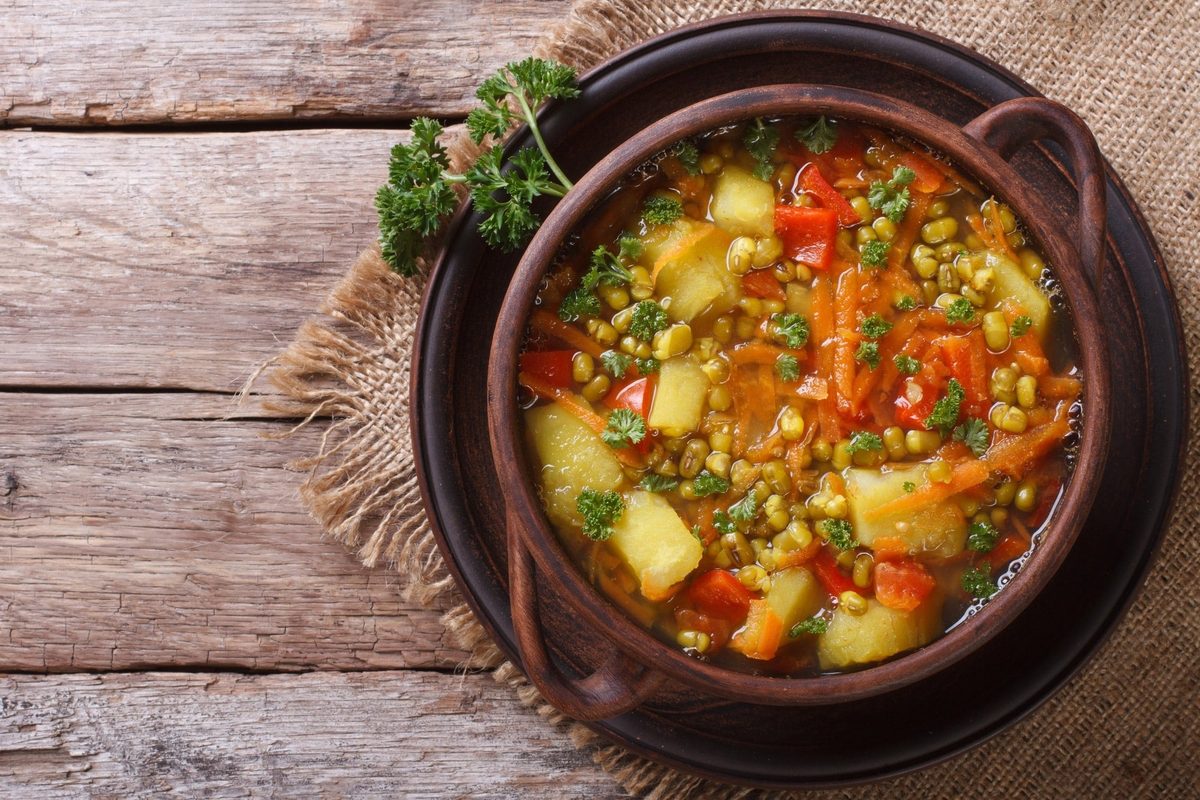
Vegetable soup takes most of its flavor from the vegetables, so its seasoning is simple and fairly consistent: onion and garlic to start, one bay leaf in the pot, one dried herb (thyme or oregano are the usual pair), black pepper, and something fresh at the end. Two tested recipes below follow that pattern. A University of Wisconsin Extension soup sheet adds the point that matters most for a soup you make at home: homemade soups can be lower in salt than canned if herbs do the flavoring instead.1 This page sets out what each seasoning does and when it goes in.
At a glance
| Seasoning | Job | In the sources below |
|---|---|---|
| Onion | Sweet, savory base | Mayo Clinic2 |
| Garlic | Pungent depth | Mayo Clinic2 |
| Bay leaf | Background herbal note; removed before serving | Both recipes; on Wisconsin’s herb list231 |
| Thyme | Savory herb for long cooking | NDSU; on Wisconsin’s herb list31 |
| Oregano | Warm, pungent herb | Mayo Clinic2 |
| Cumin | Earthy warmth | Mayo Clinic2 |
| Black pepper | Mild heat | Both recipes23 |
| Fresh cilantro or parsley, lemon zest | Fresh finish | Mayo Clinic; parsley on Wisconsin’s list21 |
| Basil, rosemary | Other herbs to try | Wisconsin’s herb list1 |
| MSG | Savory boost | Optional; none of the recipes |
Two recipes side by side
| Mayo Clinic, Summer Vegetable Soup (serves 8)2 | NDSU Extension, Hearty Vegetable Beef Soup (serves 4)3 | |
|---|---|---|
| Base | 1 tbsp olive oil, 1 yellow onion, 3 garlic cloves | Unsalted chicken broth and water |
| Vegetables | Plum tomatoes, carrot, yellow bell pepper, zucchini | 2 cups frozen mixed soup vegetables, 16 oz canned tomatoes |
| Dried herb and spice | 1 tbsp fresh oregano or 1 tsp dried; 1 tsp ground cumin | 1 tsp crushed thyme leaves |
| Bay leaf | 1, discarded at the end | 1, removed at the end |
| Liquid | 4 cups no-salt-added vegetable stock | 10.5 oz unsalted or reduced-sodium chicken broth plus water |
| Finish | 1 tbsp lemon zest, 2 tbsp fresh cilantro | Narrow noodles |
| Salt and pepper | 1/4 tsp kosher salt, 1/4 tsp freshly ground pepper | 1/4 tsp salt (omit with reduced-sodium broth), dash of pepper |
These are the publishers’ recipes, not a house standard. NDSU’s version includes cooked beef.3
The core seasonings and what each one does
Onion and garlic
The Mayo Clinic recipe starts by cooking a chopped yellow onion and three garlic cloves in olive oil.2 Britannica describes garlic’s powerful, onionlike aroma and pungent taste.4 Fresh cloves or garlic powder both work; see garlic powder vs. garlic and onion powder vs. onion. NDSU’s recipe skips the aromatics and relies on frozen soup vegetables.3
Bay leaf: in early, out before serving
Both recipes add one bay leaf with the liquid and take it out at the end.23 In one analysis of bay leaf oil, 1,8-cineole (31.9%), sabinene and linalool were the main components.5 J. Kenji López-Alt, speaking to The Splendid Table, says bay brings out the meaty flavors of beef and chicken; that is a cook’s view, not a measured effect.6
Removing the leaf matters for safety as well as taste. López-Alt compares eating one to eating a fish bone,6 and a Canadian surgical case report notes that bay leaves are rigid and can have sharp points and margins.7 See cooking with bay leaves and too much bay leaf.
Thyme or oregano: the main herb
Each recipe picks one dried herb: a teaspoon of crushed thyme in NDSU’s,3 a teaspoon of dried (or a tablespoon of fresh) oregano in Mayo Clinic’s.2 Thyme’s character comes from thymol and carvacrol;8 Britannica notes that oregano contains the same two compounds and describes its strong aroma and warm, pungent taste.9 America’s Test Kitchen classes both as hearty herbs to add early in cooking,10 and both recipes do: Mayo Clinic sautés the oregano with the tomatoes and cumin before the stock goes in.2
The University of Delaware’s extension guide takes a different line for long-simmered soups, suggesting herbs go in during the last 45 minutes.11 NDSU’s soup simmers only about 25 minutes in all, so its early thyme is never long in the pot.3 See oregano vs. thyme, fresh vs. dried thyme and fresh vs. dried oregano.
Cumin
Mayo Clinic adds a teaspoon of ground cumin with the oregano,2 which in our view pulls the soup toward a warmer, earthier flavor. It is optional; NDSU’s soup has none.3 See cumin uses and too much cumin.
Fresh herbs and lemon at the end
Mayo Clinic finishes with a tablespoon of lemon zest and two tablespoons of fresh cilantro, stirred in after the simmer.2 The LSU AgCenter groups cilantro, parsley and basil with the delicate herbs best added at the end.12 Parsley or basil from the Wisconsin herb list can play the same role.1
Herbs instead of salt
Wisconsin’s FoodWIse soup sheet lists basil, bay leaf, parsley, rosemary and thyme under “Herbs Add Flavor,” and its herb shaker of rosemary, thyme, sage, basil and marjoram is meant to be used instead of salt.1 Both recipes here use unsalted or low-sodium liquid and only 1/4 teaspoon of salt, and NDSU says the salt can be omitted when reduced-sodium broth is used.23 Season at the end, after the soup has reduced.
MSG and the tomato
Tomatoes appear in both recipes,23 and FDA notes that MSG occurs naturally in many foods, such as tomatoes and cheeses.13 Britannica lists tomatoes among foods with a natural umami taste.14 Pure MSG is an option for a savory boost. FDA explains that in 1908 the Japanese professor Kikunae Ikeda extracted glutamate from a glutamate-rich seaweed broth, and that MSG is now produced by fermenting starch, sugar beets, sugar cane or molasses.13 Britannica likewise says it is now made by bacterial fermentation.15 FDA regards added MSG as generally recognized as safe.13 See cooking with MSG and MSG vs. salt.
Celery
Neither recipe here uses celery, though the Wisconsin sheet’s potato soup simmers onion and celery together.1 Celery seeds or celery salt can stand in; if you use celery salt, cut the added salt.
When to add what
| Seasoning | When | Source |
|---|---|---|
| Onion, garlic | First, in oil | Mayo Clinic2 |
| Dried oregano or thyme, cumin | Early, with the vegetables or tomatoes | Mayo Clinic, NDSU23 |
| Bay leaf | With the liquid; remove at the end | Mayo Clinic, NDSU23 |
| Fresh herbs, lemon zest | After simmering | Mayo Clinic2 |
| Salt | To taste, at the end | Our suggestion, given low-sodium broth |
Related
- Minestrone soup spices and tomato soup spices
- Spices for chicken soup and split pea soup spices
- Potato soup spices
- Bay leaf substitutes
- The master list of herbs and spices
Footnotes
-
“Soup Saves Money”, FoodWIse, University of Wisconsin-Madison Extension, Dunn County. dunn.extension.wisc.edu · Reference work ↩ ↩2 ↩3 ↩4 ↩5 ↩6 ↩7 ↩8
-
“Summer vegetable soup”, Mayo Clinic Staff, Mayo Clinic. mayoclinic.org · Publication ↩ ↩2 ↩3 ↩4 ↩5 ↩6 ↩7 ↩8 ↩9 ↩10 ↩11 ↩12 ↩13 ↩14 ↩15 ↩16 ↩17 ↩18 ↩19 ↩20
-
Julie Garden-Robinson, “Add Some Vegetables to Your Diet”, NDSU Extension, reviewed 2020. ndsu.edu · Reference work ↩ ↩2 ↩3 ↩4 ↩5 ↩6 ↩7 ↩8 ↩9 ↩10 ↩11 ↩12 ↩13 ↩14
-
“Garlic”, Encyclopaedia Britannica, 2026. britannica.com · Reference work ↩
-
Caputo et al., “Laurus nobilis: Composition of Essential Oil and Its Biological Activities”, Molecules, 2017. mdpi.com · Peer-reviewed ↩
-
David Leite with J. Kenji López-Alt, “Bay leaves are an optional ingredient”, The Splendid Table, 2014. splendidtable.org · Publication ↩ ↩2
-
Bell and Mustard, “Bay leaf perforation of Meckel’s diverticulum”, Canadian Journal of Surgery, 1997. canjsurg.ca · Peer-reviewed ↩
-
S.H. Widodo, “Thymus vulgaris”, PROSEA. uses.plantnet-project.org · Reference work ↩
-
Anoushka Pant, “Oregano”, Encyclopaedia Britannica, 2026. britannica.com · Reference work ↩
-
Liz Bomze, “Our Guide to Fresh Herbs”, America’s Test Kitchen, 2019. americastestkitchen.com · Publication ↩
-
“Using Herbs and Spices”, University of Delaware Cooperative Extension, revised 2025. udel.edu · Reference work ↩
-
“Flavorful Herbs”, LSU AgCenter. lsuagcenter.com · Reference work ↩
-
“Questions and Answers on Monosodium glutamate (MSG)”, U.S. Food and Drug Administration. fda.gov · Regulator ↩ ↩2 ↩3
-
“Umami”, Encyclopaedia Britannica, 2026. britannica.com · Reference work ↩
-
“Monosodium glutamate”, Encyclopaedia Britannica, 2026. britannica.com · Reference work ↩