Cooking · Dish guide
Tomato Soup Spices: Onion, Garlic, Basil and the Small Touches That Balance the Acid
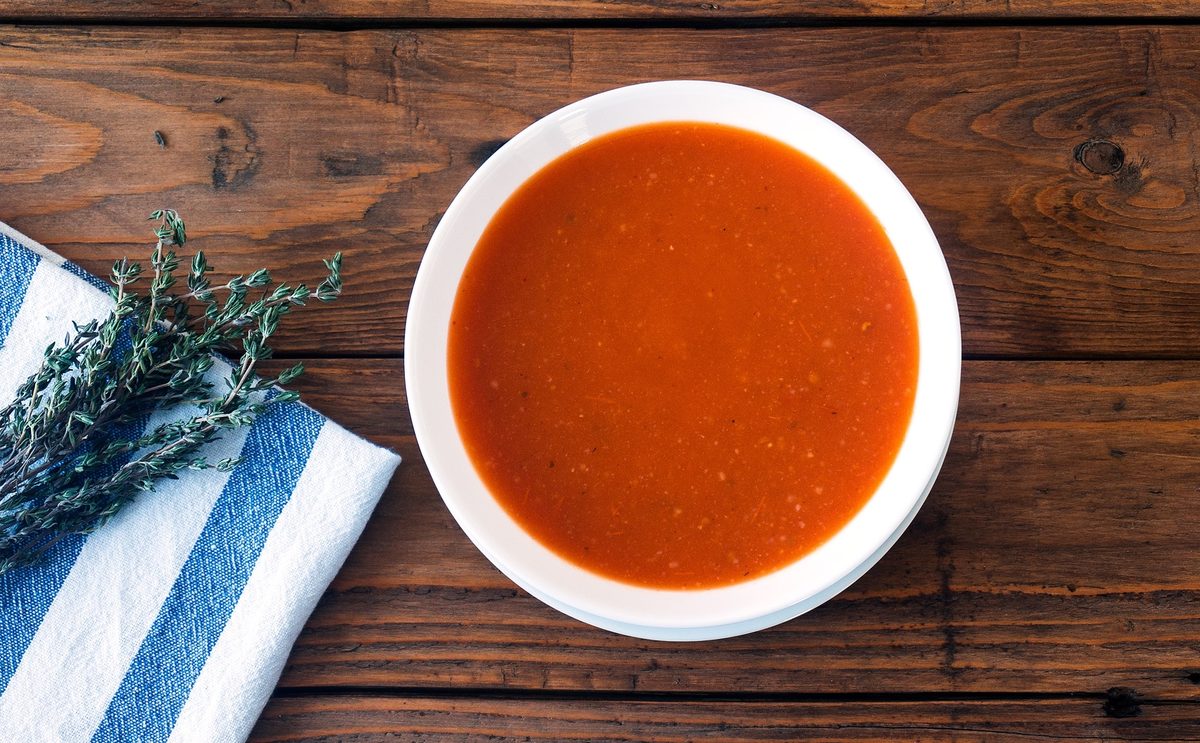
Tomato soup is seasoned lightly and mostly from the bottom of the pot: onion and garlic cooked in fat, then the tomatoes, then a herb. Three named recipes below agree on that base, and two of the three finish with basil. The interesting differences are in the small touches: a bay leaf, a pinch of red pepper, a spoonful of brown sugar to take the edge off the acid, and cheese on top. This page sets out what each one does and when it goes in.
At a glance
| Seasoning | Job | In the recipes below |
|---|---|---|
| Onion | Sweet, savory base | All three123 |
| Garlic | Pungent depth | All three123 |
| Basil | The signature herb; sweet, fresh aroma | Two of three13 |
| Bay leaf | Background herbal note in the simmer | One2 |
| Red pepper (ground or flakes) | A little heat | Two of three12 |
| Brown sugar | Tones down acidity | One2 |
| Parmesan or other cheese | Salty, savory topping | One3 |
| Chives | Fresh finish | One2 |
| Thyme | Optional savory herb | None of the three |
Three recipes side by side
| USDA Tomato Basil Soup1 | Cook’s Illustrated Creamless Creamy Tomato Soup2 | Massachusetts WIC Cheesy Tomato Soup3 | |
|---|---|---|---|
| Tomatoes | 1 can (14 1/2 oz), drained | 2 cans (28 oz) whole, in juice | 4 cups cherry or grape tomatoes |
| Fat | 1 tbsp olive oil | 1/4 cup extra-virgin olive oil | 2 tbsp olive oil |
| Onion | 1 medium | 1 medium | 1 |
| Garlic | 2 cloves (or 1/4 tsp garlic powder) | 3 cloves | 3 cloves |
| Herbs | 1 tsp dried basil | 1 bay leaf; 1/4 cup chopped chives to finish | 2/3 cup fresh basil or 1 tbsp dried |
| Heat | 1/8 tsp ground red pepper | Pinch of red pepper flakes (optional) | None |
| Other | Nonfat dry milk; salt and pepper optional | 1 tbsp brown sugar; bread for body; brandy optional; salt and pepper | Broth; whole wheat toast; Parmesan or mozzarella on top |
These are the publishers’ recipes, not a house standard.
The core seasonings and what each one does
Onion and garlic: the base
All three recipes start by cooking onion in olive oil, then add garlic before the tomatoes.123 The USDA recipe browns the onion for about four minutes and gives the garlic one minute more;1 garlic goes in after the onion because it will quickly burn and turn bitter if it cooks too long, as America’s Test Kitchen explains.4 Britannica describes garlic’s powerful, onionlike aroma and pungent taste.5 The USDA recipe allows 1/4 teaspoon of garlic powder in place of two cloves.1 See garlic powder vs. garlic and onion powder vs. onion.
America’s Test Kitchen chose olive oil over butter for this step after finding that butter muted the tomato flavor.2
Basil: the usual herb
Two of the three recipes are built around basil.13 PROSEA describes sweet basil’s aroma as soothing, sweet-spicy, slightly green and fresh.6
When it goes in depends on the form. The LSU AgCenter groups basil with the delicate herbs that lose flavor under prolonged heat;7 the WIC recipe tops each bowl with fresh basil.3 The University of Delaware’s extension guide says dried herbs are stronger than fresh.8 Even so, the USDA recipe adds its dried basil only at the end, with the milk, heating the soup without boiling it.1 For a long-simmered pot, Delaware’s guide suggests adding herbs during the last 45 minutes.8 See dried vs. fresh basil and too much basil.
Bay leaf: one, simmered and removed
The Cook’s Illustrated recipe uses a single bay leaf for two large cans of tomatoes.2 Bay leaves come from Laurus nobilis, the bay laurel of the family Lauraceae.9 In one analysis of the leaf oil, 1,8-cineole (31.9%), sabinene and linalool were the main components.10 J. Kenji López-Alt, speaking to The Splendid Table, says bay brings out the meaty flavors of beef and chicken; that is a cook’s observation, not a measured effect.11 Fish the leaf out before blending or serving: López-Alt likens eating one to eating a fish bone.11 See cooking with bay leaves and too much bay leaf.
A little heat
The USDA recipe uses 1/8 teaspoon of ground red pepper, which it calls a pinch; Cook’s Illustrated offers an optional pinch of red pepper flakes.12 At these amounts the job is a faint warmth, not heat. See red pepper flakes and cayenne pepper.
Brown sugar: balancing the acid
Cook’s Illustrated adds a tablespoon of brown sugar and explains that a little brown sugar toned down the acidity.2 Taste before adding any; the other two recipes use none.
Cheese and the savory side
The WIC recipe tops each bowl with shredded Parmesan or mozzarella.3 Tomatoes and cheese share a savory side: FDA notes that MSG occurs naturally in many foods, such as tomatoes and cheeses,12 and Britannica lists tomatoes and cheese among foods with a natural umami taste.13 A grilled cheese sandwich alongside the bowl is a familiar American pairing (common practice).
Thyme: optional
None of the three recipes uses thyme. It is a reasonable addition if you want a more savory soup: its character comes from thymol and carvacrol in its oil,14 and America’s Test Kitchen classes it as a hearty herb to add early in cooking.15 Use a light hand; a sprig or a pinch of dried is plenty for a pot of this size (our starting point, not a tested amount). See fresh vs. dried thyme and too much thyme.
When to add what
| Seasoning | When | Source |
|---|---|---|
| Onion, then garlic | Start, cooked in olive oil | All three recipes123 |
| Dried basil, red pepper | End, with the milk | USDA1 |
| Fresh basil, cheese | On top, at serving | WIC3 |
| Chives | To finish | Cook’s Illustrated2 |
Related
- Vegetable soup spices and minestrone soup spices
- Basil vs. oregano
- Bay leaves vs. basil
- MSG vs. salt
- The master list of herbs and spices
Footnotes
-
“Tomato Basil Soup”, USDA Food and Nutrition Service, via MyPlate. myplate.gov · Regulator ↩ ↩2 ↩3 ↩4 ↩5 ↩6 ↩7 ↩8 ↩9 ↩10 ↩11 ↩12 ↩13
-
“Creamless Creamy Tomato Soup”, Cook’s Illustrated, America’s Test Kitchen, 2008. americastestkitchen.com · Publication ↩ ↩2 ↩3 ↩4 ↩5 ↩6 ↩7 ↩8 ↩9 ↩10 ↩11 ↩12 ↩13 ↩14
-
“Cheesy Tomato Soup”, Massachusetts WIC Nutrition Program. mass.gov · Regulator ↩ ↩2 ↩3 ↩4 ↩5 ↩6 ↩7 ↩8 ↩9 ↩10 ↩11
-
Liz Bomze, “Why You Should Wait to Add Garlic”, America’s Test Kitchen, 2023. americastestkitchen.com · Publication ↩
-
“Garlic”, Encyclopaedia Britannica, 2026. britannica.com · Reference work ↩
-
Aguilar, Pham and Oyen, “Ocimum basilicum”, PROSEA. uses.plantnet-project.org · Reference work ↩
-
“Flavorful Herbs”, LSU AgCenter. lsuagcenter.com · Reference work ↩
-
“Using Herbs and Spices”, University of Delaware Cooperative Extension, revised 2025. udel.edu · Reference work ↩ ↩2
-
“Laurus nobilis L.”, Plants of the World Online, Royal Botanic Gardens, Kew. powo.science.kew.org · Reference work ↩
-
Caputo et al., “Laurus nobilis: Composition of Essential Oil and Its Biological Activities”, Molecules, 2017. mdpi.com · Peer-reviewed ↩
-
David Leite with J. Kenji López-Alt, “Bay leaves are an optional ingredient”, The Splendid Table, 2014. splendidtable.org · Publication ↩ ↩2
-
“Questions and Answers on Monosodium glutamate (MSG)”, U.S. Food and Drug Administration. fda.gov · Regulator ↩
-
“Umami”, Encyclopaedia Britannica, 2026. britannica.com · Reference work ↩
-
S.H. Widodo, “Thymus vulgaris”, PROSEA. uses.plantnet-project.org · Reference work ↩
-
Liz Bomze, “Our Guide to Fresh Herbs”, America’s Test Kitchen, 2019. americastestkitchen.com · Publication ↩