Spice Comparisons · Comparison
Cilantro vs. Oregano: Two Herb Families, Two Kitchen Jobs
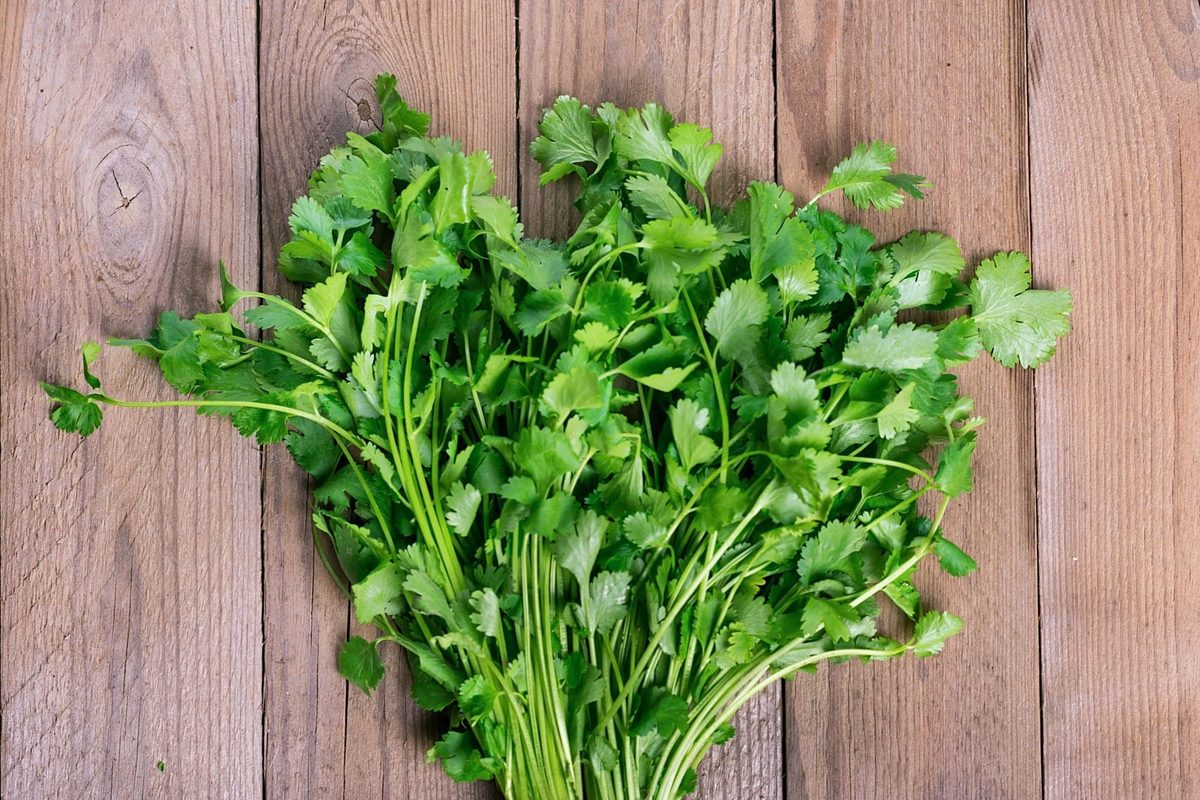
Cilantro and oregano meet in Mexican cooking and almost nowhere else. Cilantro is the fresh leaf of Coriandrum sativum, a plant of the parsley family, and its smell comes mostly from aldehydes.12 Oregano is the leaf of Origanum vulgare and its relatives in the mint family, and its bite comes from two phenols, carvacrol and thymol.34 In the kitchen that difference shows up as timing: cilantro goes in raw at the end, oregano goes in early and is usually bought dried. Neither makes a good stand-in for the other.
Side by side
| Cilantro | Oregano | |
|---|---|---|
| Species | Coriandrum sativum5 | Origanum vulgare; the name is also used for other Origanum species and for plants in other genera64 |
| Family | Apiaceae, the parsley family1 | Lamiaceae, the mint family, which also includes basil37 |
| Native range | Eastern Mediterranean to western Pakistan5 | Macaronesia to China6 |
| Life cycle | Annual1 | Perennial6 |
| Leaves | Variable on one plant: the lowest leaves deeply lobed and toothed, the upper ones split into narrow, pointed lobes2 | Opposite and oval, about 1.5 cm long, covered with glandular hairs3 |
| Part used | Fresh leaves and stems; the dried fruit is the spice coriander1 | Leaves, fresh or dried |
| Key aroma compounds | Aldehydes, more than 80% of the leaf’s volatile oil2 | Carvacrol and thymol, about 78 to 85% of the essential oil combined4 |
| Flavor (editorial) | Green, citrusy and sharp; soapy to some people | Warm, resinous, pungent and a little bitter |
| In the pot | A delicate herb, added in the last minute or two8 | A hearty herb, added early9 |
| Fresh or dried | Much weaker dried; best used fresh10 | Keeps its value dried10 |
| Typical uses | Latin American, Indian and Chinese dishes;1 Mexican salsas and meat dishes11 | Italian pizza and pasta sauces, Greek salads and gyros3 |
| Safety note | FDA import controls on some fresh cilantro from Puebla, Mexico, over Cyclospora12 | 48% of oregano samples flagged as suspect in an EU fraud survey, mostly for olive leaves13 |
The flavor row is our description. It fits the chemistry. The aldehydes that dominate cilantro are described in the research literature as soapy, fatty, “like cilantro” or pungent,14 and the Wisconsin Master Gardener program says descriptions of cilantro run from citrusy with a biting tang to soapy.11 Britannica describes Greek and Italian oreganos as having a strong aroma and a warm, pungent taste.3 Those are two unrelated sets of compounds, which is why the herbs taste nothing alike.
For the individual herbs, see cilantro and oregano.
Raw at the end vs. in from the start
This is the difference that changes a dish. LSU AgCenter lists cilantro among the delicate herbs to add in the last minute or two of cooking, because prolonged heat costs flavor and aroma.8 America’s Test Kitchen puts oregano in the opposite group: hearty herbs to add early.9 In ATK’s tests of dried herbs, dried oregano held up reasonably well in dishes cooked for more than 20 minutes with a good amount of liquid.15
The dried forms split the same way. ATK’s Danielle Lapierre lists cilantro among the herbs that are much weaker when dried, and oregano among the dried herbs worth keeping in the pantry.10 For dried oregano in place of fresh, ATK’s testing found 1 part dried to 3 parts fresh came closest to equal strength for herbs in general.15 Dried cilantro is a weaker case; see dried vs. fresh cilantro and fresh vs. dried oregano.
The soapy-taste question
Only cilantro divides people this way. In a genetic study of 14,604 people of European ancestry who reported whether cilantro tasted soapy, Eriksson and colleagues found a variant near a cluster of smell-receptor genes; one of those genes codes for a receptor that binds several of cilantro’s key aldehydes.14 The effect is small: the heritability tagged by common variants was low, about 0.087.14 We found no comparable finding for oregano. If cilantro tastes like soap to you, see cilantro substitutes for herbs built on different compounds.
Where each one turns up
Mexican and Tex-Mex cooking. Cilantro goes into Mexican salsas and meat dishes.11 By common practice it is also scattered over tacos. The oregano used in Mexico is often a different plant: Mexican oregano, which Britannica gives as Lippia graveolens, is in another family altogether, the Verbenaceae.3 America’s Test Kitchen tasted Mediterranean and Mexican oregano side by side in tomato sauce and in marinated skirt steak and found only minimal differences, with the Mexican type stronger and carrying a hint of menthol.16 Oregano is also part of the US federal purchasing specification for chili powder, alongside ground chili pepper, cumin, salt and garlic powder.17 So a pot of chili can take both herbs: oregano in the pot, cilantro at the table. That last point is kitchen judgment. See Mexican oregano and Mexican oregano vs. oregano.
Mediterranean and Middle Eastern cooking. Britannica calls oregano a key ingredient in Mediterranean and Middle Eastern cooking and essential in Italian pizza and pasta sauces, Greek salads and gyros.3
Asian cooking. Britannica notes that cilantro’s young leaves are widely used in Latin American, Indian and Chinese dishes.1 Oregano has no comparable role in the sources we reviewed.
Buying: two different risks
Cilantro is bought fresh, so the concern is the produce itself. The FDA links outbreaks of cyclosporiasis in the United States in 2012 through 2015 to fresh cilantro from Puebla, Mexico, and under Import Alert 24-23 such cilantro offered for entry from April 1 through August 31 each year can be detained without physical examination.12 See cilantro for the details.
Oregano is mostly bought dried, and the concern is what else is in the jar. In the European Commission’s 2019 to 2021 coordinated control plan on herb and spice fraud, 48% of oregano samples were flagged as at risk of adulteration, in most cases with olive leaves.13 Whole or crushed leaf is easier to inspect than fine powder; that is a practical suggestion, not a tested method.
Can one stand in for the other?
Not well, and no source we found suggests trying. Neither herb appears on the other’s substitute list in the sources we reviewed, so both directions below are Method: our direction and starting point, with no published ratio behind them.
| Swap | Treatment | What to do |
|---|---|---|
| Oregano in place of cilantro | Method | Not recommended. Raw oregano’s phenolic bite would dominate a salsa or a taco garnish, in our judgment. Use a cilantro substitute instead: culantro at about half the amount, or flat-leaf parsley at the same amount (both Method). |
| Cilantro in place of oregano | Method | Not recommended. Cilantro loses its aroma in long cooking8 and adds nothing of oregano’s character. Use an oregano substitute instead: marjoram at the same amount, then up to half as much again (Method), or basil in tomato sauce, which A Couple Cooks says to use in equal parts (Attributed).18 |
The full rankings, with every ratio labeled, are on cilantro substitutes and oregano substitutes.
What isn’t known
- No published sensory study compares cilantro and oregano directly. The flavor row is editorial.
- The compound figures are essential-oil shares from different studies of different plants. They show which compounds lead in each herb, not how strong one herb is against the other. We found no measured carvacrol or thymol content for retail dried oregano leaf.
- No source gives a ratio for using either herb in place of the other.
- It is often said that fresh oregano is hard to find in US supermarkets. We found no data on how widely it is sold.
Related
- Cilantro, cooking with cilantro, cilantro substitutes and too much cilantro
- Oregano, cooking with oregano, oregano substitutes and too much oregano
- Cilantro vs. parsley, basil vs. cilantro and coriander vs. cilantro
- Basil vs. oregano, marjoram vs. oregano and oregano vs. parsley
Footnotes
-
“Coriander”, Encyclopaedia Britannica. britannica.com · Reference work ↩ ↩2 ↩3 ↩4 ↩5 ↩6
-
Coriandrum sativum, Plant Resources of South-East Asia (PROSEA). uses.plantnet-project.org · Reference work ↩ ↩2 ↩3
-
Anoushka Pant, “Oregano”, Encyclopaedia Britannica, 2026. britannica.com · Reference work ↩ ↩2 ↩3 ↩4 ↩5 ↩6 ↩7
-
Lombrea et al., “A Recent Insight Regarding the Phytochemistry and Bioactivity of Origanum vulgare L. Essential Oil”, International Journal of Molecular Sciences, 2020. mdpi.com · Peer-reviewed ↩ ↩2 ↩3
-
Coriandrum sativum L., Plants of the World Online, Royal Botanic Gardens, Kew. powo.science.kew.org · Reference work ↩ ↩2
-
Origanum vulgare L., Plants of the World Online, Royal Botanic Gardens, Kew. powo.science.kew.org · Reference work ↩ ↩2 ↩3
-
“Basil”, Encyclopaedia Britannica, 2026. britannica.com · Reference work ↩
-
“Flavorful Herbs”, LSU AgCenter. lsuagcenter.com · Reference work ↩ ↩2 ↩3
-
Liz Bomze, “Our Guide to Fresh Herbs”, America’s Test Kitchen, 2019. americastestkitchen.com · Publication ↩ ↩2
-
Danielle Lapierre, “When You Should Actually Use Dried Herbs (and Which Ones to Avoid)”, America’s Test Kitchen, 2022. americastestkitchen.com · Publication ↩ ↩2 ↩3
-
Susan Mahr, “Cilantro”, Wisconsin Master Gardener Program, University of Wisconsin-Madison, 2017. mastergardener.extension.wisc.edu · Reference work ↩ ↩2 ↩3
-
Import Alert 24-23, U.S. Food and Drug Administration. accessdata.fda.gov · Regulator ↩ ↩2
-
Herbs and spices (2019-2021), EU Agri-Food Fraud Network, European Commission. food.ec.europa.eu · Regulator ↩ ↩2
-
Eriksson et al., “A genetic variant near olfactory receptor genes influences cilantro preference”, Flavour, 2012. link.springer.com · Peer-reviewed ↩ ↩2 ↩3
-
“Science: Substituting Dried Herbs for Fresh”, America’s Test Kitchen. americastestkitchen.com · Publication ↩ ↩2
-
“Oregano: Mediterranean and Mexican”, America’s Test Kitchen. americastestkitchen.com · Publication ↩
-
Commercial Item Description A-A-20001C, Spices and Spice Blends, USDA Agricultural Marketing Service, 2023. ams.usda.gov · Regulator ↩
-
Sonja Overhiser, “Best Oregano Substitute”, A Couple Cooks, 2026. acouplecooks.com · Publication ↩