Cooking · Dish guide
The Best Spices for Pot Roast: What Each Seasoning Does in the Braise
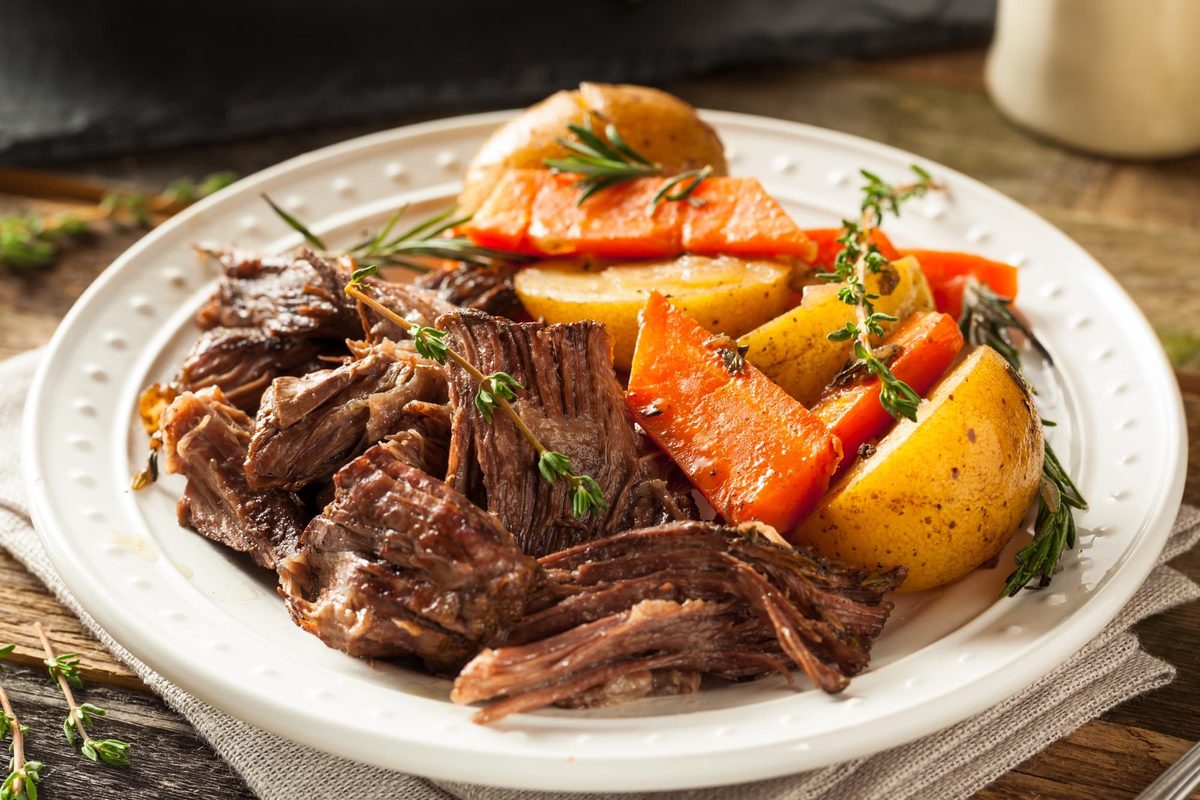
Pot roast is a braise: a tough beef cut, usually chuck, cooked slowly in liquid with onions and other vegetables. The seasoning is short. A University of Illinois Extension recipe uses onion, garlic, coarse black pepper, sprigs of fresh rosemary and thyme, two bay leaves and a cup of red wine,1 while Purdue Extension’s slow-cooker version leans on onions, Worcestershire sauce, chili sauce or ketchup, salt and pepper.2 This page covers what each seasoning does, when it goes in, and what comes out before serving. Quantities appear only where a named recipe gives them.
At a glance
| Seasoning | Job in the pot | Notes |
|---|---|---|
| Onion | Sweet, savory base | Quartered, in both recipes12 |
| Thyme | Woodsy, sharp herbal note | Fresh sprigs, removed at the end1 |
| Rosemary | Piney, slightly bitter top note | Fresh sprigs, removed at the end1 |
| Bay leaf | Background note that brings out meaty flavor | Remove before serving13 |
| Garlic | Savory depth | Minced, added with the broth1 |
| Black pepper | The usual source of bite | Coarse ground in the Illinois recipe1 |
| Red wine | Acidity, fruit, and the browned bits from the pan | Used to deglaze1 |
| Paprika | Optional color and pepper flavor | In neither recipe; a variation |
Two baseline recipes
| Illinois Extension, oven braise (8 servings)1 | Purdue Extension, slow cooker (8 servings)2 | |
|---|---|---|
| Beef | 3 to 4 lb chuck roast | 2 1/2 lb boneless beef chuck pot roast |
| Onion | 1 large, quartered | 2 medium, quartered |
| Garlic | 2 cloves, minced | none |
| Herbs | 2 sprigs each fresh rosemary and thyme, 2 bay leaves | none |
| Pepper and salt | 1 tsp coarse ground black pepper | 1/2 tsp each salt and pepper |
| Liquid | 1 cup red wine, 2 cups reduced-sodium beef broth | 1/2 cup chili sauce or ketchup, 1/3 cup water, 1 tbsp Worcestershire sauce |
These are the extension services’ own recipes, not a house standard. They show the two directions a pot roast usually takes: herb and wine, or a sweet-tangy sauce.
The core seasonings and what each one does
Onion: the base
Onion (Allium cepa) belongs to the amaryllis family, Amaryllidaceae, with garlic.4 Both extension recipes quarter the onions and cook them with the meat for the whole braise.12 In the Illinois recipe the onions and carrots are browned first, then set aside while the roast is seared.1 Long cooking softens and sweetens the onion; that is common kitchen experience. Onion powder can stand in a pinch, though neither recipe uses it.
Thyme and rosemary: the herb pair
Thyme (Thymus vulgaris) is in the mint family, Lamiaceae,5 and its sharp, savory character comes from an oil whose characteristic constituents are thymol and carvacrol.6 Rosemary is in the same family; Kew now files it as Salvia rosmarinus.7 Britannica describes rosemary’s taste as pungent and slightly bitter.8
The Illinois recipe uses both as whole fresh sprigs and removes them before serving.1 America’s Test Kitchen classes thyme and rosemary as hearty herbs to add early in cooking, noting that their flavor compounds are somewhat more heat-stable than those of delicate herbs.9 The University of Delaware’s extension guide gives different advice for long-cooked dishes:
| Source | Advice on herb timing |
|---|---|
| America’s Test Kitchen | Hearty herbs (thyme, rosemary) go in early9 |
| University of Delaware Extension | For recipes that call for long simmering, add herbs during the last 45 minutes10 |
| Illinois Extension pot roast | Fresh rosemary and thyme sprigs go in with the broth for the whole braise, then come out1 |
A practical starting point (Method, not a measured rule): whole fresh sprigs can go in at the start and be fished out; if you use dried, crumbled herbs in a braise of several hours, add them toward the end. Dried herbs are stronger than fresh, and the Delaware guide’s conversion is 3/4 to 1 teaspoon dried for 2 to 3 teaspoons fresh.10 See cooking with thyme, cooking with rosemary, too much thyme and too much rosemary.
Bay leaf: in early, out before serving
The Illinois recipe adds two bay leaves with the broth and ends with “remove bay leaf and herb sprigs.”1 J. Kenji López-Alt, speaking to The Splendid Table, says bay leaves bring out the meaty flavors of beef and chicken, and compares eating a dried leaf to eating a fish bone.3 A surgical case report notes that bay leaves are rigid and can have sharp points and margins.11 Count them in and count them out. See cooking with bay leaves and bay leaf substitutes.
Garlic: optional, and timing matters
Garlic appears in the Illinois recipe (2 minced cloves) but not in Purdue’s.12 In the Illinois braise it goes in with the broth rather than into hot oil.1 When garlic is sautéed, America’s Test Kitchen advises adding it after the other vegetables have softened, because garlic added too early can burn and turn acrid and bitter.12 See garlic and garlic powder.
Black pepper: the bite
Both recipes use black pepper.12 Its characteristic flavor comes mainly from piperine.13 The Illinois recipe calls for a teaspoon of coarse ground pepper.1 Whether to grind it fresh is a matter of preference; we found no measurement comparing fresh and pre-ground pepper in a braise. See black pepper.
Red wine: deglazing and flavor
In the Illinois recipe, a cup of red wine goes into the hot pot after searing, and the browned bits are scraped from the bottom before the meat and broth go back in.1 A widely repeated claim says the acid and tannins in wine tenderize the meat in a braise. We found no source that tests this for pot roast, so this page does not repeat it. Choosing a dry rather than sweet wine is a matter of taste.
Paprika: a variation
Neither extension recipe uses paprika.12 In Hungarian dishes such as goulash and paprikash, paprika is a key ingredient.14 Spain’s Pimentón de la Vera is smoke-dried and has a smoky, intense flavor and aroma,15 which takes a pot roast in a different direction. No source we found says when to add paprika to a braise; stirring it into the liquid rather than frying it hard is a reasonable starting point (Method). See paprika and smoked paprika.
Related
- Beef stew spices covers the same herbs in a stew
- Corned beef and cabbage spices
- Thyme substitutes and rosemary substitutes
- The master list of herbs and spices
Footnotes
-
“Pot Roast”, recipe by Jenna Smith, University of Illinois Extension. extension.illinois.edu · Reference work ↩ ↩2 ↩3 ↩4 ↩5 ↩6 ↩7 ↩8 ↩9 ↩10 ↩11 ↩12 ↩13 ↩14 ↩15 ↩16 ↩17 ↩18 ↩19 ↩20
-
“Easy Beef Pot Roast”, Purdue University Extension Nutrition Education Program. extension.purdue.edu · Reference work ↩ ↩2 ↩3 ↩4 ↩5 ↩6 ↩7
-
David Leite with J. Kenji López-Alt, “Bay leaves are an optional ingredient, ‘but things are definitely better with them’”, The Splendid Table. splendidtable.org · Publication ↩ ↩2
-
“Allium cepa L.”, Plants of the World Online, Royal Botanic Gardens, Kew. powo.science.kew.org · Reference work ↩
-
“Thymus vulgaris L.”, Plants of the World Online, Royal Botanic Gardens, Kew. powo.science.kew.org · Reference work ↩
-
S.H. Widodo, “Thymus vulgaris”, PROSEA. uses.plantnet-project.org · Reference work ↩
-
“Salvia rosmarinus Spenn.”, Plants of the World Online, Royal Botanic Gardens, Kew. powo.science.kew.org · Reference work ↩
-
“Rosemary”, Encyclopaedia Britannica. britannica.com · Reference work ↩
-
Liz Bomze, “Our Guide to Fresh Herbs”, America’s Test Kitchen, 2019. americastestkitchen.com · Publication ↩ ↩2
-
“Using Herbs and Spices”, University of Delaware Cooperative Extension, revised 2025. udel.edu · Reference work ↩ ↩2
-
Bell and Mustard, “Bay leaf perforation of Meckel’s diverticulum”, Canadian Journal of Surgery, 1997. canjsurg.ca · Peer-reviewed ↩
-
Liz Bomze, “Why You Should Wait to Add Garlic”, America’s Test Kitchen, 2023. americastestkitchen.com · Publication ↩
-
“Black pepper”, Encyclopaedia Britannica. britannica.com · Reference work ↩
-
“Paprika: why this smoky spice plays a crucial role in Hungarian cuisine”, Michelin Guide, 2023. guide.michelin.com · Publication ↩
-
Pimentón de la Vera PDO product specification. assets.publishing.service.gov.uk · Regulator ↩