Spice Substitutes · Substitutes
Sazón Seasoning Substitutes, Ranked by the Job the Blend Is Doing
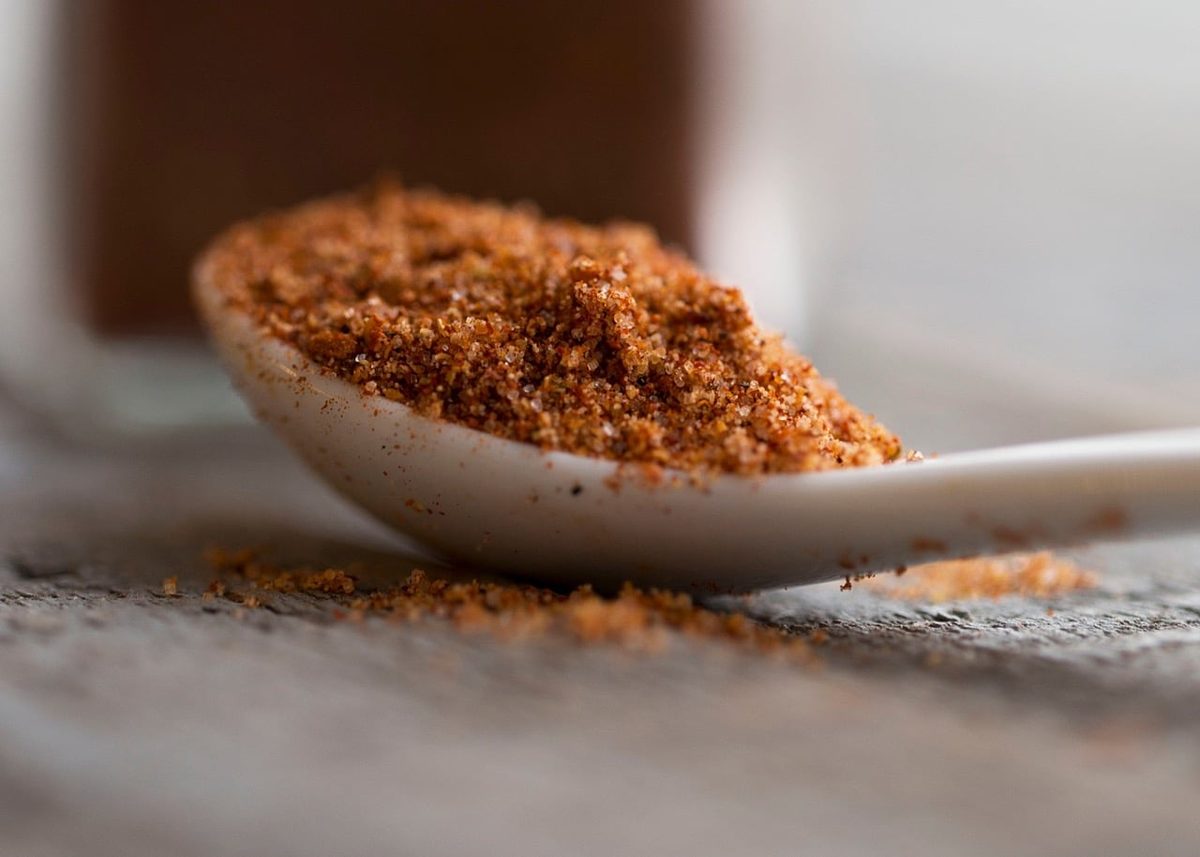
Sazón is a dry, salty seasoning that adds savory flavor and a red-orange color to rice, beans, stews and meat. In the United States it is best known in Goya’s foil packets, and America’s Test Kitchen says it is used across the board in Puerto Rican cooking.1 Goya’s Sazón with Coriander and Annatto lists monosodium glutamate, salt, dehydrated garlic, cumin, Yellow 5, an anticaking agent, coriander, annatto (for color) and Red 40, in that order.2 US labels list ingredients in descending order of weight,3 so MSG and salt are its two largest ingredients. Any substitute has four jobs: salt, savory depth, garlic and warm spice, and color. Salt is the one that is easiest to get wrong.
Quick answer
| What sazón is doing | Best substitute | Starting amount, per 1 teaspoon Goya sazón | Treatment |
|---|---|---|---|
| All of it: salt, savory, spice and color | Homemade sazón (America’s Test Kitchen’s formula) | 1 teaspoon, plus about 1/5 teaspoon table salt | Computed (salt), Method (spice) |
| Salt, garlic and pepper, color not needed | Goya adobo | 1/3 teaspoon, plus a pinch of cumin and coriander | Computed (salt), Method (spice) |
| Salt, garlic and some heat | Tony Chachere’s Creole seasoning | 1/2 teaspoon | Computed (salt), Method (spice) |
| Salt and seasoning, in a pinch | Old Bay | 1 teaspoon, plus a pinch of table salt | Computed (salt), Method (spice) |
| Only the color | Ground annatto (achiote), or sweet paprika | A pinch, then judge by eye | Method |
The rest of the page explains each choice.
How the ratios on this page are labeled
Every ratio carries one of four labels.
- Computed: based on a measurable physical relationship, with the source named.
- Attributed: a named source publishes this ratio. We quote it as theirs.
- Disputed: named sources give different answers to the same swap. We show each one and do not average them.
- Method: we found no published ratio. We give a direction and a cautious starting point, and say so.
Every Computed figure on this page concerns salt only. It is worked out from the sodium on each product’s Nutrition Facts label, so it applies to the products named and says nothing about flavor. We found no credible published ratio for swapping any blend for sazón.
Matching the salt first
Goya’s Sazón with Coriander and Annatto carries 170 mg of sodium per 1/4 teaspoon serving of 1 g.4 Goya’s directions are one packet for every four people a recipe serves.4 Here is how the alternatives compare, spoon for spoon:
| Product | Sodium per 1/4 teaspoon | A 1:1 swap gives this share of sazón’s sodium | Source |
|---|---|---|---|
| Goya Sazón with Coriander and Annatto | 170 mg | 100% | 4 |
| Morton Iodized Table Salt | 590 mg | 347% | 5 |
| Goya Adobo All-Purpose Seasoning with Pepper | 520 mg | 306% | 6 |
| Tony Chachere’s Original Creole Seasoning | 340 mg | 200% | 7 |
| Old Bay Seasoning | 125 mg | 74% | 8 |
The percentages are our arithmetic from the label figures, and each figure is for a single product, not its category. Two results follow. A teaspoon of Goya sazón carries about as much sodium as a generous 1/4 teaspoon of Morton table salt (170 ÷ 590 = 0.29), so table salt is the yardstick for topping up. And most of the jarred alternatives are far saltier than sazón, so they must be used in smaller amounts. FDA puts the Daily Value for sodium at less than 2,300 mg a day.9
If sazón is doing all of its jobs
Homemade sazón
America’s Test Kitchen’s recipe, by David Pazmiño, makes about 1/4 cup:1
| Ingredient | Amount |
|---|---|
| Ground achiote (annatto) | 1 tablespoon |
| Granulated garlic | 1 teaspoon |
| Granulated onion | 1 teaspoon |
| Monosodium glutamate (optional) | 1 teaspoon |
| Table salt | 1 teaspoon |
| Pepper | 1/2 teaspoon |
| Ground coriander | 1/2 teaspoon |
| Dried cilantro | 1/2 teaspoon |
| Ground cumin | 1/4 teaspoon |
| Dried oregano | 1/4 teaspoon |
ATK says powdered garlic and onion can stand in for granulated, and the MSG can be left out.1 Achiote is the largest single ingredient, so this version gets its color from annatto alone, with no synthetic dyes.
Why it works: it has every flavor element on Goya’s label (salt, MSG, garlic, cumin, coriander, annatto)2 and adds onion, pepper, cilantro and oregano. Cumin’s main aroma compound is cuminaldehyde,10 and coriander seed oil is 60 to 80 percent linalool and related terpene alcohols.11
Where it falls short: it is much less salty, spoon for spoon. Salt (Computed): the batch contains 1 teaspoon of table salt in about 9 teaspoons of measured ingredients (ATK puts the yield at about 1/4 cup, or 12 teaspoons).1 Taking Morton’s 590 mg per 1/4 teaspoon as the table-salt figure,5 each teaspoon of the blend carries roughly 200 to 260 mg of sodium from salt, against about 680 mg in a teaspoon of Goya sazón.4 To match Goya, add about 1/5 teaspoon of table salt per teaspoon of homemade sazón. MSG also contains sodium (it is the sodium salt of glutamic acid),12 so if you include it, taste before adding the full amount.
Spice amount (Method): Use the same volume of homemade sazón as the Goya sazón called for, then taste.
If sazón is mostly salt, garlic and pepper
Goya adobo
Goya’s Adobo with Pepper lists salt, garlic, an anticaking agent, black pepper, oregano and turmeric.6 It shares salt and garlic with sazón, but it has no cumin, no coriander, no annatto and, unlike Goya’s sazón, no MSG on the label.26 Turmeric gives it a little yellow from curcumin,13 not sazón’s red-orange.
Ratio (Computed, salt only): A teaspoon of Goya adobo carries about 2,080 mg of sodium (4 × 520 mg) against sazón’s 680 mg (4 × 170 mg).64 Use about 1/3 as much adobo as sazón. Spice (Method): add a pinch each of ground cumin and coriander per teaspoon of sazón replaced, and annatto or paprika for color if it matters.
If sazón is salt, garlic and a little heat
Tony Chachere’s Creole seasoning
Tony Chachere’s lists salt, red pepper, black pepper and chili powder, which itself contains garlic powder.7 It shares salt and garlic with sazón and adds chile heat and color that sazón does not have.
Ratio (Computed, salt only): At 340 mg of sodium per 1/4 teaspoon, it is twice as salty as Goya sazón.74 Use 1/2 teaspoon per teaspoon of sazón. Spice (Method): add a pinch of cumin, and taste for heat before adding more.
If you need something salty and seasoned, in a pinch
Old Bay
Old Bay is celery salt, spices including red and black pepper, and paprika.8 It is the least like sazón in flavor: celery has no part in sazón, and the label names no cumin or garlic.28 It is on this list only because it is widely stocked and close in salt.
Ratio (Computed, salt only): At 125 mg per 1/4 teaspoon, a 1:1 swap gives about 74 percent of sazón’s sodium.84 Add a pinch of table salt (a little under 1/10 teaspoon) per teaspoon to close the gap.5 Spice (Method): add a pinch each of garlic powder and cumin.
If you only need the color
Goya labels annatto “annatto (color).”2 The seeds’ pigments are carotenoid derivatives, chiefly bixin, which can make up as much as 80 percent of the total pigment.14 Katzer notes that dried annatto seeds have only a weak, perfumed odor, and that in the Caribbean the seeds are usually fried in fat to color it.15 So color is the job to replace.
- Ground annatto (achiote). The same pigment. Start with a pinch per teaspoon of sazón replaced and judge by eye (Method).
- Sweet paprika. Its red comes from capsanthin and capsorubin, also carotenoids.16 It adds a mild pepper flavor. Start with a pinch (Method).
- Turmeric. Curcumin gives a yellow rather than red-orange color,13 and turmeric adds a flavor of its own, which annatto barely does.15 Use a small pinch, or combine with paprika (Method).
If you are avoiding synthetic dyes, note that FDA requires any certified color additive, such as Yellow 5 or Red 40, to be named on the label.17 Goya also sells a Sazón without Annatto.2
The savory note: MSG
FDA says MSG is the sodium salt of glutamic acid and considers its addition to foods generally recognized as safe.12 If your substitute lacks it, the dish may taste less savory. ATK’s recipe uses 1 teaspoon of MSG alongside 1 teaspoon of salt;1 use that proportion as a guide if you add MSG to adobo or another blend (Method), and count its sodium as part of the salt.
What isn’t known
- No credible published ratio for replacing sazón with any blend was found. The Computed figures match sodium only.
- Sodium figures are for the specific products named. Goya sells several versions of sazón,2 and other versions and brands will differ.
- How much MSG is in Goya’s sazón is not published on the label we read; only its order (first) is known.2
- The yield of ATK’s recipe is approximate, so the homemade salt figures are a range.
Related
- Sazón seasoning
- Adobo seasoning and adobo seasoning substitutes
- Creole seasoning, Old Bay seasoning and Old Bay vs. Creole seasoning
- Annatto seeds, annatto seeds substitutes, achiote powder and cooking with annatto seeds
- Monosodium glutamate, MSG vs. salt and MSG substitutes
- Garlic powder, cumin, coriander, culantro, paprika and turmeric
Footnotes
-
David Pazmiño, “Homemade Sazón with Achiote, Coriander, and Cilantro”, America’s Test Kitchen. americastestkitchen.com · Publication ↩ ↩2 ↩3 ↩4 ↩5
-
“Sazón with Coriander and Annatto”, Goya Foods (product page). goya.com · Merchant ↩ ↩2 ↩3 ↩4 ↩5 ↩6 ↩7 ↩8
-
21 CFR 101.4, Food; designation of ingredients, US Food and Drug Administration. ecfr.gov · Regulator ↩
-
“Goya Sazón With Coriander and Annatto”, Goya Foods (online shop listing). shop.goya.com · Merchant ↩ ↩2 ↩3 ↩4 ↩5 ↩6 ↩7
-
“Morton Iodized Table Salt”, Morton Salt (product page). mortonsalt.com · Merchant ↩ ↩2 ↩3
-
“Adobo All-Purpose Seasoning with Pepper”, Goya Foods (trade page). trade.goya.com · Merchant ↩ ↩2 ↩3 ↩4
-
“Tony Chachere’s Original Creole Seasoning”, ingredients and nutrition label via Giant Food Stores. giantfoodstores.com · Merchant ↩ ↩2 ↩3
-
“Old Bay Seasoning”, ingredients and nutrition label via ShopRite. shoprite.com · Merchant ↩ ↩2 ↩3 ↩4
-
“Sodium in Your Diet”, U.S. Food and Drug Administration. fda.gov · Regulator ↩
-
P.C.M. Jansen, Cuminum cyminum, Plant Resources of South-East Asia (PROSEA). uses.plantnet-project.org · Reference work ↩
-
Al-Khayri et al., “Essential Oil from Coriandrum sativum: A Review”, Molecules, 2023. mdpi.com · Peer-reviewed ↩
-
“Questions and Answers on Monosodium glutamate (MSG)”, U.S. Food and Drug Administration. fda.gov · Regulator ↩ ↩2
-
“Turmeric: Usefulness and Safety”, National Center for Complementary and Integrative Health, 2025. nccih.nih.gov · Regulator ↩ ↩2
-
“Carotenoid Derivates in Achiote (Bixa orellana) Seeds”, Frontiers in Plant Science, 2016. frontiersin.org · Peer-reviewed ↩
-
Gernot Katzer, “Annatto (Bixa orellana L.)”, Gernot Katzer’s Spice Pages. gernot-katzers-spice-pages.com · Reference work ↩ ↩2
-
“Paprika extract”, Chemical and Technical Assessment for the 77th JECFA, FAO/WHO. fao.org · Regulator ↩
-
“Color Additives Questions and Answers for Consumers”, U.S. Food and Drug Administration, 2023. fda.gov · Regulator ↩