Cooking · Dish guide
Good Spices for Meatballs: What Goes in the Meatball and What Goes in the Sauce
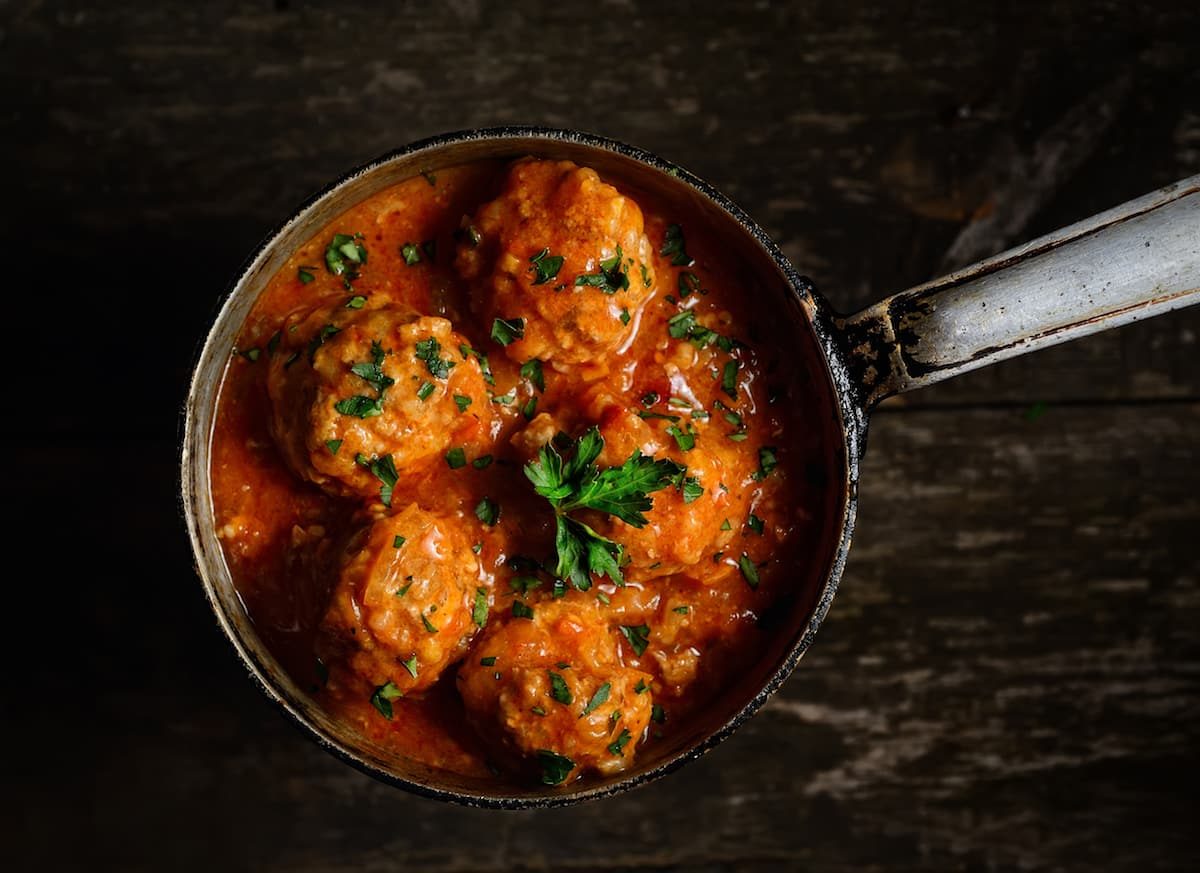
Most Italian-American meatball recipes season the meat with the same short list: garlic, flat-leaf parsley, onion, grated hard cheese, salt and pepper, sometimes with a pinch of red pepper flakes. The dried oregano and fresh basil that people associate with meatballs usually go into the tomato sauce instead. Three named recipes below show the pattern, followed by the job each seasoning does and how meatballs differ outside the United States.
Three recipes side by side
| Mayo Clinic (1 1/2 lb beef)1 | Food Network Kitchen (1 1/2 lb beef, pork, veal)2 | Cook’s Illustrated (1 lb meatloaf mix)3 | |
|---|---|---|---|
| Garlic | 2 1/2 tsp minced | 2 cloves, minced | 2 cloves, minced |
| Parsley | 1/3 cup chopped flat-leaf | 1/4 cup chopped flat-leaf | 1/4 cup chopped fresh |
| Onion | 1/3 large onion, minced and sautéed | 1/2 medium onion, grated | None |
| Cheese | 6 Tbsp grated Parmesan | Parmesan and Pecorino Romano, 1/4 cup plus 2 Tbsp each | 1 oz grated Pecorino Romano |
| Salt | 1 tsp kosher | 2 tsp kosher | 1/2 tsp table salt |
| Pepper | 1/8 tsp black | Black, to taste | 1/4 tsp red pepper flakes |
| Herbs in the sauce | Not part of the recipe | Basil and thyme in the marinara | 1 1/4 tsp dried oregano; 1/4 cup fresh basil at the end |
None of the three puts oregano or basil in the meatball mix.132 That doesn’t make it wrong to add them; it means the classic place for them is the sauce.
The core seasonings
Garlic
All three recipes use garlic in the meat, about two cloves per pound or a little less.132 The Mayo Clinic recipe softens the garlic with the onion in a saucepan before mixing it in.1 Mixing raw minced garlic straight into the meat also works (kitchen practice). See garlic, garlic powder vs. garlic and too much garlic.
Flat-leaf parsley
Parsley is the one herb all three recipes share, in generous amounts: 1/4 to 1/3 cup chopped.132 PROSEA describes parsley’s flavor as warm, but slightly burning and bitter,4 which keeps the mix from tasting flat; the green flecks are a bonus. Dried parsley is far milder, so it is no swap at these amounts (editorial). See parsley, flat-leaf vs. Italian parsley and fresh vs. dried parsley.
Onion
Two of the three recipes use fresh onion, either sautéed first or grated.12 Fresh onion is mostly water, 89.1 g per 100 g by USDA’s figures, while onion powder has 5.39 g.56 Grating it, or cooking it first as the Mayo Clinic recipe does, helps it blend into the mix (kitchen practice). If you use onion powder instead, no source gives an amount for meatballs; about 1 teaspoon per pound is a reasonable starting point (Method). See onion powder vs. onion.
Grated cheese
All three recipes use grated Parmesan, Pecorino Romano or both.132 In our view the cheese is a seasoning as much as a binder, bringing salt and a savory note. With a salty cheese in the mix, go easy on added salt and taste a test meatball (kitchen practice).
Red pepper flakes
The Cook’s Illustrated meatballs use 1/4 teaspoon of red pepper flakes per pound of meat.3 McCormick Science Institute lists meats and Italian cooking among the places red pepper adds heat and bite.7 See red pepper flakes.
Oregano and basil: usually in the sauce
Oregano has a strong aroma and a warm, pungent taste, according to Britannica.8 ATK classes it as a hearty herb whose flavor holds up better to cooking,9 which suits a long-simmered sauce; the Cook’s Illustrated Sunday gravy uses 1 1/4 teaspoons dried.3 Basil is a delicate herb that the LSU AgCenter advises adding near the end of cooking,10 and the same recipe stirs in 1/4 cup of fresh basil just before serving.3
If you want oregano in the meatballs themselves, dried is the practical choice. The LSU AgCenter’s rule is that one tablespoon of fresh herbs equals one teaspoon of crumbled dried herbs,10 so a little goes a long way. A common claim says fresh oregano is rare and extremely pungent; we found no source for that. See cooking with oregano, fresh vs. dried oregano and cooking with basil.
Rosemary and fennel: optional
None of the recipes above uses rosemary. ATK counts it among the hearty herbs suited to cooking,9 so a small amount, finely chopped, can go into the mix; that is kitchen judgment, not a sourced recipe. ATK tested whether anise seed, fennel seed and star anise could stand in for one another in Italian sausage meatballs; with so many other spices in the dish, the differences were harder to detect.11 So a pinch of fennel or anise seed is a low-risk addition (editorial). See fennel seed.
Meatballs in Italy and elsewhere
Spaghetti and meatballs is an Italian-American dish. Writing for Tasting Table, Joseph Hartwell says you are very unlikely to find it on a restaurant menu in Rome; Italian polpette are generally rolled smaller, can be made from a variety of meats including turkey and fish, and are eaten by themselves or in soups.12 He attributes the larger, beef-heavy American meatball to Italian immigrants finding meat less expensive in the United States than at home.12 His article relies on secondary sources, including Smithsonian Magazine.12
Other traditions season meatballs differently. The Spice House names Swedish meatballs among the dishes where mace is used.13 See cooking with mace, nutmeg and allspice.
Doneness
Cook beef, pork or veal meatballs to 160°F, the federal minimum for ground meat; meatballs made with ground turkey or chicken need 165°F.14 FSIS warns that color and texture are not reliable signs of doneness, so use a thermometer.15 The Mayo Clinic recipe bakes 1-inch meatballs at 350°F for 10 to 15 minutes, until they reach 160°F.1
Related
- Italian spices and Italian seasoning
- Good spices for meatloaf and spices for hamburgers
- Dried herbs vs. fresh
- Do spices go bad?
Footnotes
-
Mayo Clinic Staff, “Italian meatballs”, Mayo Clinic. mayoclinic.org · Reference work ↩ ↩2 ↩3 ↩4 ↩5 ↩6 ↩7 ↩8
-
Food Network Kitchen, “Italian-American Meatballs”, Food Network. foodnetwork.com · Publication ↩ ↩2 ↩3 ↩4 ↩5 ↩6
-
“Hearty Italian Meat Sauce (Sunday Gravy)”, Cook’s Illustrated, America’s Test Kitchen, 2009. americastestkitchen.com · Publication ↩ ↩2 ↩3 ↩4 ↩5 ↩6 ↩7 ↩8
-
I.B. Ipor and L.P.A. Oyen, “Petroselinum crispum”, PROSEA. uses.plantnet-project.org · Reference work ↩
-
“Onions, raw”, FDC ID 170000, USDA FoodData Central. fdc.nal.usda.gov · Regulator ↩
-
“Spices, onion powder”, FDC ID 171327, USDA FoodData Central. fdc.nal.usda.gov · Regulator ↩
-
“Red Pepper”, McCormick Science Institute. mccormickscienceinstitute.com · Merchant ↩
-
Anoushka Pant, “Oregano”, Encyclopaedia Britannica. britannica.com · Reference work ↩
-
Liz Bomze, “Our Guide to Fresh Herbs”, America’s Test Kitchen, 2019. americastestkitchen.com · Publication ↩ ↩2
-
“Flavorful Herbs”, LSU AgCenter. lsuagcenter.com · Reference work ↩ ↩2
-
Andrew Janjigian, “Why Anise Seed, Fennel Seed, and Star Anise aren’t Interchangeable”, America’s Test Kitchen, 2020. americastestkitchen.com · Publication ↩
-
Joseph Hartwell, “Why You Shouldn’t Expect To Find Spaghetti And Meatballs In Italy”, Tasting Table, 2023. tastingtable.com · Publication ↩ ↩2 ↩3
-
“Mace Spice Explained”, The Spice House, 2024. thespicehouse.com · Merchant ↩
-
“Cook to a Safe Minimum Internal Temperature”, FoodSafety.gov, U.S. Department of Health and Human Services. foodsafety.gov · Regulator ↩
-
“Color of Cooked Ground Beef as It Relates to Doneness”, USDA Food Safety and Inspection Service. fsis.usda.gov · Regulator ↩