Cooking · Dish guide
The Best Spices for Asparagus: Salt, Pepper, Garlic, Lemon and Beyond
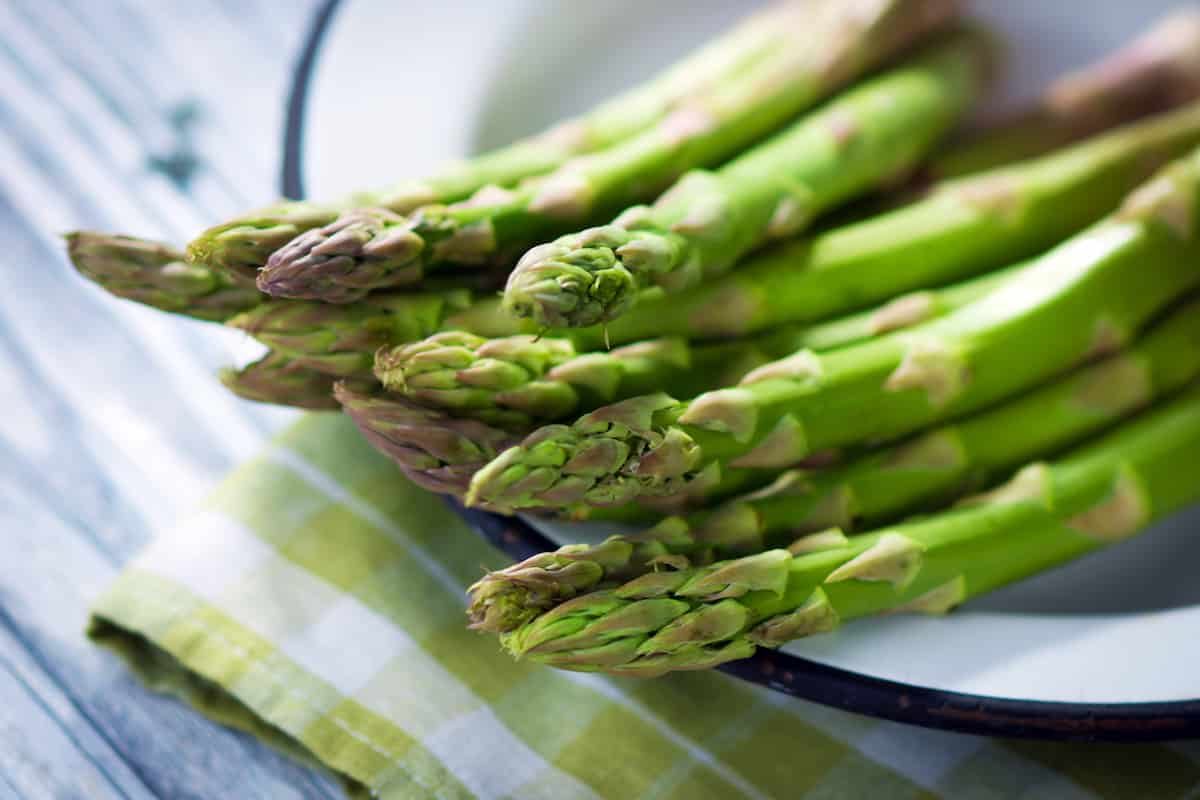
Asparagus needs very little. Oregon State University Extension’s Food Hero recipe roasts it with oil, salt and black pepper, then suggests lemon zest or garlic powder as the next step.1 This page covers what each common seasoning does for asparagus, what the named recipes use, and a few directions beyond the basics. Quantities appear only where a named recipe gives them.
At a glance
| Seasoning | What it does for asparagus | Where it comes from |
|---|---|---|
| Salt | Seasons; flaky salt adds crunch at the table | In the extension recipe1 |
| Black pepper | Heat and aroma | In the extension recipe1 |
| White pepper | Pepper flavor without dark specks | Kitchen option; see below |
| Garlic or garlic powder | Pungent, savory depth | Suggested by Food Hero1 |
| Lemon zest or juice | Brightness | Suggested by Food Hero12 |
| Lemon balm | A softer lemon note from a fresh herb | Kitchen option |
| Sesame seeds | Nutty flavor and crunch | Japanese goma-ae3 |
| Ground mustard | Sharp, slightly bitter savor | McCormick suggests it for roasted asparagus4 |
The baseline: oil, salt and pepper
Food Hero’s roasted asparagus uses 1 tablespoon of vegetable oil and a dash each of salt and black pepper for 3 pounds of spears, roasted at 400°F for 12 to 15 minutes or until lightly browned.1 Its general roasted-vegetables recipe runs hotter, at 425°F, and notes that thin pieces such as asparagus may need only about 5 minutes.2 For extra flavor, the asparagus recipe suggests lemon zest or garlic powder, and the general recipe suggests thyme, rosemary, oregano, balsamic vinegar or lemon juice.12
Those suggestions map onto the seasonings below. Most people stop at two or three of them; that is a matter of taste.
Salt
Salt is the one seasoning almost every asparagus recipe uses, and it makes the others work (cooking judgment). Any salt does the job during cooking. At the table, a flaky salt adds crunch: America’s Test Kitchen recommends sea salts as finishing salts,5 and Maldon’s maker describes its pyramid crystals as having a clean taste.6
A common claim says a pure flaky salt tempers asparagus’s bitterness better than other salts. We found no source for that. Salt is sodium chloride whatever its source, and table salt, kosher salt and most sea salts are each about 40 percent sodium.57 The difference between salts here is texture, not chemistry. See Maldon sea salt, fleur de sel and kosher salt.
Black pepper
Black pepper’s characteristic flavor comes mainly from piperine.8 It is in the baseline extension recipe,1 and it is the most common partner for salt on almost any vegetable (common practice). For the most aroma, America’s Test Kitchen advises grinding your own peppercorns just before you need them.9 Grinding straight over the spears works well. See cracked vs. ground black pepper.
White pepper
White and black pepper come from the same berries. The Codex standard defines black pepper as dried berries with the outer pericarp intact and white pepper as dried berries with it removed,10 and America’s Test Kitchen describes white peppercorns as fully ripened berries soaked in water to ferment.11
Whether white pepper is milder is disputed. Gernot Katzer says white pepper keeps the full pungency of black,12 while an America’s Test Kitchen tasting found the black-pepper version of a soup spicier and more aromatic.11 The same tasters preferred the white-pepper soup for its floral, earthy flavor and greater complexity,11 so the earthy description holds up. Katzer notes white pepper is often suggested where black would spoil the color of a pale sauce,12 which makes it a natural choice for asparagus served with a cream or butter sauce. See white pepper vs. black pepper.
Garlic
Garlic brings a powerful onionlike aroma and a pungent taste.13 Food Hero suggests garlic powder for roasted asparagus.1 America’s Test Kitchen found that garlic powder straight from the jar has not developed its full flavor and recommends hydrating it in an equal amount of water before use.14 A common claim says garlic adds umami to asparagus; we found no source for that, though its savory pungency is real.
For fresh garlic in a quick sauté or stir-fry, timing matters. America’s Test Kitchen warns that garlic added to a hot pan too early will quickly burn and turn acrid and bitter, so add it once the other ingredients are already cooking.15 See garlic powder vs. garlic and too much garlic.
Lemon and lemon balm
Lemon is the brightener in both extension recipes: zest in one, juice in the other.12
Lemon balm is a lemon-scented herb of the mint family, used to flavor salads, soups, sauces and stuffings.16 Its lemon note comes from a small amount of leaf oil, 0.06 to 0.8 percent, made up mainly of citral, neral and citronellal.17 We found no named recipe pairing it with asparagus, so treat it as a kitchen option: chop fresh leaves over the spears just before serving. See lemon balm substitutes.
Sesame seeds
Sesame gives asparagus a nutty flavor and some crunch. Goma-ae is a Japanese dish of vegetables in a sesame dressing, and asparagus takes it well. Hiroko Liston’s creamy version dresses 150 grams of asparagus with 1 tablespoon of ground toasted sesame seeds, 1/4 teaspoon of sugar, 1 teaspoon of soy sauce and 1 tablespoon of Japanese mayonnaise.3
Toasting matters: Katzer explains that sesame’s characteristic toasted flavor compounds form only during toasting, with pyrazines dominating at mild toasting temperatures, and that toasted sesame is often sprinkled over Japanese and Korean dishes.18 Sprinkling toasted seeds over roasted or stir-fried asparagus just before serving is the simplest use (common practice). See black vs. white sesame seeds, gomasio and furikake.
Ground mustard
McCormick suggests mixing ground mustard with olive oil, salt and pepper and tossing vegetables such as asparagus in it before roasting.4 It describes the taste as sharp, hot and slightly bitter.4 See mustard powder uses.
Related
- Spices for broccoli, spices for cauliflower and seasonings for green beans
- White pepper vs. black pepper
- The master list of herbs and spices
- How long do spices last?
Footnotes
-
“Roasted Asparagus”, Food Hero, Oregon State University Extension Service. foodhero.org · Reference work ↩ ↩2 ↩3 ↩4 ↩5 ↩6 ↩7 ↩8 ↩9 ↩10
-
“Roasted Vegetables”, Food Hero, Oregon State University Extension Service. foodhero.org · Reference work ↩ ↩2 ↩3 ↩4
-
Hiroko Liston, “Creamy ‘Goma-ae’ Asparagus”, Hiroko’s Recipes. hirokoliston.com · Publication ↩ ↩2
-
“About Ground Mustard: Uses, Pairings and Substitutes”, McCormick Kitchens, 2025. mccormick.com · Merchant ↩ ↩2 ↩3
-
“Salt Types and Measurements”, America’s Test Kitchen. americastestkitchen.com · Publication ↩ ↩2
-
“About Us”, Maldon Salt. maldonsalt.com · Merchant ↩
-
“Sodium Sources: Where Does All That Sodium Come From?”, American Heart Association. heart.org · Reference work ↩
-
“Black pepper”, Encyclopaedia Britannica. britannica.com · Reference work ↩
-
“Savory Spices”, America’s Test Kitchen. americastestkitchen.com · Publication ↩
-
Standard for Black, White and Green Peppers (CXS 326-2017), Codex Alimentarius Commission. fao.org · Standard ↩
-
“Substituting Black Pepper for White Pepper”, America’s Test Kitchen. americastestkitchen.com · Publication ↩ ↩2 ↩3
-
“Black Pepper (Piper nigrum L.)”, Gernot Katzer’s Spice Pages. gernot-katzers-spice-pages.com · Reference work ↩ ↩2
-
“Garlic”, Encyclopaedia Britannica. britannica.com · Reference work ↩
-
Carolyn Grillo, “For Great Garlic Bread, Hydrate Your Garlic Powder First”, America’s Test Kitchen, 2021. americastestkitchen.com · Publication ↩
-
Liz Bomze, “Why You Should Wait to Add Garlic”, America’s Test Kitchen, 2023. americastestkitchen.com · Publication ↩
-
Melissa Petruzzello, “Lemon balm”, Encyclopaedia Britannica. britannica.com · Reference work ↩
-
Assessment report on Melissa officinalis L., folium, European Medicines Agency. ema.europa.eu · Regulator ↩
-
“Sesame (Sesamum indicum)”, Gernot Katzer’s Spice Pages. gernot-katzers-spice-pages.com · Reference work ↩