Spices · Profile
Winter Spices: Seven Warm Spices for Cold-Weather Cooking, and What Each One Does
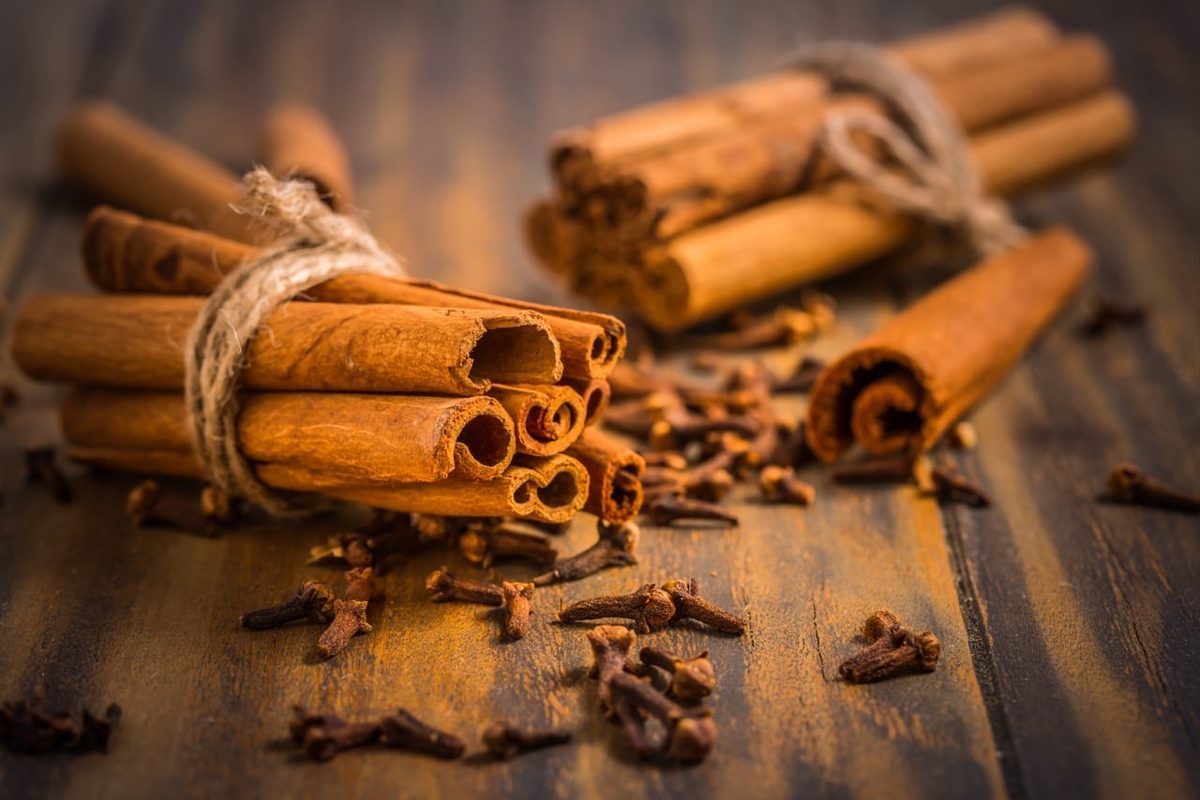
Seven spices do most of the work in cold-weather cooking: cinnamon, nutmeg, allspice, cloves, cardamom, ginger and black pepper. They turn up in mulled wine and hot cider, in gingerbread and pumpkin pie, and in slow-cooked savory food from Jamaican jerk to Cincinnati chili and garam masala. This page gives a short profile of each, the combinations that recipes and regulators actually record, what the evidence says about “warming” and health claims, and the two safety points worth knowing before a winter of heavy baking.
At a glance
| Spice | What it is | Main flavor compound | Classic cold-weather uses |
|---|---|---|---|
| Cinnamon | Inner bark of several Cinnamomum species1 | Cinnamaldehyde, about 50 to 63% of bark oil1 | Mulled wine, hot cider, baking234 |
| Nutmeg | Dried seed kernel of Myristica fragrans5 | Warm, slightly sweet taste6 | Eggnog, pumpkin pie, gingerbread78 |
| Allspice | Dried berry of Pimenta dioica910 | Eugenol, 50 to 80% of berry oil11 | Baking, jerk, broths and gravies101211 |
| Cloves | Dried flower bud of Syzygium aromaticum1314 | Eugenol, 70 to 90% of bud oil14 | Mulled wine, hot cider, meats, baking2315 |
| Cardamom | Dried fruit and seeds of Elettaria cardamomum1617 | 1,8-cineole and α-terpinyl acetate18 | Curries, spiced rice, coffee and tea, Scandinavian pastries1817 |
| Ginger | Rhizome of Zingiber officinale19 | Gingerols (pungency)20 | Gingerbread, masala chai2122 |
| Black pepper | Dried fruit of Piper nigrum2324 | Piperine, 4.9 to 7.7% of black pepper25 | Garam masala and most savory cooking26 |
Measured values
5 figures, sourced| Measure | Value | Scope | Source |
|---|---|---|---|
| Cinnamaldehyde (cinnamon) | roughly 49.9 to 62.8 % of bark oil | Cinnamon bark (C. zeylanicum), Ranasinghe et al. systematic review | link.springer.com |
| Eugenol (allspice) | 50 to 80 % of berry oil | Allspice, PROSEA | uses.plantnet-project.org |
| Eugenol (cloves) | 70 to 90 % of bud oil | Cloves, PROSEA | uses.plantnet-project.org |
| Piperine (black pepper) | 4.9 to 7.7 % of black pepper | Black pepper, PROSEA | uses.plantnet-project.org |
| Lead (ground cinnamon) | 2.03 to 7.68 parts per million | Specific ground cinnamon products sold in the US named in FDA public health alerts since July 2024Specific products, not cinnamon in general. | fda.gov |
Each figure is quoted as its source states it, with the samples or standard it applies to. Where sources differ, both are shown; nothing is averaged. All measured values
Do winter spices actually warm you up?
The idea is old. Dioscorides, writing around 50 to 70 CE, described ginger as “warming and digestive”, according to AramcoWorld’s history of the spice.22 Modern claims go further: that cinnamon and ginger boost circulation, and that nutmeg and cloves fight infection and strengthen the immune system. We found no NIH summary or systematic review that supports any of those claims for spices eaten in food.
What the evidence does say:
- Cinnamon. NCCIH says research doesn’t clearly support using cinnamon for any health condition.27 A systematic review of Ceylon cinnamon lists antimicrobial activity among its reported properties but notes that data on humans are sparse; most of that work is in the laboratory or in animals.1
- Ginger. NCCIH says ginger may help with nausea and vomiting in pregnancy, but most studies of ginger for motion sickness have not shown it to help.28
- Black pepper. Claims that black pepper aids weight loss could not be traced; see spices and herbs for weight loss for what the human evidence on spices and weight shows.
The warmth people mean when they call these “warm spices” is about flavor and aroma, and that is reason enough to keep them on hand.
Cinnamon
“Cinnamon” covers the inner bark of several trees in the genus Cinnamomum.1 Ceylon cinnamon is one species; cassia is a group of related ones, and cassia is the type most often sold in North America, according to NCCIH.27 The warm, sweet smell comes mainly from cinnamaldehyde, which a systematic review puts at roughly 49.9 to 62.8% of the bark oil.1
In Europe, the EU-funded import agency CBI says cinnamon goes into everything from bakery and sweet treats to beverages and herbal infusions, and it names cinnamon as a key ingredient in garam masala and masala chai.4 EU law defines Glühwein, a mulled wine, as flavored mainly with cinnamon and/or cloves.2 Oregon State University Extension’s hot apple-orange cider steeps six cinnamon sticks with whole cloves and allspice.3 See Ceylon vs. cassia cinnamon and cinnamon vs. nutmeg.
Nutmeg
Nutmeg is the dried seed kernel of Myristica fragrans, a tree whose native range Kew gives as the Banda Islands in Indonesia’s Maluku province.5 Britannica describes a distinctive pungent fragrance and a warm, slightly sweet taste.6
The FAO’s handbook on nutmeg lists eggnog among its dairy uses and says nutmeg is obligatory in Grenadian rum punch.7 McCormick suggests its ground nutmeg for pumpkin pie and gingerbread, and in savory dishes such as scalloped potatoes, glazed carrots and creamed spinach.8 Use it in small amounts; see Safety below. See fresh vs. ground nutmeg and how to store nutmeg.
Allspice
Allspice is one spice, not a blend: the dried berry of Pimenta dioica, a tree native to southern Mexico, Central America and the Caribbean.910 Britannica says it was named because its flavor resembles a combination of cinnamon, nutmeg and cloves.10 The clove resemblance has a chemical basis: eugenol, the main compound in clove oil, also makes up 50 to 80% of allspice berry oil.1114
Britannica notes that allspice is widely used in baking.10 PROSEA records whole berries going into meat broths, gravies and pickling liquids,11 and Smithsonian Magazine’s history of Jamaican jerk calls pimento (allspice) an essential ingredient.12 See allspice vs. cloves and jerk seasoning.
Cloves
Cloves are the dried flower buds of Syzygium aromaticum, picked just before they open, from a tree native to Maluku in Indonesia.1314 Britannica describes them as strong in aroma and hot and pungent in taste, and says they flavor many foods, particularly meats and baked goods.15 PROSEA puts eugenol at 70 to 90% of clove bud oil.14
Cloves share the EU’s mulled-wine definition with cinnamon,2 and the Oregon State cider recipe uses 12 whole cloves.3 They are strong, so whole cloves in a liquid are easy to fish out. See ground vs. whole cloves and too much clove.
Cardamom
Green cardamom is the dried fruit and seeds of Elettaria cardamomum, a ginger-family plant native to southwest India.1617 Black cardamom is a different plant, Amomum subulatum, native from Nepal to central China.29 Green cardamom’s essential oil is mainly 1,8-cineole and α-terpinyl acetate.18
PROSEA calls cardamom an important ingredient of curries and of spiced rice dishes, and notes its use to flavor coffee and tea.18 Britannica notes its popularity in Scandinavian pastries.17 Madhur Jaffrey’s garam masala, published by Saveur, uses a quarter cup of cardamom seeds.26 See black cardamom, cardamom vs. cloves and chai spices.
Ginger
Ginger is the rhizome, an underground stem, of Zingiber officinale.19 Its bite comes from non-volatile phenolic compounds called gingerols.20 Kew notes that the fresh rhizome is essential in many Asian dishes, while the dried, powdered spice is more popular in European cooking.19
Amelia Simmons’s 1796 American Cookery measures ginger for gingerbread by the ounce.21 AramcoWorld names ginger as a core ingredient of masala chai.22 See fresh vs. ground ginger and cooking with ginger.
Black pepper
Black pepper is the dried fruit of Piper nigrum, a climbing vine; Kew calls it one of the earliest known and most widely used spices in the world.2324 Its pungency comes principally from piperine,24 which PROSEA puts at 4.9 to 7.7% of black pepper.25 It is also part of Madhur Jaffrey’s garam masala alongside cardamom, cloves, cinnamon and nutmeg.26 See allspice vs. black pepper and cracked vs. ground black pepper.
Winter spice combinations, by recipe
There is no single winter spice blend. These named sources show how the same spices recombine:
| Dish or blend | Spices named | Source |
|---|---|---|
| Glühwein (EU legal definition) | Mainly cinnamon and/or cloves | EU Regulation 251/20142 |
| Hot apple-orange cider | Cloves, allspice, cinnamon sticks | Oregon State University Extension, Food Hero3 |
| Pumpkin pie spice | Cinnamon, ginger, nutmeg, allspice | McCormick label30 |
| Molasses gingerbread (1796) | Cinnamon, coriander or allspice | Amelia Simmons, American Cookery21 |
| Gingerbread cakes (1796) | Nutmeg, ginger | Amelia Simmons, American Cookery21 |
| Cincinnati chili | Cinnamon, allspice, cloves, nutmeg | Saveur31 |
| Garam masala | Cardamom, cloves, cinnamon, black pepper, nutmeg, black cumin | Madhur Jaffrey, via Saveur26 |
For more on the drinks and blends, see mulling spices for apple cider, pumpkin pie spice, garam masala, best spices for chili and Christmas spices.
Safety: two things worth knowing
Cassia cinnamon and coumarin, plus lead alerts. Cassia contains coumarin. Germany’s Federal Institute for Risk Assessment (BfR) estimates that a 60 kg adult reaches the tolerable daily intake by eating about 2 g a day of cassia with average coumarin content.32 Separately, in a public health alert first issued in July 2024 and updated since, the FDA has listed ground cinnamon products sold in the U.S. that tested at 2.03 to 7.68 parts per million lead.33 See too much cinnamon.
Nutmeg in large amounts. The National Capital Poison Center notes that nutmeg tastes great in cookies and eggnog, but too much can cause hallucinations, and that kitchen spices are not dangerous used as recommended.34 The Tennessee Poison Center puts reported effects at 15 to 20 grams, about two to three tablespoons of ground nutmeg, far above any recipe amount.35 See too much nutmeg.
Related
- Christmas spices
- Thanksgiving herbs and spices
- Apple pie spice
- Do spices go bad?
- Cinnamon vs. nutmeg, cardamom vs. cloves
Footnotes
-
Ranasinghe et al., “Medicinal properties of ‘true’ cinnamon”, BMC Complementary and Alternative Medicine, 2013. link.springer.com · Peer-reviewed ↩ ↩2 ↩3 ↩4 ↩5
-
Regulation (EU) No 251/2014, Annex II, EUR-Lex. eur-lex.europa.eu · Regulator ↩ ↩2 ↩3 ↩4 ↩5
-
“Hot Apple Orange Cider”, Food Hero, Oregon State University Extension. extension.oregonstate.edu · Reference work ↩ ↩2 ↩3 ↩4 ↩5
-
“The European market potential for cinnamon”, CBI. cbi.eu · Publication ↩ ↩2
-
“Myristica fragrans Houtt.”, Plants of the World Online, Royal Botanic Gardens, Kew. powo.science.kew.org · Reference work ↩ ↩2
-
“Nutmeg”, Encyclopaedia Britannica. britannica.com · Reference work ↩ ↩2
-
G.B. Marcelle, Production, handling and processing of nutmeg and mace, Section VII, FAO, 1995. fao.org · Reference work ↩ ↩2
-
McCormick Ground Nutmeg, product page. mccormick.com · Merchant ↩ ↩2
-
“Pimenta dioica (L.) Merr.”, Plants of the World Online, Royal Botanic Gardens, Kew. powo.science.kew.org · Reference work ↩ ↩2
-
“Allspice”, Encyclopaedia Britannica. britannica.com · Reference work ↩ ↩2 ↩3 ↩4 ↩5
-
D. Sulistiarini, “Pimenta dioica”, PROSEA. uses.plantnet-project.org · Reference work ↩ ↩2 ↩3 ↩4
-
Vaughn Stafford Gray, “A Brief History of Jamaican Jerk”, Smithsonian Magazine, 2020. smithsonianmag.com · Publication ↩ ↩2
-
“Syzygium aromaticum (L.) Merr. & L.M.Perry”, Plants of the World Online, Royal Botanic Gardens, Kew. powo.science.kew.org · Reference work ↩ ↩2
-
Verheij and Snijders, “Syzygium aromaticum”, PROSEA. uses.plantnet-project.org · Reference work ↩ ↩2 ↩3 ↩4 ↩5
-
“Clove”, Encyclopaedia Britannica. britannica.com · Reference work ↩ ↩2
-
“Elettaria cardamomum (L.) Maton”, Plants of the World Online, Royal Botanic Gardens, Kew. powo.science.kew.org · Reference work ↩ ↩2
-
Gregory Lewis McNamee, “Cardamom”, Encyclopaedia Britannica. britannica.com · Reference work ↩ ↩2 ↩3 ↩4
-
Wardini and Thomas, “Elettaria cardamomum”, PROSEA. uses.plantnet-project.org · Reference work ↩ ↩2 ↩3 ↩4
-
“Zingiber officinale Roscoe”, Plants of the World Online, Royal Botanic Gardens, Kew. powo.science.kew.org · Reference work ↩ ↩2 ↩3
-
Sutarno, Hadad and Brink, “Zingiber officinale”, PROSEA. uses.plantnet-project.org · Reference work ↩ ↩2
-
Amelia Simmons, American Cookery, 1796, Project Gutenberg. gutenberg.org · Reference work ↩ ↩2 ↩3 ↩4
-
Jeff Koehler, “Spice Migrations: Ginger”, AramcoWorld, 2021. aramcoworld.com · Publication ↩ ↩2 ↩3
-
“Piper nigrum L.”, Plants of the World Online, Royal Botanic Gardens, Kew. powo.science.kew.org · Reference work ↩ ↩2
-
“Black pepper”, Encyclopaedia Britannica. britannica.com · Reference work ↩ ↩2 ↩3
-
“Piper nigrum”, PROSEA. uses.plantnet-project.org · Reference work ↩ ↩2
-
“Garam Masala”, Saveur, 2014. saveur.com · Publication ↩ ↩2 ↩3 ↩4
-
“Cinnamon: Usefulness and Safety”, NCCIH, 2024. nccih.nih.gov · Regulator ↩ ↩2
-
“Ginger: Usefulness and Safety”, NCCIH, 2025. nccih.nih.gov · Regulator ↩
-
“Amomum subulatum Roxb.”, Plants of the World Online, Royal Botanic Gardens, Kew. powo.science.kew.org · Reference work ↩
-
McCormick Pumpkin Pie Spice, product page. mccormick.com · Merchant ↩
-
“Cincinnati Chili”, Saveur. saveur.com · Publication ↩
-
“Cassia cinnamon with high coumarin contents to be consumed in moderation”, BfR. bfr.bund.de · Regulator ↩
-
“More Ground Cinnamon Products Added to FDA Public Health Alert Due to Presence of Elevated Levels of Lead”, FDA. fda.gov · Regulator ↩
-
Rose Ann Gould Soloway, “Kitchen surprises and cautions”, National Capital Poison Center. poison.org · Reference work ↩
-
Nena Bowman, “Nutmeg, a Potentially Uninvited Holiday Guest?”, Tennessee Poison Center, 2020. vumc.org · Reference work ↩